Red Fox Labrador Price Guide: From Puppy Cost to Ownership Expenses

A fox red Labrador is difficult to pass up. It’s that warm, coppery coat that can make even a sensible puppy plan go awry, into “perhaps we should get one.” But before your heart gets in the way of your wallet, it’s a good idea to understand what the asking price includes.
Fox red is not a separate breed of Labrador. It is a dark yellow colour and the dog should retain the characteristics that are expected of a Labrador Retriever – health, temperament and structure. While color can affect demand, it should not be the primary consideration for a litter selection.
How Much Does A Fox Red Labrador Cost?
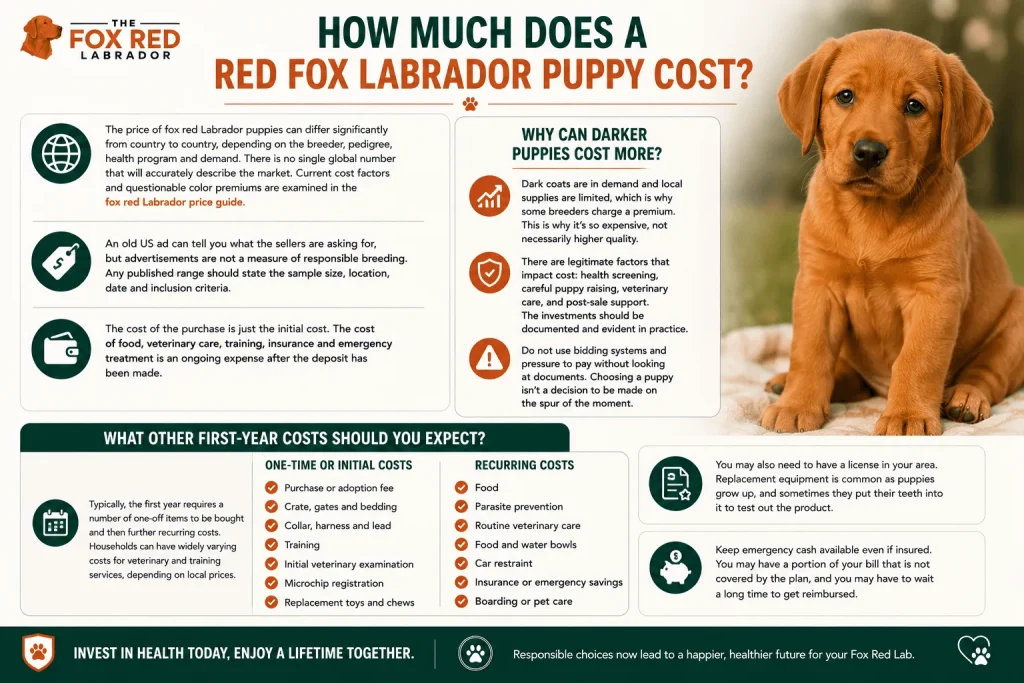
If you see a fox red Labrador puppy advertised, it can cost between $750 and $5,000, depending on the US price that has been publicly announced and reviewed in July 2026. A number of the existing breeder programs in the sample reviewed were closer to $2,000 to $5,000. These are asking prices, not an official national average, and do not cover all taxes, delivery costs, training fees, or first year costs.
The broad range must be put into perspective. Three offers are a marketplace ad, a well-documented breeder program and a puppy with professional training. Higher prices don’t necessarily indicate that a breeder is responsible, and lower prices don’t necessarily mean that a breeder is not responsible.
Price snapshot details:
- Market reviewed: United States
- Currency: US dollars
- Evidence used: Public breeder and marketplace asking prices
- Excluded from the headline range: Tax, transport, optional training, and ongoing care
- Planned review: January 2027, or earlier if the market changes materially
No breeders paid to be included in the snapshot. Buying checks were compared with information from the Labrador Retriever Club, the parent club of the breed in the United States.
Fox Red Labrador Retriever Price: Quick Price Comparison
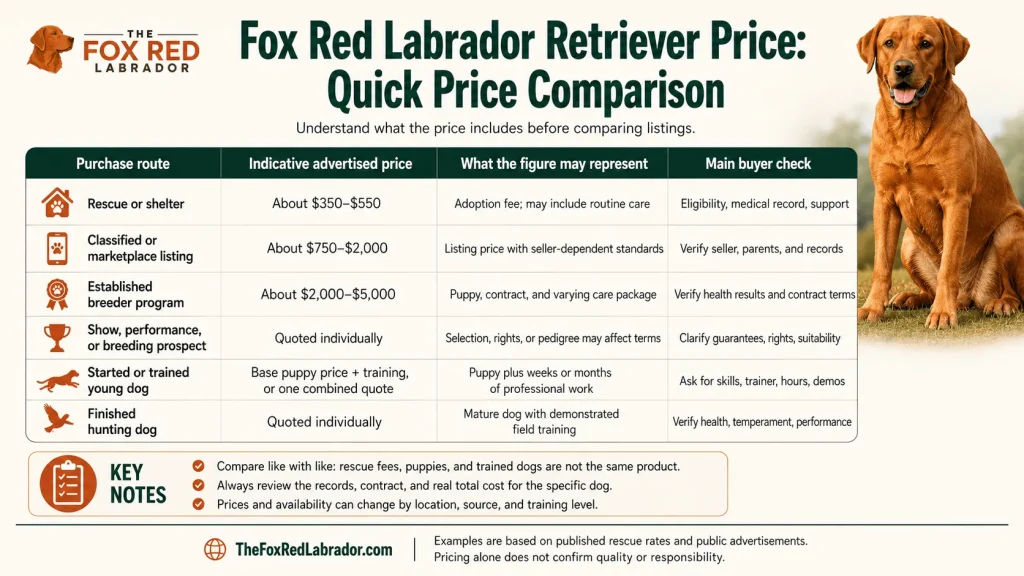
The number on a listing is more meaningful when you understand what type of listing it is. It is not a fair comparison to make between an eight-week-old family puppy and a trained young dog, nor is a rescue adoption fee a “breeder discount.
These are guidelines to follow and then check the records, contract and costs on the specific dog. Prices and availability are subject to change.
| Purchase route | Indicative advertised price | What the figure may represent | Main buyer check |
|---|---|---|---|
| Rescue or shelter | About $350–$550 in selected current Lab rescues | Adoption fee: may include routine care | Eligibility, medical record, and support |
| Classified or marketplace listing | About $750–$2,000 in the reviewed sample | Listing price with seller-dependent standards | Verify the seller, parents, and records independently |
| Established breeder program | About $2,000–$5,000 in the reviewed sample | Puppy, contract, and a varying care package | Verify health results and contract terms |
| Show, performance, or breeding prospect | Quote individually; no reliable public range | Selection, rights, or pedigree may affect terms | Clarify guarantees, rights, and suitability |
| Started or trained a young dog | Base puppy price plus training, or one combined quote | Puppy plus weeks or months of professional work | Ask for skills, trainer, hours, and demonstrations |
| Finished hunting dog | Quote individually | Mature dog with demonstrated field training | Verify health, temperament, and performance |
The rescue examples are based on published rates from organizations like Heart of Texas Lab Rescue and American Lab Rescue. Marketplace and breeder figures are not an evaluation of the organization but rather a reflection of public advertisements.
Are Red Labradors More Expensive Than Other Labs?
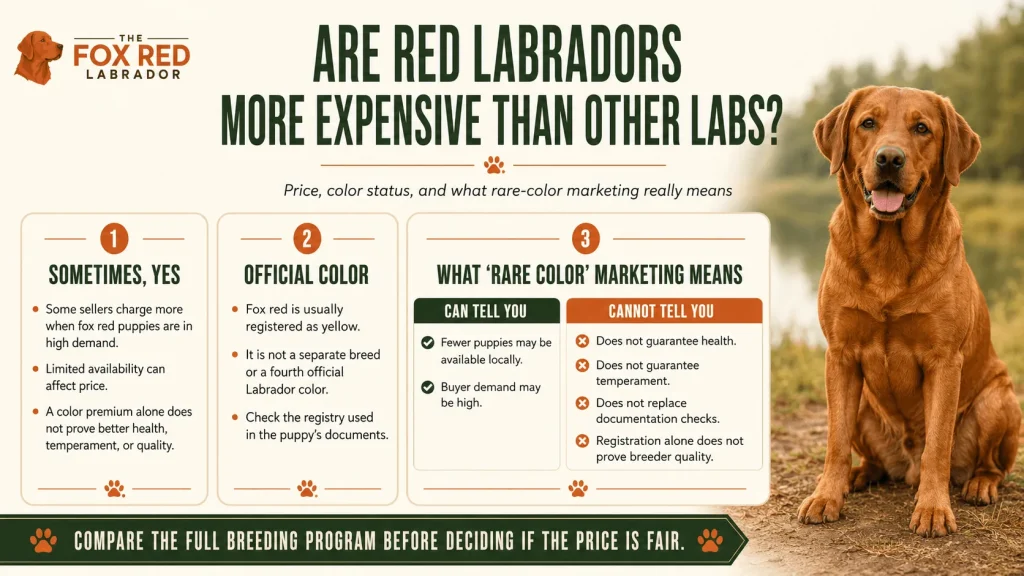
Sometimes they are, but there is no rule for all breeds. A seller may ask for a higher price when red fox puppies are in high demand, if they are having a limited number of puppies, or if they are selling all puppies at the same price.
The color premium provides you with information about the seller’s pricing choice. It doesn’t give you much information on its own about the puppy’s health, character, or future suitability. Before considering the quote fair, compare the entire breeding program.
Is Fox Red An Official Labrador Color?
Fox red is not usually reported as a fourth Labrador colour, but as yellow. That is, you’re looking for a yellow Labrador that’s deep red, not a “Red Labrador Retriever” breed. For a clearer explanation of Labrador color classification and whether fox red differs from standard yellow.
The terms used in registration may differ from country to country, so please consult the regulations of the registry indicated in the documents. A legitimate description should not cause “fox red” to turn “red” for “superior genetics”, “guaranteed darkness” or “special breed”.
What “Rare Color” Marketing Can and Cannot Tell You
The term “rare” can refer to local supply or to what buyers are looking for now. It is not an indication of sound joints, eye exams or temperament on the part of the parents.
Rarity doesn’t mean that a puppy is worth more. Don’t interpret it as a quality certificate, but as a description that requires context.
- It can mean that there are fewer puppies of the desired color in the area.
- It does not guarantee pedigree, health, temperament or responsible breeding.
- It should not be a substitute for the documentary checks.
- Breeder registration does not guarantee the quality of a breeder.
What Determines A Fox Red Labrador Puppy’s Price?
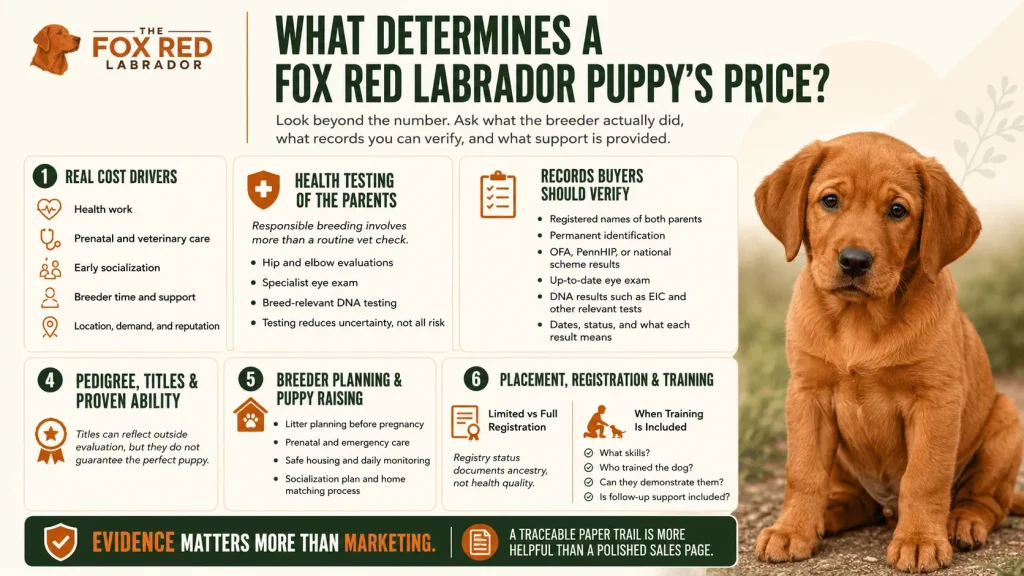
There are a number of real costs to a responsibly raised litter. The quote can be influenced by health work, prenatal care, veterinary support, careful socialization and breeder time. It can also be raised by location, reputation, contract terms and marketing, so the amount should be considered in conjunction with evidence.
Inquire about what the seller actually did, what records are available, and what support is provided after collection. A smooth web page is pleasant. A paper trail that can be traced is much more helpful.
Health Testing Of The Parents
Parent health testing is not just a simple “dog looks healthy” by a veterinarian. There are different questions answered with a physical examination, orthopedic evaluation, specialist eye exam and DNA test. You can’t stand in for everyone else.
The Labrador Retriever Club recommends the following for US Labradors: hip and elbow evaluations, an eye examination, and specific DNA clearances. While testing does not guarantee that a puppy will never become ill, it does help to minimize unnecessary uncertainty and make better informed breeding pairs.
Records Buyers Should Be Able to Verify
The breeder should be able to provide the registered names of both parents. This enables you to compare certificates or database hits with the dogs themselves, and not an unlabeled screenshot.
Look at the result itself, its date, and whether an orthopedic result is final or preliminary. The care of the DNA language is also required. A carrier is not necessarily an affected dog and the pairing of dogs depends on the condition and the other parent’s result.
- Names and permanent identification for both parents.
- Evaluation of hips and elbows by OFA, PennHIP or the appropriate national scheme.Evaluation of hips and elbows by OFA, PennHIP or appropriate national scheme.
- An up-to-date eye exam if recommended
- Breed relevant DNA results: EIC and other tests recommended for the line/country
- Original certificates or public database records that correspond to each dog.
- Dates, status of results and an explanation of what the results mean
When checking a litter, use our Labrador health-testing checklist. It assists in distinguishing a comprehensive health program from the much shorter term “DNA tested.”
Pedigree, Titles And Proven Ability
Titles such as conformation, field, and obedience indicate that others, not connected to the breeding program, judged specific attributes. To achieve those goals, training, travel, entry fees and time will also play a role in the cost of a litter.
The title is not magic dust. Not all puppies of a champion are easy to train, healthy, or good for a busy family. Inquire into the parents’ own assessment and why they are a good match for your home.
Breeder Experience, Litter Planning and Puppy Raising
A well planned litter begins before the pregnancy. Costs can include health clearance, stud arrangement, reproductive care, prenatal examination and emergency veterinary services. Safe housing, sanitary conditions, monitoring and all of the little jobs are part of life when puppies arrive.
Good puppy training should also be visible. Request the socialization plan, surfaces and sounds exposed, individual temperament information, veterinary history, and the breeder’s puppy-to-home matching process. Welcome bags are good; they are no replacement for eight weeks of careful work.
Location, Demand And Litter Availability
Veterinary fees, labour, property, sales tax and transport vary from state to state in the United States. A breeder in a high-priced area may run at higher costs compared to a breeder in a lower-priced area. The quote may also be impacted by small local supply and a lengthy waiting list.
Geography and popularity are no measure of merit. Research at least three programs that are appropriate, and then adjust the prices of those programs so that delivery costs and required extras don’t skew the results.
Pet, Show And Breeding Placement
Breeders can keep one as a family pet and one as a show, performance or breeding dog. The second arrangement may include other selection criteria, responsibilities, co-ownership, or registration rights.
Pet quality should not be synonymous with unhealthy, unthoughtfully raised pets, or pets that are somehow less of a pet. Most often, it indicates that the puppy will be bred to be a companion animal, not a pet for breeding or show.
Limited Registration Vs Full Registration
With AKC limited registration, litters sired by that dog are not eligible for AKC registration. Full registration may allow for the registration of eligible descendants, but the sales contract may include separate conditions.
Inquire about the registration status and whether it can be changed, who does the registration, and if there is an additional fee. Most important, keep in mind that registry documents ancestry and status; it is not a substitute for health testing.
- Limited registration: Used for companion placements and limits registration of offspring.
- Full registration: May allow eligible offspring to be registered and may include extra breeder conditions.
- Contract conditions: Can include anything other than registry requirements that may involve breeding, co-ownership, health checks or other requirements.
- Buyer action: Ensure that all conditions and fees are read prior to payment of a deposit.
Ref Lab Age, Training And Demonstrated Skills
An eight-week-old puppy comes with foundations, not finished manners. A puppy may have weeks or months of crate training, basic obedience, or field introduction under his belt. A finished dog should have mature skills that can be demonstrated and takes much longer to build up, much more professional input. Buyers choosing between an eight-week-old puppy and a started dog can review our Fox Red Labrador training guide to understand the skills and daily practice a young Labrador still needs.
Value does not accrue with age. The important thing is the quality of the training, the dog’s response, and whether those skills are appropriate for your objectives.
What to Ask When Training Is Included
The term “trained dog” is a very flexible one. One seller could be basic house training, another could be advanced house training around birds, gunfire and retrieving.
Ask for a list of behaviours in writing and observe the dog perform them, preferably in real time or in a video that is not edited. The handover should also include teaching you how to keep this work going; otherwise the dog may know it better than the new owner.
- What behaviors, obedience, or field skills are covered?
- Who was trained and for how long?
- Does the seller show each of the skills claimed?
- Are transfer lessons and follow-up support provided?
- Does the total price include the training or is it an additional cost that is included in the puppy price?
What Should Be Included In The Fox Red Labrador Puppy Price?
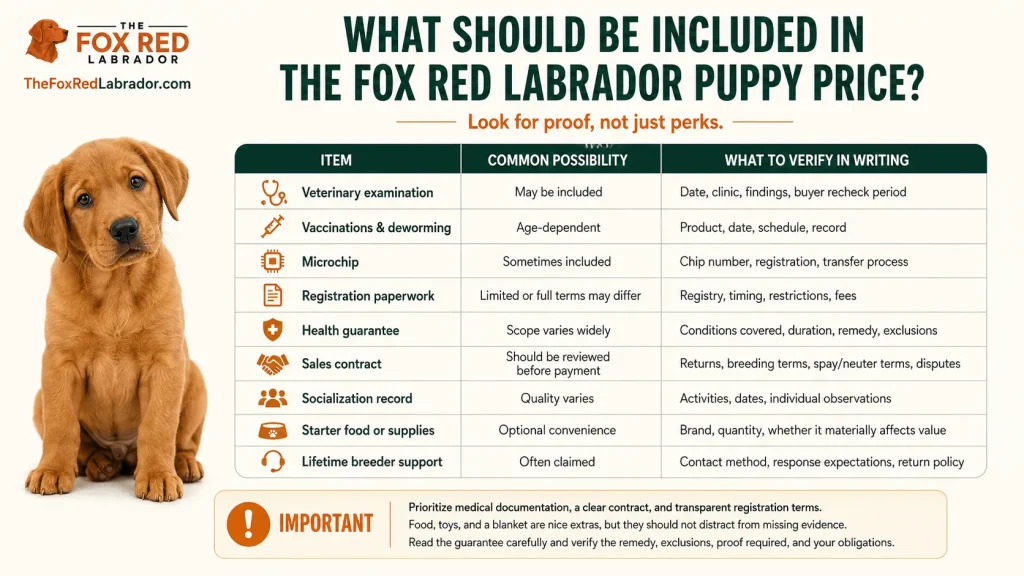
Breeder packages come in a variety of different forms – ask for a list of items rather than take it for granted. Puppies that are the same price can have different records, protection, and extra costs.
Prioritize medical documentation, a clear contract, and transparent registration terms. Food, toys and a blanket are nice treats, but should not distract from missing evidence.
| Item | Common possibility | What to verify in writing |
|---|---|---|
| Veterinary examination | May be included | Date, clinic, findings, and buyer recheck period |
| Vaccinations and deworming | Age-dependent | Product, date, schedule, and record |
| Microchip | Sometimes included | Chip number, registration, and transfer process |
| Registration paperwork | Limited or full terms may differ | Registry, timing, restrictions, and fees |
| Health guarantee | Scope varies widely | Conditions covered, duration, remedy, and exclusions |
| Sales contract | Should be reviewed before payment | Returns, breeding terms, spay/neuter terms, and disputes |
| Socialization or enrichment record | Quality and detail vary | Activities, dates, and individual observations |
| Starter food or supplies | Optional convenience | Brand, quantity, and whether it affects value materially |
| Lifetime breeder support | Often claimed | Contact method, response expectations, and return policy |
Read the guarantee carefully enough to know what the remedy is. Some contracts offer a set amount or specific reimbursement instead of unlimited veterinarian fees. Review the proof that is needed, the conditions that are not included, and your obligations.
Extra Costs That May Not Appear In The Advertised Price
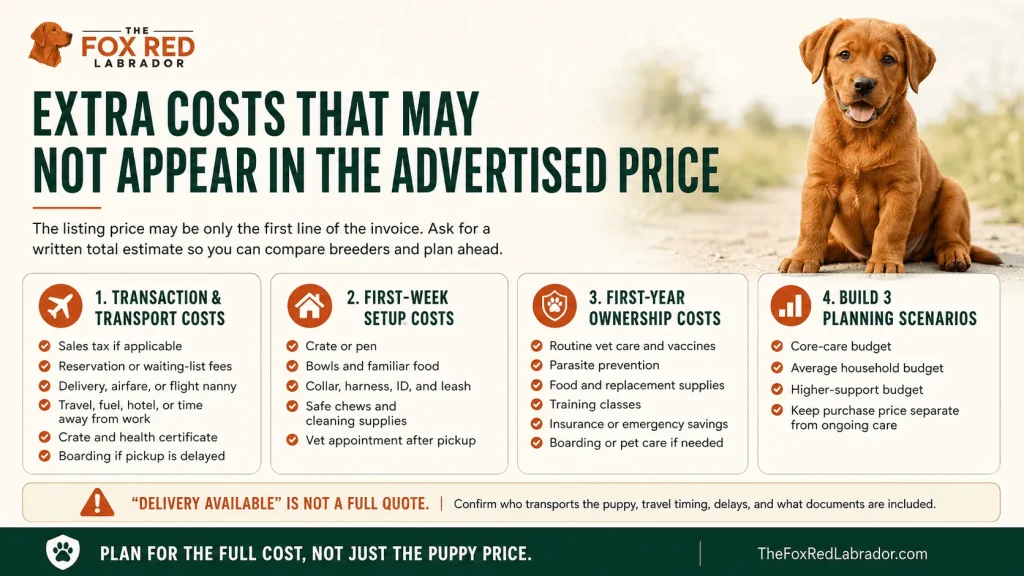
The listing price could be just the first line of the invoice. There can be hundreds or thousands of dollars in tax, collection, transport and optional services before the puppy even gets a taste of the amazing culinary possibilities of your shoelaces.
Request a written estimate for the total job. Separating the care of acquisition extras from regular care makes comparisons with the breeders easier and household planning more straightforward.
Red Fox Labrador Transaction And Transport Costs
Depending on the transaction and location, sales tax may apply. Further travellers may also be charged for fuel, hotel, airfares, flight nanny, ground transport, crate and/or travel health certificate.
Boarding charges can be created due to delays in collection. Some sellers may require some of these services to be paid for as an option, and some may require them to be paid for as a mandatory service. Write down each cost before adding them up.
- The sales tax (if applicable) is included in the price.
- Fees for the application, reservation or waiting list.
- The ground delivery, airfare or flight-nanny service
- Travel, accommodation, fuel and time away from work.
- Crate and necessary health certificate
- Boarding due to lateness for pick-up time.
- Registration or breeding-rights upgrade
- Extended care by the breeder or optional training is available.
Do not take “delivery available” as a full quotation. Inquire about the person who transports the dog, how long the trip takes, what happens when there are delays and which documents are provided.
First-Week Fox Red Lab Setup Costs
Bring the following to collection: a properly sized crate/pen, bowls, a secure collar/harness, identification, leash, familiar food, safe chews, cleaning supplies and an appointment with your veterinarian. A growing lab doesn’t require a designer outfit. It requires equipment that fits safely.
There are certain items that you can wait to buy until you have checked the size and your preference. Beds, harnesses and some toys are more difficult to select if you don’t know the puppy you’re buying, and accessories are not required.
First-Year Fox Red Lab Ownership Costs
The first year budget is just the cost of the purchase. After collection day, routine veterinary care, vaccinations, parasite prevention, food, training, and replacement supplies all continue. Use our Fox Red Labrador feeding guide to estimate food requirements based on the puppy’s age, body condition, activity and chosen diet.
Insurance premiums or a special emergency savings account should be listed separately. This can be significantly more for daycare, boarding and/or professional training, particularly for a family with long workdays or a lot of traveling. While published estimates are helpful for planning, your veterinarian, trainer and insurer will have more accurate estimates for your home.
Build Three Planning Scenarios
One national figure is not enough to give the impression of precision. Create a budget for the services you will use and then allow for flexibility as the puppy grows.
Do not include the purchase price in the care subtotal. This will allow you to make the right choices for the acquisition without the possibility of eradicating food or animal care from the equation.
- Core-care budget: Basic care, food, preventives, basic equipment, owner training without paid daycare.
- Average household expenses: Includes group classes, insurance or a savings account for emergencies and sometimes boarding or pet care.
- Higher-support budget: Professional training, regular daycare, frequent boarding, or traveling support.
An older AKC Pet Insurance guide placed the cost of first-year puppy veterinary care at $100 to $500, but it was published in 2022, so it is not comprehensive enough to be a 2026 Labrador budget. Use these numbers as examples of categories rather than the price you will pay at your local clinic.
How To Compare Two Red Labrador Prices Fairly
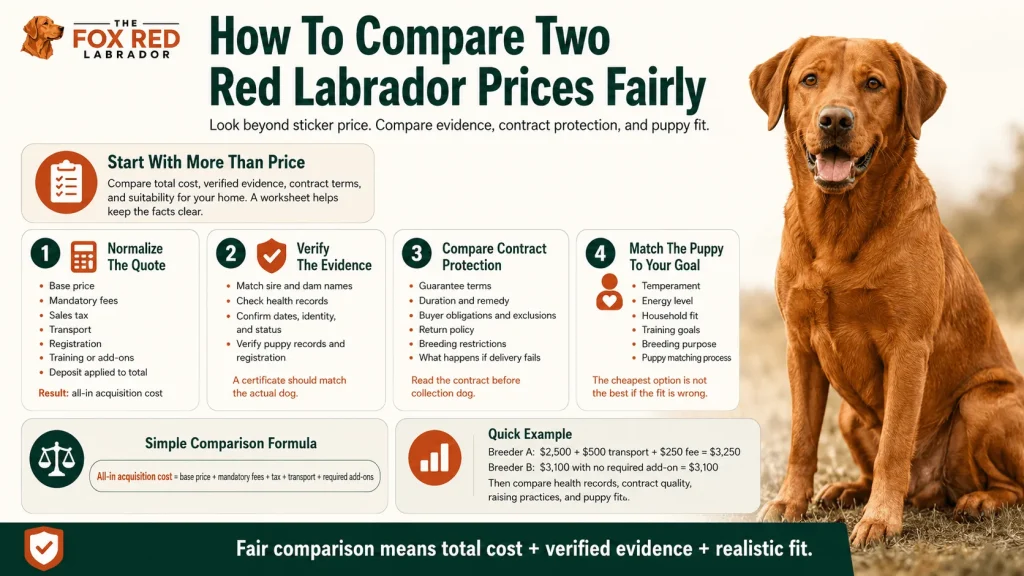
Start with the number of dollars needed to adopt each puppy. Next, compare Evidence, Contract Protection, and Suitability. Attempting to boil all of that down to a single sticker price obscures the important differences.
A simple worksheet keeps pretty pictures and lengthy phone calls from muddying the facts. It also simplifies follow-up questions as you will be able to see which box is empty.
Step 1: Normalize The Quote
Record the base price, fixed costs, sales tax, transport, registration and training. The deposit is only added to the total once and is usually applied to the balance of the total, not added to the top.
Document the due date of each payment, and if the amount is variable. The outcome is the all-in acquisition cost, providing you with a better financial comparison.
Step 2: Verify The Evidence
Match the names of the sire and dam with the health results. Don’t just take someone’s word for it that the “lines are clear,” but verify the date, identity and status of those results.
Verify the contact details, medical history and registration of the puppy as well. A dog’s certificate should be for the dog, rather than a relative with a similar call name.
Step 3: Compare Contract Protection
Understand the terms of the guarantee, its duration and remedy. Search for any obligations on the buyer, any exclusions, any return policy, any breeding restrictions, and what happens if the breeder is unable to deliver the puppy.
Please don’t wait until the collection day to view the contract. A document in front of an excited family with a puppy is not coming at a time for legal concentration to be calm.
Step 4: Match The Puppy To Your Goal
Take into account the breed’s temperament, energy, household environment, training program and breeding objective. A lower price is a bad deal if the dog’s requirements don’t mesh with your house for the next 10 or so years. Before comparing breeders only by price, review our Fox Red Labrador ownership guide for the daily routines, household preparation, expenses and long-term responsibilities involved.
Inquire about the process of evaluating and pairing puppies. Responsible answers must not just be coat shade or pick order, but individual behaviour and family fit.
Simple Comparison Formula
The maths is simple. This judgment is based on comparison with verified evidence and a realistic assessment of fit.
All-in acquisition cost = base price + mandatory fees + tax + transport + required add-ons
If Breeder A is charging $2,500 for a puppy and $500 for transport and $250 for a program fee, then the total cost to the buyer is $3,250. Breeder B offers $3,100 and no requirement for an add-on fee. They have purchased a total of $3,250 and $3,100 respectively, but until the health records, contract, raising practices, and puppy match have been compared, neither of these is the better purchase.
Deposits, Waiting Lists And Payment Terms
A deposit can reserve a place on a general waiting list, a specific litter, pick position or named puppy. Those assurances are not equivalent. The receipt and contract should specify exactly what your payment is for.
Breeder and jurisdiction specific. Read them before sending money; keep the advertisement, invoice, agreement, messages and payment confirmation.
Questions To Ask Before Paying A Deposit
Start with refund and transfer rules. Then ask what if the breeding doesn’t result in a suitable puppy, the breeder cancels, or a veterinary concern delays the placement.
The payment must be made to the person or company that has been verified in the agreement. If it’s an unexpected request to wire funds to an account that you don’t know, you should take a break, regardless of how cute the puppy photo is.
- Does the payment come back, transfer or go into your account?
- If there is no suitable puppy born, what is to be done?
- What about if you don’t accept the puppy you are offered?
- Is the deposit for a litter, pick position or named puppy?
- What is the payment due date and how can you pay?
- Is there any additional cost for cards, tax, registration or delivery?
- If the breeder cancels or the puppy does not pass a health check-up?
- Will you receive the complete contract and a signed receipt first?
Deposit Decision Rule
Wait until all parties (seller, written terms, breeding plan/litter information, and payment destination) are in agreement before payment is made. Apply a traceable approach and do not allow artificial urgency to take the place of simple verification.
Contract rights are subject to the agreement and the law. If a large amount of money or some unusual provision is involved, get local advice before agreeing to it.
How To Tell Whether The Price Is Reasonable

A reasonable quote is backed by clear care, evidence of health work, clear terms and a dog that is an appropriate match for the buyer. The darkest coat, the longest waiting list, or the shiniest website won’t be able to answer those questions.
Use the same framework to evaluate all sellers. Consistency helps you avoid the false conclusion that something that costs more is safe, or that something that costs less is suspicious.
Signs Of Strong Value
Good value is often more authentic than showy. The breeder can explain his decisions, create matching records, and talk about potential problems without making it a sales pitch.
Take notice of how questions regarding your home are handled also. You should be interested in the puppy’s destination, not just the payment!
- Records of parents’ health and/or records from the public service.
- A detailed puppy-care and socialization information sheet.
- A sensible perspective of the mother and the nurturing environment
- A frank appraisal of strengths, weaknesses and household appropriateness
- A contract that is provided prior to payment.
- The identity and contact information are available and can be traced to the source.
- A clearly stated return policy and helpful after-sales service
Warning Signs At Any Price
There’s a missing piece and it could be a simple explanation. If there is a pattern of pressure, lack of information and prevented verification, then this is more concerning.
When the puppy changes, records can’t be matched, or the instructions for payment change, slow it down. If a reasonable request for documentation does not result in the demise of a genuine opportunity, then it is a genuine opportunity.
- Urgent need to pay upfront
- If the price or who the payment is going to changes during the conversation.
- Photos of puppies from stock, copied descriptions, or inconsistent puppy details.
- Failure to identify the parents or full results
- An alternative to parent health screening is called “vet checked.”
- Adult shade, size, temperament and/or lifelong health guaranteed
- Lots of litters that are available all the time, but not well documented individually.
- A parking-lot-only handover with no good reason.
Why A High Price Is Not Proof Of Quality
The quote can be inflated by using luxury language and by having limited numbers of colors and a fancy puppy package, but this does not necessarily mean that the breeding program has been improved. A high-dollar toy doesn’t fix elbow results and a fancy brand name doesn’t clarify a non-specific contract.
Do the evidence checks at $5,000 as rigorously as at $1,000. Documentation is the only way to determine if responsible work was done, and price can indicate that.
Why A Low Price Is Not Automatically A Scam
If you have an older puppy, a changed family situation, were rescued, or the breeder is looking for the right home, this may result in a reduced fee. None of those scenarios is inherently dangerous.
There should be no lessening of scrutiny because of reduced cost. Check who they are, health details, ownership, contract conditions, and why the price.
Breeder, Marketplace Or Rescue: Which Route Fits You?

The choices for the right route will vary according to your age, the amount of history you require, your flexibility, and the support you have. Rescue should not be a bargain shelf and purchasing from a breeder is not necessarily safer unless it is verified.
Consider the dog you can really help. The family who wants a fox red puppy might have to wait longer, but if they don’t mind the age or color, they might discover a great puppy from a rescue.
| Route | Best fit | Advantages | Trade-offs | Verification priority |
|---|---|---|---|---|
| Responsible breeder | Buyer wants puppy history and breeder support | More background may be available | Higher upfront cost and possible wait | Parent health evidence and contract |
| Marketplace listing | Buyer wants a broad local selection | Easy discovery and price comparison | Platform presence does not verify every seller | Independent seller and record checks |
| Breed rescue or shelter | Buyer is flexible on age and history | Gives a dog a home; care may be included | Availability and background vary | Medical, behavior, and adoption terms |
A marketplace is not a guarantee of every listing. Rescue groups also determine their own eligibility, matching and care policies. Read the individual organisation, not just the route’s label.
Before You Buy: Red Labrador Price Checklist

When you have a serious seller or organization you have in mind, use the checklist. It combines the financial, health and contract issues before emotion begins to do creative accounting.
Save the answers and supporting documents to a single folder. If something important is not clear, stop and ask for clarification; don’t fill the void with wishful thinking.
- State that fox red is a color of yellow Labrador.
- Get the registered names of both parents.
- Verify recommended health results, not only DNA panels.
- Check the puppy’s veterinary, vaccination and deworming history.
- Read the entire sales contract and health guarantee.
- Determine the specific amount of money that is being held in a deposit.
- Ask for an itemized “all-in” acquisition cost.
- Create a first-year care budget on its own.
- Review transportation and any relevant restrictions.
- Verify the terms of cancellation, return and support.
- Consider temperament, energy and fit in the home.
Use our Is This Dog Right for You? checklist to assess your schedule, exercise capacity, training commitment, shedding tolerance and long-term budget before paying a deposit.
Final Takeaway
Fox red Labradors are not all the same breed and therefore the prices are not the same. Compare the cost of acquisition, then move on. A cute colour or a high price tag is not as important as verified parent health, thoughtful puppy raising, understandable contract terms, or temperament.
To estimate the ongoing work behind the purchase price, visit our Fox Red Labrador care hub, which covers feeding, exercise, training, grooming and shedding. Take time to review the records and create a realistic first year budget. It is not about the lowest or highest price puppy. It’s about selecting a well-bred, well-raised pet that will be a good fit in your house, and knowing what you’re getting into before you buy.
FAQ’s
Public US advertisements reviewed in July 2026 ranged roughly from $750 to $5,000. Many established breeder programs in the sample were closer to $2,000–$5,000. These are advertised prices rather than an official average, and tax, delivery, optional training, and ongoing care may cost extra.
Established US breeder programs in the July 2026 sample commonly advertised around $2,000–$5,000. A fair comparison should include parent health records, puppy care, registration terms, contract protection, and mandatory extras, since the highest quote is not automatically the strongest program.
Demand for the deeper shade, regional availability, parent health screening, stud costs, veterinary care, and puppy raising can all affect the price. Marketing may influence it too. Shade alone does not prove quality, so ask for evidence behind the quote.
Some sellers charge more for fox red puppies because the shade attracts strong demand, while others price all yellow shades equally. Fox red is part of the yellow Labrador color range, so any premium is a seller or market decision rather than a separate-breed requirement.
Not necessarily, but price cannot confirm that a puppy is legitimate or responsibly bred. Verify the seller, parents, recommended health results, medical record, ownership, and contract. Apply those checks at every price rather than treating $1,000 as an automatic bargain or scam.
A price of $5,000 may fall within some current breeder-program asking prices, but the amount needs documented value behind it. Examine health clearances, puppy raising, contract terms, support, required extras, and suitability. A premium quote cannot compensate for missing records.
The package may include a sales contract, age-appropriate veterinary care, vaccination and deworming records, registration paperwork, a microchip, a health guarantee, and breeder support. Ask for an itemized list because no single package is universal.
Deposit terms vary. The written agreement should state whether the payment is refundable or transferable, what it reserves, and what happens if no suitable puppy is available, the breeder cancels, or the buyer changes plans. Read those outcomes before paying.
Registration status and breeding rights may influence a seller’s terms or price. AKC registration records eligibility and ancestry information, but it does not prove that the parents completed recommended health testing or that the breeder followed responsible practices.
There is no dependable one-price answer because veterinary fees, food, training, insurance, daycare, and location vary widely. Build a local care budget separately from the purchase price and obtain current quotes from a veterinarian, trainer, and insurer before bringing the puppy home.
Adoption fees are often lower than breeder asking prices. Selected US Labrador rescues currently publish fees around $350–$550, sometimes including services such as veterinary care or spay/neuter. Exact-shade availability can be limited, and normal ownership costs still apply.
Usually, because the price may include the dog’s additional age, boarding, and professional work. Ask which skills are included, who completed the training, and whether they can be demonstrated. Confirm whether the quoted amount is a full price or an add-on.
There is no authoritative national average based on completed sales. The most supportable July 2026 US guide is an advertised range of $750–$5,000, with many established programs around $2,000–$5,000.
Many established US programs in the reviewed sample charged $2,000–$5,000. Pay only when the total is supported by verifiable health testing, responsible puppy care, fair registration terms, and a clear contract.
Current US marketplace advertisements included puppies near $750. Selected Labrador rescues published adoption fees around $350–$550. A low price should never reduce your seller, health-record, and contract checks.
The upper end of the reviewed US puppy sample was approximately $5,000. Trained dogs, finished hunting Labradors, show prospects, and breeding placements may cost more.
Seller type, location, parent health testing, pedigree, titles, puppy care, registration rights, training, demand, and mandatory extras can affect the final price.
They may be worth the price when the dog suits the household and the quote is supported by health evidence, responsible raising, and fair contract terms. Paying extra only for coat color is poor value.
The July 2026 US advertised range reviewed was approximately US$750–$5,000. Many established breeder programs charged around US$2,000–$5,000.
No dependable Texas-wide average was available. Use the broader US range of $750–$5,000 as a reference and compare several current, itemized Texas breeder quotes.
No supportable California-wide average was found because many breeders did not publish their prices. Start with the US range of $750–$5,000 and obtain current local quotes.
No fox-red-specific Florida average was established. One Florida Labrador breeder advertised puppies at $2,000 in July 2026, while the broader US fox red range was $750–$5,000.
Current UK fox red Labrador advertisements reviewed in July 2026 ranged from approximately £500 to £2,800. This is an asking-price range rather than an official national average.
Visible Canadian classified advertisements in the reviewed sample ranged from approximately C$1,100 to C$2,450. The sample was too small to establish a Canadian national average.
Transparent registered-breeder examples were around A$3,500. Too few Australian fox red prices were publicly available to establish a dependable national range.
Registered US puppies can appear across much of the $750–$5,000 advertised range. Ask whether the price includes limited or full registration and whether breeding rights cost extra.
The puppy should come with a sales contract, receipt, veterinary record, vaccination and deworming information, microchip details when applicable, registration paperwork, and verifiable parent health results.
Start with national Labrador breed clubs, kennel-club breeder directories, established health-testing breeders, and Labrador rescues. Marketplace listings still require independent seller verification.
Collect at least three itemized quotes from breeders within a realistic travel distance. Compare the puppy price, tax, registration, collection, delivery, required training, and every mandatory charge.
Look for a breeder who identifies both parents, provides verifiable health results, supplies the contract before payment, explains the socialization program, and accepts responsibility for dogs they have bred.
Ask about parent health tests, temperament, puppy raising, veterinary care, registration, guarantees, returns, deposits, the complete purchase price, transport, and ongoing breeder support.
US buyers should verify hip and elbow evaluations, an eye examination when recommended, EIC results, and other breed-relevant genetic tests advised for the line.
Choose based on health background, temperament, energy, and household suitability before coat shade. Ask how the litter was evaluated and how puppies are matched with families.
Adoption may suit someone flexible about age, exact shade, and background. A responsible breeder may suit a buyer who wants early history and breeder support. Both routes require careful matching.
Availability depends on the country and region. Fox red Labradors appear regularly in US and UK advertisements but were less consistently available in the Australian sources reviewed.
Not reliably. Responsible breeders plan limited litters, and puppy numbers, sex, temperament, and coat shade cannot be guaranteed.
Verify the seller’s identity, check the photographs, see the puppy and mother live or through real-time video, match health records to the parents, review the contract, and use a traceable payment method.
Fox red Labradors have the same general ownership costs as other Labradors. Obtain local prices for food, veterinary care, parasite prevention, insurance, licensing, training, boarding, and emergency planning.
Monthly expenses may include food, parasite prevention, insurance or emergency savings, treats, toys, training, and daycare. Annual veterinary and licensing costs should also be included in the monthly budget.
Food cost depends on the dog’s age, weight, activity, chosen formula, feeding amount, and local retailer. Calculate monthly consumption using the product’s feeding guide and current local price.
Labradors usually need brushing, nail care, ear checks, and occasional bathing rather than regular haircuts. Home grooming is less expensive, while professional bathing and deshedding prices vary locally.
Routine expenses depend on local examination fees, vaccinations, parasite risks, and preventive plans. Illness or injury can cost considerably more, so consider insurance or an emergency fund.
Insurers generally price them as Labradors. Age, location, coverage, deductible, reimbursement level, and medical history affect the premium more than the fox red shade.
Insurance can reduce exposure to large eligible veterinary bills. Compare premiums, exclusions, waiting periods, and hereditary-condition coverage with the emergency savings you could maintain yourself.
Possible hidden costs include tax, transport, crates, gates, training, licensing, parasite prevention, insurance, boarding, daycare, damaged household items, and emergency veterinary treatment.
No single total is reliable without assumptions about lifespan, inflation, location, health, and lifestyle. Build a local annual budget, include emergency savings, and adjust future costs for inflation.
Price Research Methodology and Reference Box
The price snapshot was designed to show what US buyers could encounter publicly in July 2026. It is not a scientific national average and does not measure confidential final-sale prices.
Commercial listings were used only as evidence of advertised amounts. Official and parent-club sources were used for breed, registration, and health-testing explanations.
How The Price Snapshot Was Built
Publicly accessible breeder-program and marketplace prices were reviewed in US dollars. Listings were grouped by seller or placement type so lower-cost marketplace advertisements were not blended with established programs, rescue fees, or trained-dog quotes.
Each observation recorded the source, access date, advertised amount, seller type, and relevant notes. Duplicate listings were not treated as independent evidence. Prices can change without notice, so the visible review date should be updated only after the underlying sources have been checked again.
Sources To Cite
The following references support the principal facts and limitations used in the guide. Commercial sources illustrate asking prices only and do not represent recommendations or quality assessments.
| Claim supported | Source organization | Evidence type | Checked date | Notes and limitations |
|---|---|---|---|---|
| Current breeder-program asking prices | Crimson Rose Puppies and Winter Valley Labs | Public commercial listings | July 2026 | Examples, not a representative national average |
| Current marketplace asking prices | Greenfield Puppies | Marketplace listings | July 2026 | Seller standards and inclusions vary |
| Labrador health clearances | Labrador Retriever Club | National parent-club guidance | July 2026 | US guidance; requirements differ by country |
| Limited registration meaning | American Kennel Club | Registry guidance | July 2026 | Contract terms may add separate restrictions |
| Labrador rescue fee examples | Heart of Texas Lab Rescue, American Lab Rescue, and Labs4rescue | Published rescue fees | July 2026 | Fees, services, and eligibility vary by organization |
| First-year veterinary cost example | AKC Pet Insurance | Consumer cost article | July 2026 | Published in 2022; limited to veterinary care, not a full budget |
Editorial note: Price observations should be reviewed at least every six months. Health and registration passages should also be rechecked whenever the relevant organizations update their guidance.