Male vs Female Red Fox Labrador: Which One Is Right for You?
Male red Labradors are typically larger; females are typically smaller and can focus earlier. There is no rule that says that one sex is automatically calmer, smarter, more loving or better with children than the other. The parents, breeding line, health, socialization and the individual puppy will tell you so much more.
Fox-red is not a breed of Labrador. Fox red is just a shade darker yellow than the Labrador Retriever breed. Many are from working lines, which means their energy, retrieving drive, and slimmer bodies could just be genetics rather than sex.
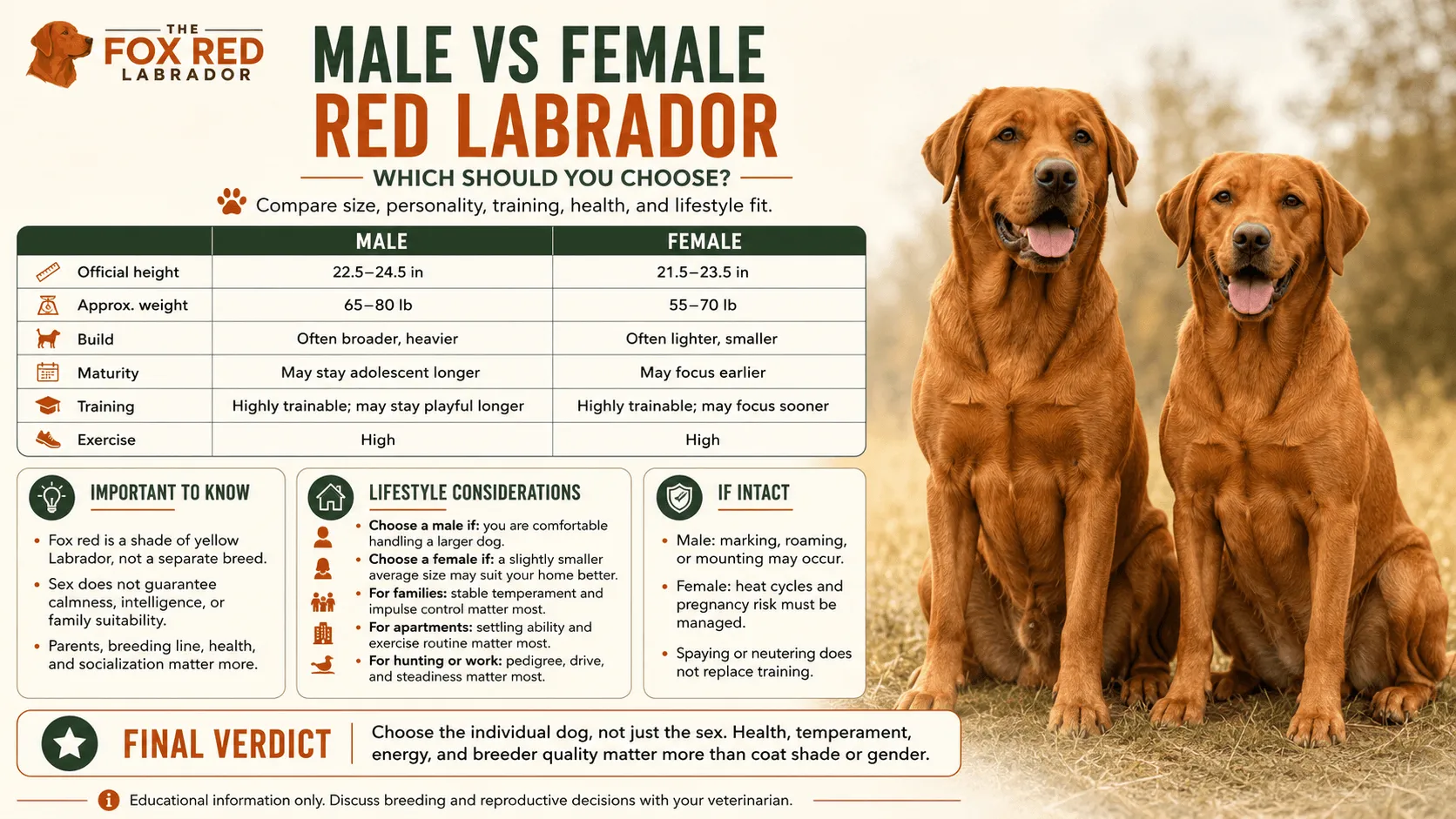
Male Vs Female Red Labrador Comparison At A Glance
Physical differences can be reliably and reasonably measured. These are just common observations of personality descriptions, as not all Labradors will adhere to these.
| Factor | Male Red Labrador | Female Red Labrador |
|---|---|---|
| Official height | 22.5–24.5 inches | 21.5–23.5 inches |
| Approximate weight | 65–80 pounds | 55–70 pounds |
| Build | Often broader and heavier | Often lighter and smaller |
| Maturity | May remain adolescent longer | May focus earlier |
| Affection style | Sometimes more demonstrative | Sometimes more selective |
| Training | Highly trainable; may stay playful longer | Highly trainable; may focus sooner |
| Exercise | High, especially in working lines | High, especially in working lines |
| Intact-dog management | Marking, roaming or mounting may occur | Heat cycles and pregnancy risk |
| Shedding | Heavy seasonal shedding | Heavy seasonal shedding |
| Lifespan | No useful sex-based guarantee | No useful sex-based guarantee |
| Typical cost difference | Larger dogs may eat more | A reproductive procedure may cost more |
| Best owner | Depends on the individual dog | Depends on the individual dog |
There is some overlap between these size ranges. If parents are of similar stature, a large female can be as tall and as heavy as a small male. For detailed measurements by sex and age, see the complete fox red Labrador size and growth guide.
Does Being Fox Red Change The Male Vs Female Red Labrador Differences?
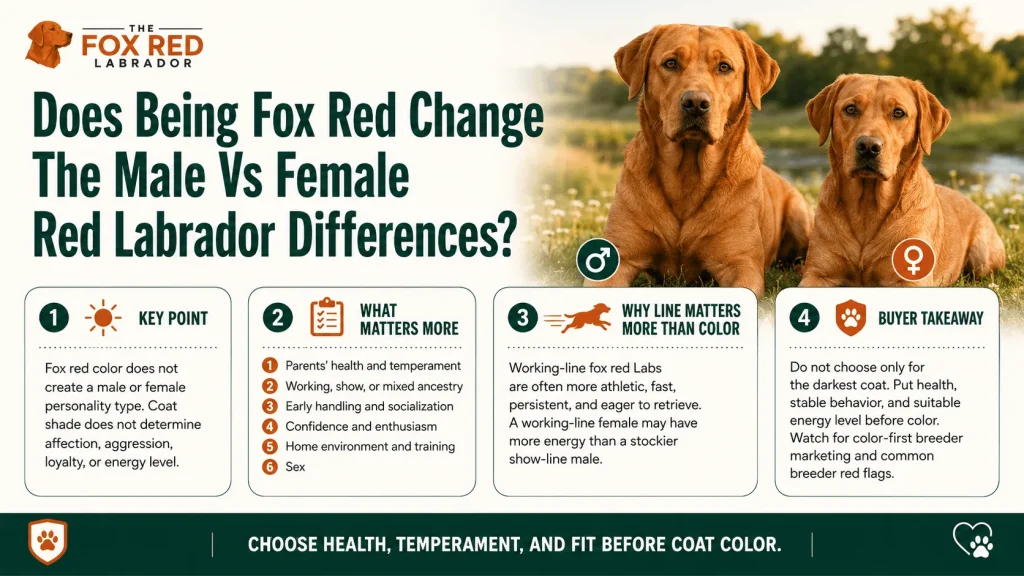
There is no male or female personality associated with foxes being fox-red. A black coat doesn’t necessarily mean a black heart. A black coat doesn’t mean a black heart, affection, aggression, loyalty or being an indoor cat.
Working ancestry is more pertinent. Fox-red Labs tend to be athletic, fast, persistent and eager to retrieve when bred in the field. A female on the working line might then have more energy than a stockier show-line male.
When comparing puppies, consider the factors in this order:
- The health and temperament of the parents.
- Mixed ancestry, working, or show.
- Early handling and socialization.
- Self-assurance and enthusiasm
- Home environment and training
- Sex
Choosing only for the darkest possible coat can limit the breeders’ focus. Colour should be considered as a secondary factor to sound health, stable behaviour and appropriate energy. Buyers should recognize color-first advertising and other common fox red Labrador breeder red flags before reserving a puppy.
What Are The Physical Differences Between Male And Female Red Labradors?
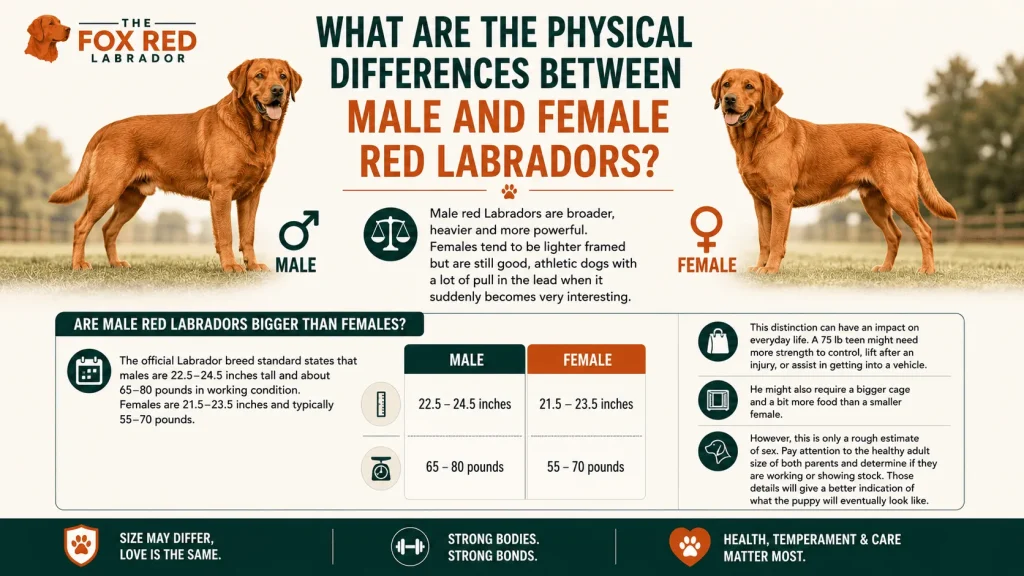
Male red Labradors are broader, heavier and more powerful. Females tend to be lighter framed but are still good, athletic dogs with a lot of pull in the lead when it suddenly becomes very interesting.
Are Male Red Labradors Bigger Than Females?
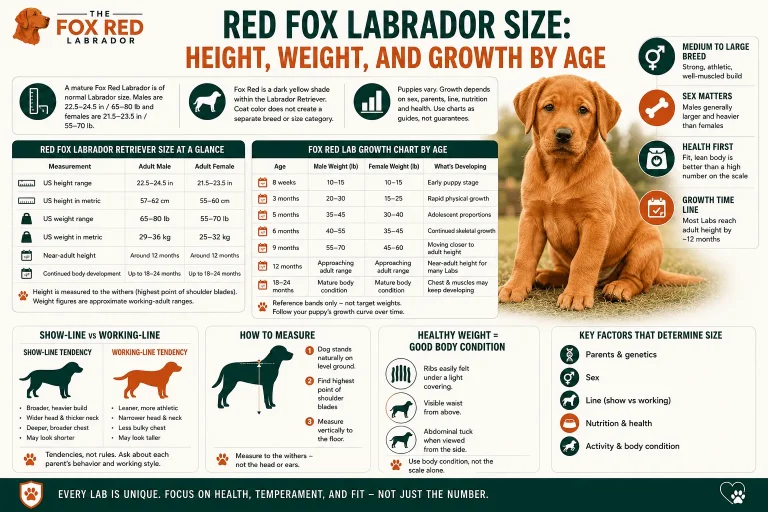
The official Labrador breed standard states that males are 22.5-24.5 inches tall and about 65-80 pounds in working condition. Females are 21.5-23.5 inches and typically 55-70 pounds.
That distinction can have an impact on everyday life. A 75 lb teen might need more strength to control, lift after an injury, or assist in getting into a vehicle. He might also require a bigger cage and a bit more food than a smaller female.
However, this is only a rough estimate of sex. Pay attention to the healthy adult size of both parents and determine if they are working or showing stock. Those details will give a better indication of what the puppy will eventually look like.
How Do Male And Female Red Labrador Personalities Compare?
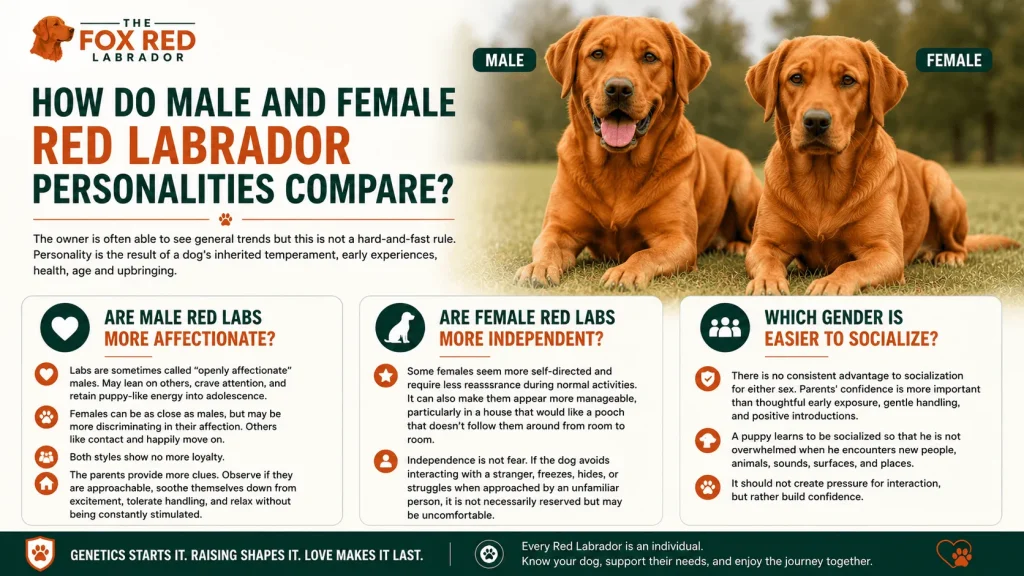
The owner is often able to see general trends but this is not a hard-and-fast rule. Personality is the result of a dog’s inherited temperament, early experiences, health, age and upbringing.
Are Male Red Labs More Affectionate?
Labs are sometimes called “openly affectionate” males. May lean on others, crave attention, and retain puppy-like energy into adolescence.
Females can be as close as males, but may be more discriminating in their affection. Others like contact and happily move on. Both styles show no more loyalty.
The parents provide more clues. Observe if they are approachable, soothe themselves down from excitement, tolerate handling, and relax without being constantly stimulated.
Are Female Red Labs More Independent?
Some females seem more self-directed and require less reassurance during normal activities. It can also make them appear more manageable, particularly in a house that would like a pooch that doesn’t follow them around from room to room.
Independence is not fear. If the dog avoids interacting with a stranger, freezes, hides, or struggles when approached by an unfamiliar person, it is not necessarily reserved but may be uncomfortable.
Which Gender Is Easier To Socialize?
There is no consistent advantage to socialization for either sex. Parents’ confidence is more important than thoughtful early exposure, gentle handling, and positive introductions.
A puppy learns to be socialized so that he is not overwhelmed when he encounters new people, animals, sounds, surfaces, and places. It should not create pressure for interaction, but rather build confidence.
Which Red Lab Is Easier To Train?
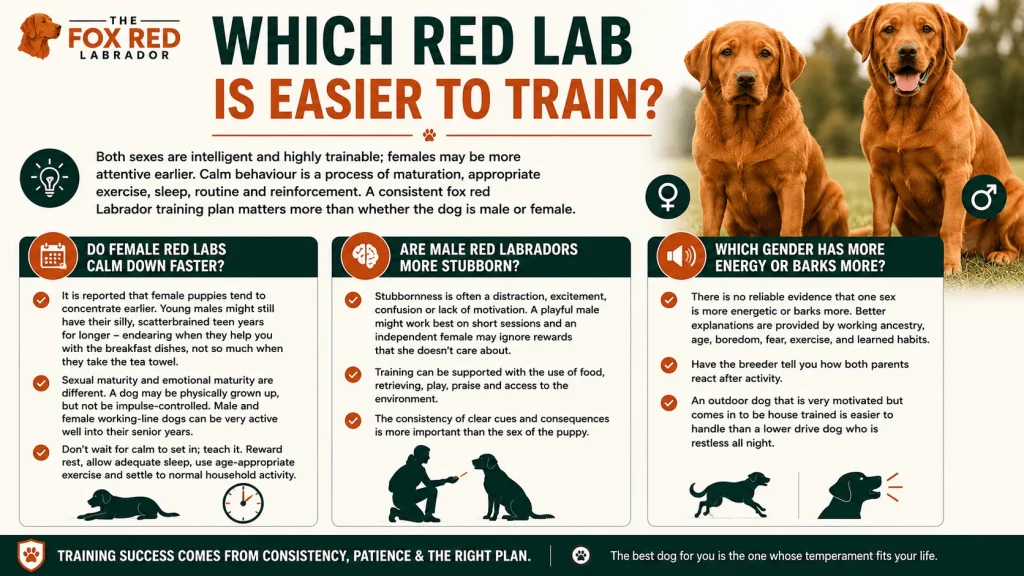
Both sexes are intelligent and highly trainable; females may be more attentive earlier. Calm behaviour is a process of maturation, appropriate exercise, sleep, routine and reinforcement.
Do Female Red Labs Calm Down Faster?
It is reported that female puppies tend to concentrate earlier. Young males might still have their silly, scatterbrained teen years for longer – endearing when they help you with the breakfast dishes, not so much when they take the tea towel.
Sexual maturity and emotional maturity are different. A dog may be physically grown up, but not be impulse-controlled. Male and female working-line dogs can be very active well into their senior years.
Don’t wait for calm to set in; teach it. Reward rest, allow adequate sleep, use age-appropriate exercise and settle to normal household activity.
Are Male Red Labradors More Stubborn?
Stubbornness is often a distraction, excitement, confusion or lack of motivation. A playful male might work best on short sessions and an independent female may ignore rewards that she doesn’t care about.
Training can be supported with the use of food, retrieving, play, praise and access to the environment. The consistency of clear cues and consequences is more important than the sex of the puppy.
Which Gender Has More Energy Or Barks More?
There is no reliable evidence that one sex is more energetic or barks more. Better explanations are provided by working ancestry, age, boredom, fear, exercise, and learned habits.
Have the breeder tell you how both parents react after activity. An outdoor dog that is very motivated but comes in to be house trained is easier to handle than a lower drive dog who is restless all night.
What Changes When A Red Labrador Is Intact, Spayed, Or Neutered?
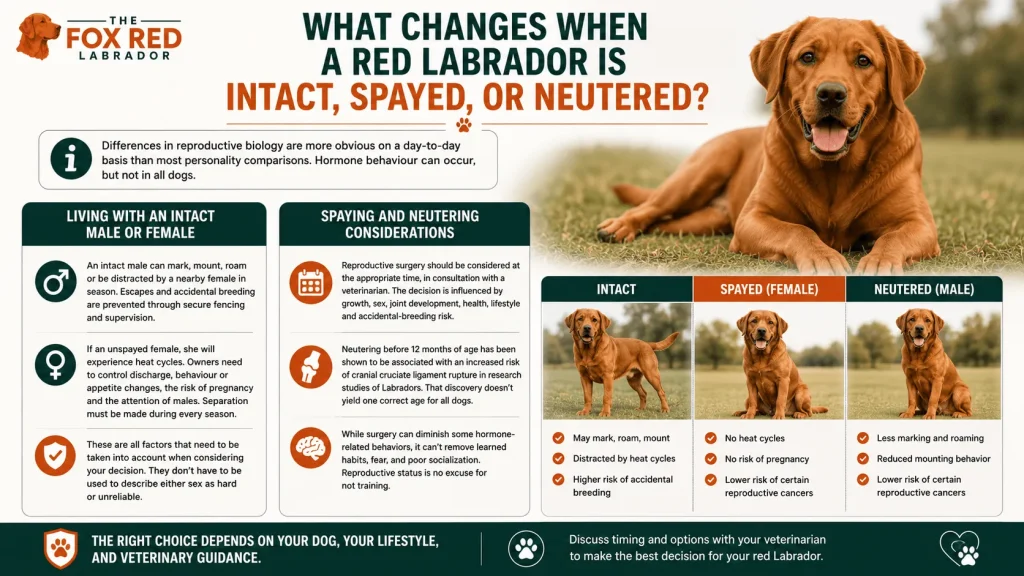
Differences in reproductive biology are more obvious on a day-to-day basis than most personality comparisons. Hormone behaviour can occur, but not in all dogs.
Living With An Intact Male Or Female
An intact male can mark, mount, roam or be distracted by a nearby female in season. Escapes and accidental breeding are prevented through secure fencing and supervision.
If an unspayed female, she will experience heat cycles. Owners need to control discharge, behaviour or appetite changes, the risk of pregnancy and the attention of males. Separation must be made during every season.
These are all factors that need to be taken into account when considering your decision. They don’t have to be used to describe either sex as hard or unreliable.
Spaying And Neutering Considerations
Reproductive surgery should be considered at the appropriate time, in consultation with a veterinarian. The decision is influenced by growth, sex, joint development, health, lifestyle and accidental-breeding risk. Reproductive decisions form one part of the wider fox red Labrador health picture and should be discussed with a veterinarian familiar with the individual dog.
Neutering before 12 months of age has been shown to be associated with an increased risk of cranial cruciate ligament rupture in research studies of Labradors. That discovery doesn’t yield one correct age for all dogs.
While surgery can diminish some hormone-related behaviors, it can’t remove learned habits, fear, and poor socialization. Reproductive status is no excuse for not training.
Which Red Labrador Is Better For Your Lifestyle?
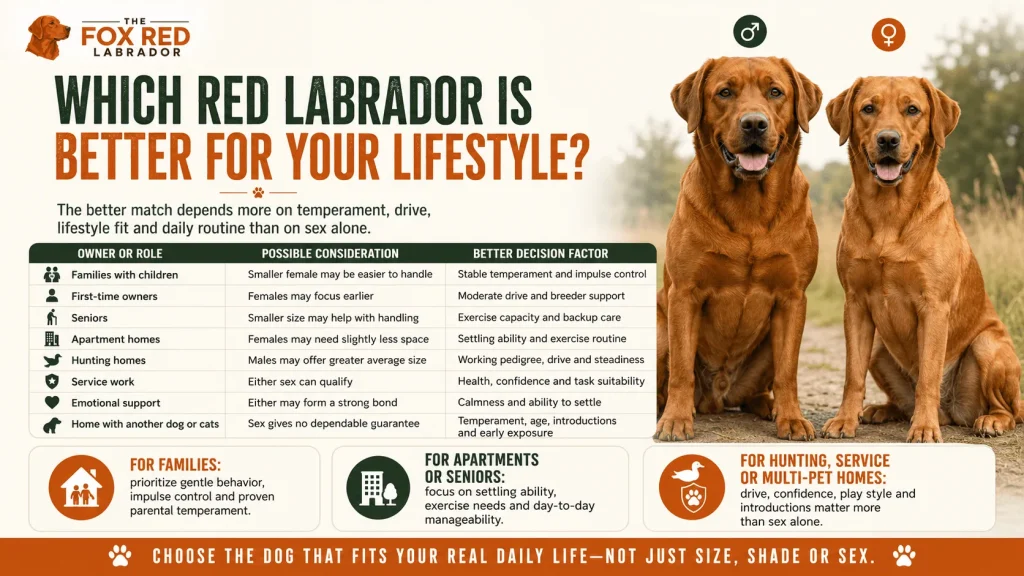
The better match will be related to the requirements of everyday life. The size or maturity of the fruit can be used as a guide, but an individual assessment should be used to determine the size.
| Owner or Role | Possible Consideration | Better Decision Factor |
|---|---|---|
| Families with children | A smaller female may be easier to handle | Stable temperament and impulse control |
| First-time owners | Females may focus earlier | Moderate drive and breeder support |
| Seniors | A smaller size may help with handling | Exercise capacity and backup care |
| Apartment homes | Females may need slightly less physical space | Settling ability and exercise routine |
| Hunting homes | Males may offer a greater average size | Working pedigree, drive and steadiness |
| Service work | Either sex can qualify | Health, confidence and task suitability |
| Emotional support | Either may form a strong bond | Calmness and the ability to settle |
| Home with another dog | Opposite-sex pairing may sometimes help | Temperament, age and introductions |
| Home with cats | Sex gives no dependable advantage | Prey drive and early exposure |
The key qualities for families to focus on are impulse control, gentle behaviors, and tested parental temperament. A more docile female can be easier to manage, but a more placid working-line male might be more appropriate for a child.
Exercise and indoor settling, not sex, are the keys to apartment living. Health, drive, confidence, stress recovery and task suitability are more important for hunting or service use.
Sometimes opposite-sex dog pairings run well, but same-sex pairs can thrive as well. Age, play style, resource guarding and careful introductions still trump.
How Should You Choose A Male Or Female Red Labrador Puppy?
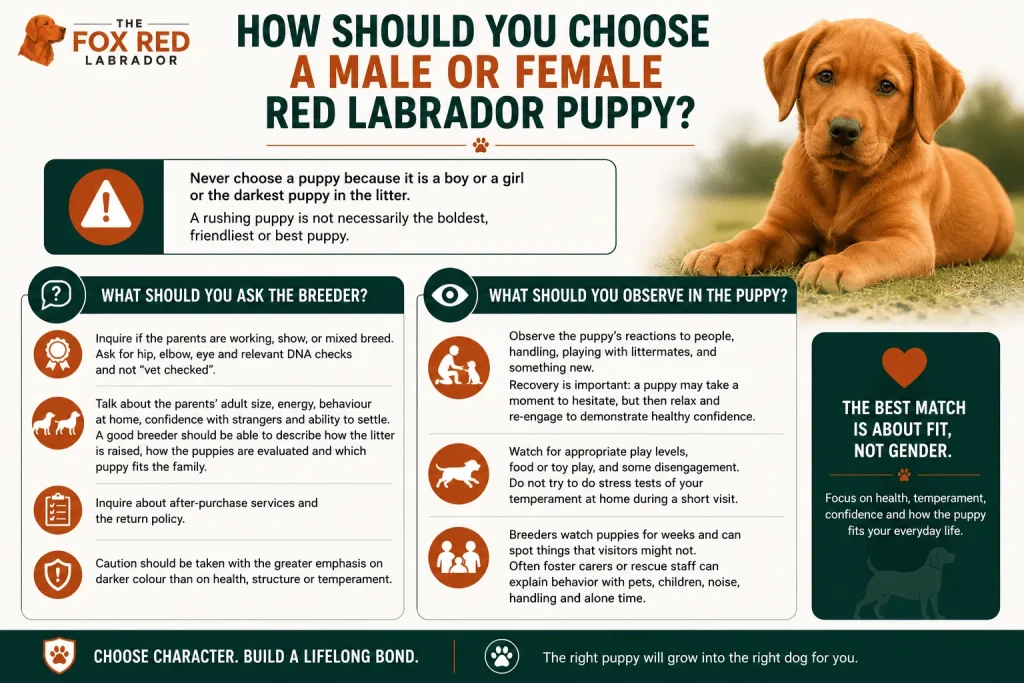
Never choose a puppy because it is a boy or a girl or the darkest puppy in the litter. A rushing puppy is not necessarily the boldest, friendliest or best puppy.
What Should You Ask The Breeder?
Inquire if the parents are working, show, or mixed breed. Ask for hip, elbow, eye and relevant DNA checks and not “vet checked”.
Talk about the parents’ adult size, energy, behaviour at home, confidence with strangers and ability to settle. A good breeder should be able to describe how the litter is raised, how the puppies are evaluated and which puppy fits the family.
Inquire about after-purchase services and the return policy. Caution should be taken with the greater emphasis on darker colour than on health, structure or temperament.
What Should You Observe In The Puppy?
Observe the puppy’s reactions to people, handling, playing with littermates, and something new. Recovery is important: a puppy may take a moment to hesitate, but then relax and re-engage to demonstrate healthy confidence.
Watch for appropriate play levels, food or toy play, and some disengagement. Do not try to do stress tests of your temperament at home during a short visit.
Breeders watch puppies for weeks and can spot things that visitors might not. Often foster carers or rescue staff can explain behavior with pets, children, noise, handling and alone time.
Male vs Female Red Labrador: The Final Verdict
If you’re looking for a more open, social dog and a larger frame, a male is your better choice, as long as the dog is the right size for the home. Think about a female if a smaller average size and maybe an earlier focus would be beneficial.
Calmness, intelligence, loyalty, shedding, lifespan and family suitability are dead draws, with no sex advantage. A healthy puppy from a healthy parent is the better option if you can provide it with the right kind of energy and thoughtful care early on.
Simply put, don’t pick the dog you think you’re looking for, but the one in front of you—whether it’s the dog with the darkest red fur or the one with the most typical traits of a dog.
FAQ’s
Choose according to adult size, reproductive management, existing pets, activity level, and individual temperament. Health and suitability matter more than sex alone.
Neither is universally better. Parent temperament, confidence, energy, health, and recovery from unfamiliar experiences provide stronger guidance.
Females may focus sooner, but neither sex is reliably calmer. Exercise, sleep, age, training, lineage, and individual drive shape settling behaviour.
Males are not automatically more protective. Genetics, confidence, socialization, training, and previous experiences influence alert or guarding behaviour.
Some females concentrate earlier during puppyhood. Clear cues, worthwhile rewards, practice, and the surrounding distractions still determine responsiveness.
Both have the same double-coat structure and shed heavily. Season, health, grooming, environment, and hormonal changes may alter coat loss.
Neither sex has a useful guaranteed advantage. Genetics, healthy weight, preventive care, exercise, and responsible breeding matter more.
Either sex can suit a family. Choose stable temperament, manageable energy, sound socialization, and good impulse control.
Working pedigree, retrieving drive, steadiness, health, and handler responsiveness matter more than sex. Both males and females can become capable working dogs.
Choose according to the available dog’s known behaviour. Foster or rescue observations can reveal compatibility with children, pets, noise, handling, and time alone.
References
- AKC Labrador Retriever
- Official AKC Labrador Retriever Standard
- Labrador Retriever Club Breed Standard
- Royal Kennel Club: Labrador Retriever
- AVMA: Spaying and Neutering
- JAVMA: Neutering Age and Cruciate Ligament Risk
- The Labrador Site: Fox Red Labrador