
Fox Red Labrador Puppies: Complete Guide To Choosing, Raising & Caring For One

A red fox Labrador puppy is a yellow Labrador retriever with a deep copper or reddish colored coat. It is not a different breed and colour doesn’t lead to a different set of health issues and temperament.
The first impression you may have of this coat is the attention they pay to it; it’s beautiful and fair enough. But the final choice is based on the fit of the house, temperament of parents, confirmed health history, early development and origins of the puppy.
This fox red labrador puppies guide addresses the topics of breeder purchase, rescue, adult adoption and private rehoming. It also covers the first night at home, the puppy’s surprisingly athletic phase of stealing socks, and much more.
Fox Red Labrador Puppies At A Glance
Fox red puppies have the same breed standard and basic requirements as other Labrador Retrievers. There is still variation in individual size, activity and behaviour.
| Fact | Information |
|---|---|
| Breed | Labrador Retriever |
| Registered color | Yellow |
| Fox red meaning | Darker shade within yellow |
| Adult red lab puppy weight | Males 65–80 lb; females 55–70 lb |
| Adult height | Approximately 21.5–24.5 inches |
| Temperament | Usually social, active, and trainable |
| Coat | Short, dense double coat |
| Shedding | Regular with seasonal increases |
| Lifespan | Commonly around 10–13 years |
| Best suited to | Involved households prepared for training and activity |
| Main decision factor | Health and temperament before shade |
These measurements are from the Labrador breed standard, and not from a separate fox-red standard. There are no separate standards.
What Is A Red Labrador Puppy?
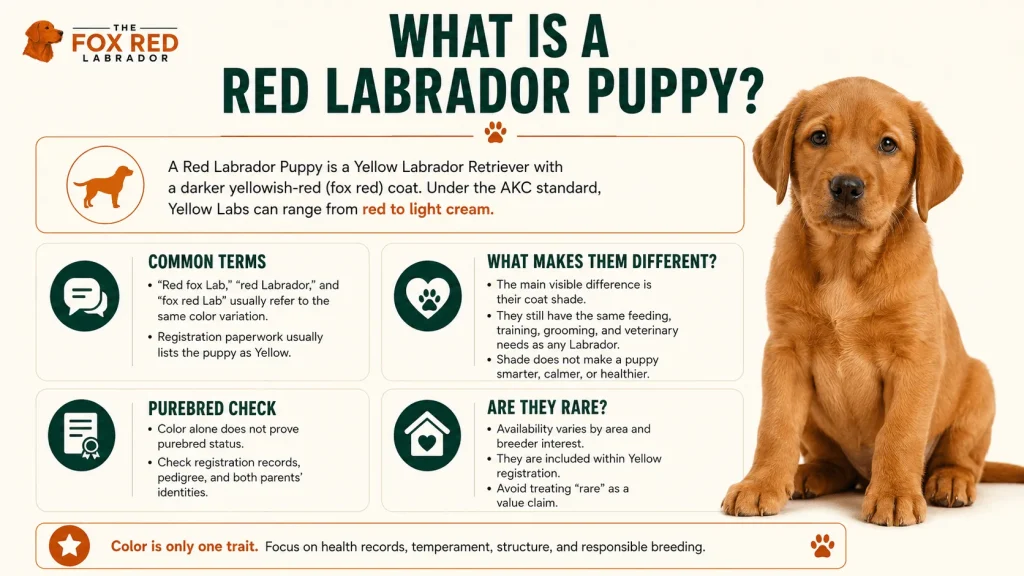
It is a yellow Labrador Retriever with a dark, yellowish red coat. Yellow can vary from red to light cream as per the official AKC standard.
The terms “red fox Lab,” “red Labrador,” and “fox red Lab” typically refer to the same color variation. Registration paperwork will typically show the puppy as being yellow.
Fox red lab puppies are not necessarily purebred, and color does not mean that they are. Check registration records, pedigree information and the identities of both parents.
What Makes A Fox Red Labrador Different?
The visible difference is the coat shade. A fox red Labrador puppy will have all the same nutritional, training, grooming and veterinary requirements as a standard Labrador.
The height and activity can change due to ancestry. Fox red puppies can also be bred from show lines, although many darker dogs can.
There is no evidence that the shade makes a puppy smarter, calmer or healthier. Beauty isn’t beauty without color.
Are Red Fox Labrador Puppies Rare?
In some areas, pale yellow, black or chocolate Labradors might be more readily available than fox red Labradors. The exact prevalence is hard to determine and they are included within the registration of yellow.
Availability is influenced by local demand and by breeders’ interest. One state may have a less common puppy than another.
Don’t use rare as a marketing term; it is not a value indicator. Inquire about the price and the breeding program.
Why Are Some Labrador Puppies Fox Red?
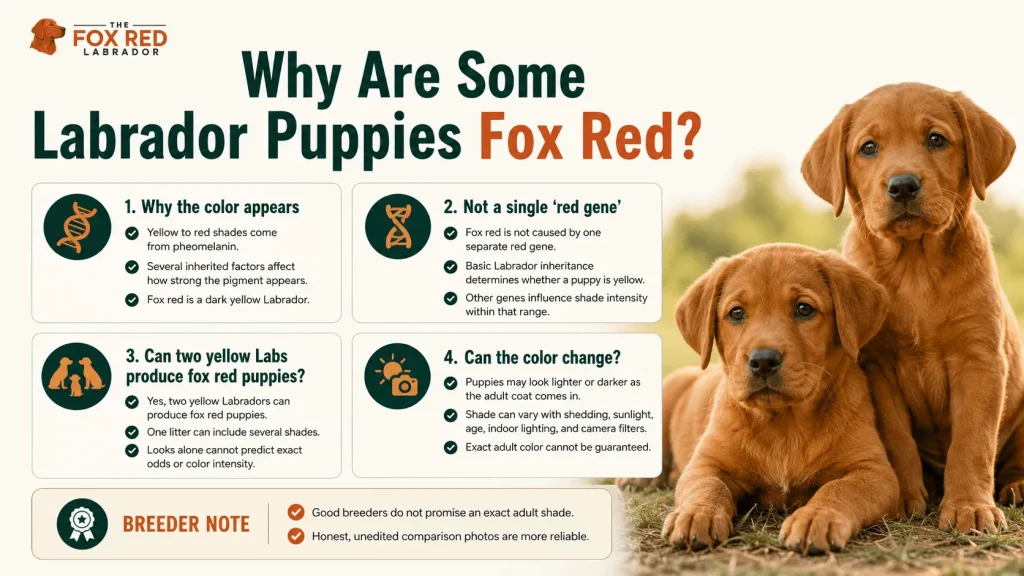
Yellow to red colors in a dog’s fur are produced by the pigment pheomelanin. There are several inherited factors that determine the strength of that pigment.
The fox red is not due to a single, independent “red gene.” The simple Labrador color inheritance dictates whether or not the puppy will be yellow or not, and other genes account for the color within the range.
This color is also not the same as light or “dilute” colors like champagne. A red Labrador puppy is not a diluted yellow dog; it is a dark yellow Labrador.
Can Two Yellow Labradors Produce Fox Red Lab Puppies?
Yes. When the factors that cause the expression of the stronger red-yellow pigment are paired together, two yellow Labradors can produce fox red puppies.
There can be several shades in the litter. One may have a rich copper color and the other a medium yellow.
It is not possible to determine odds from looks alone. A good breeder will not guarantee any specific intensity of red in their puppies.
Can A Fox Red Labrador Puppy Change Color?
The puppy might appear lighter or darker when the soft puppy coat changes to the adult coat. Some noticeably change colours; others stay more or less the same colour.
The color may change due to seasonal shedding, sunlight, age and indoor lighting. Another cause is camera filters, which can turn a warm yellow into a dramatic mahogany in a flash. Puppy shade cannot be predicted with complete certainty, and sellers who guarantee an exact adult color may display one of several fox red Labrador breeder red flags.
There is no guarantee of an exact shade when grown to maturity. The lighting and the photos are not edited when taken as a comparison, which is a better representation than the heavily processed ones.
A Short History Of Fox Red Labradors
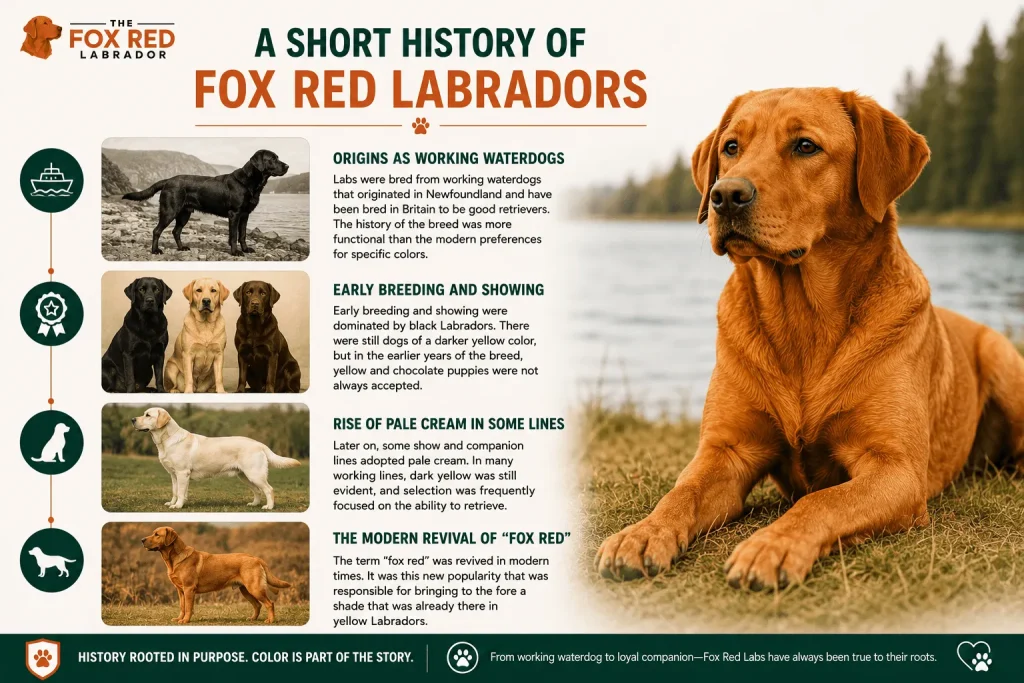
Labs were bred from working waterdogs that originated in Newfoundland and have been bred in Britain to be good retrievers. The history of the breed was more functional than the modern preferences for specific colors.
Early breeding and showing were dominated by black Labradors. There were still dogs of a darker yellow color, but in the earlier years of the breed, yellow and chocolate puppies were not always accepted.
Later on, some show and companion lines adopted pale cream. In many working lines, dark yellow was still evident, and selection was frequently focused on the ability to retrieve.
The term “fox red” was revived in modern times. It was this new popularity that was responsible for bringing to the fore a shade that was already there in yellow Labradors.
Fox Red Labrador Appearance And Adult Size
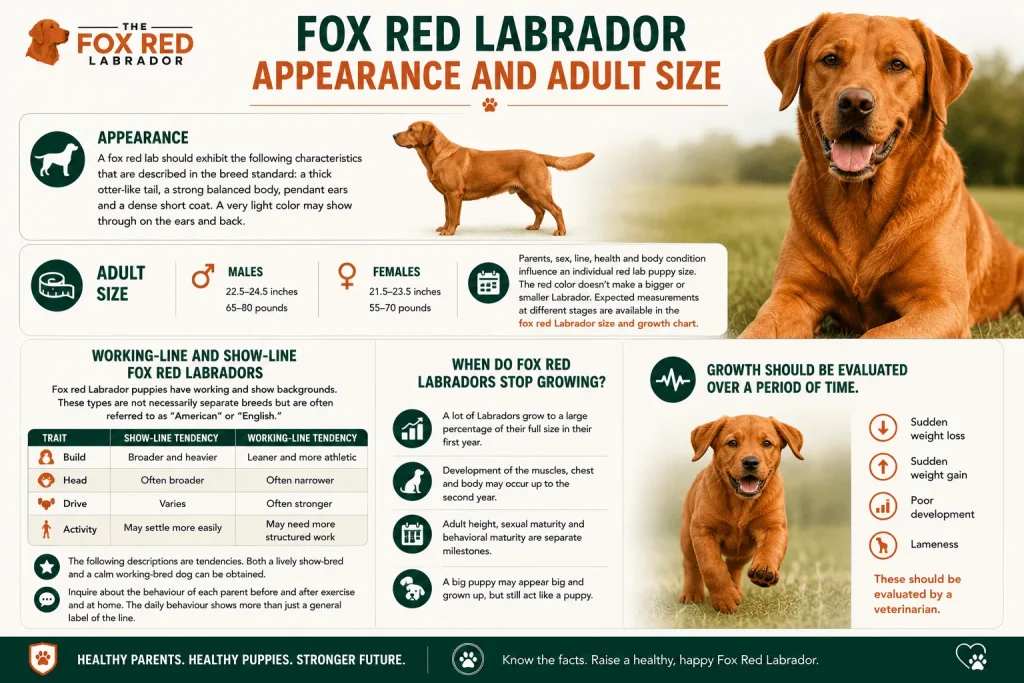
A fox red lab should exhibit the following characteristics that are described in the breed standard: a thick otter-like tail, a strong balanced body, pendant ears and a dense short coat. A very light color may show through on the ears and back.
Adult males are typically 22.5-24.5 inches and weigh 65-80 pounds. Females typically weigh 55-70 pounds and are 21.5-23.5 inches in height.
Parents, sex, line, health and body condition influence an individual red lab puppy size. The red color doesn’t make a bigger or smaller Labrador. Expected measurements at different stages are available in the fox red Labrador size and growth chart.
Working-Line And Show-Line Fox Red Labradors
Fox red Labrador puppies have working and show backgrounds. These types are not necessarily separate breeds but are often referred to as “American” or “English.”
| Trait | Show-line tendency | Working-line tendency |
|---|---|---|
| Build | Broader and heavier | Leaner and more athletic |
| Head | Often broader | Often narrower |
| Drive | Varies | Often stronger |
| Activity | May settle more easily | May need more structured work |
The following descriptions are tendencies. Both a lively show-bred and a calm working-bred dog can be obtained.
Inquire about the behaviour of each parent before and after exercise and at home. The daily behaviour shows more than just a general label of the line.
When Do Fox Red Labradors Stop Growing?
A lot of Labradors grow to a large percentage of their full size in their first year. Development of the muscles, chest and body may occur up to the second year.
Adult height, sexual maturity and behavioral maturity are separate milestones. A big puppy may appear big and grown up, but still act like a puppy.
Growth should be evaluated over a period of time. Sudden weight loss, sudden weight gain, poor development or lameness should be evaluated by a veterinarian.
Fox Red Lab Temperament And Family Suitability
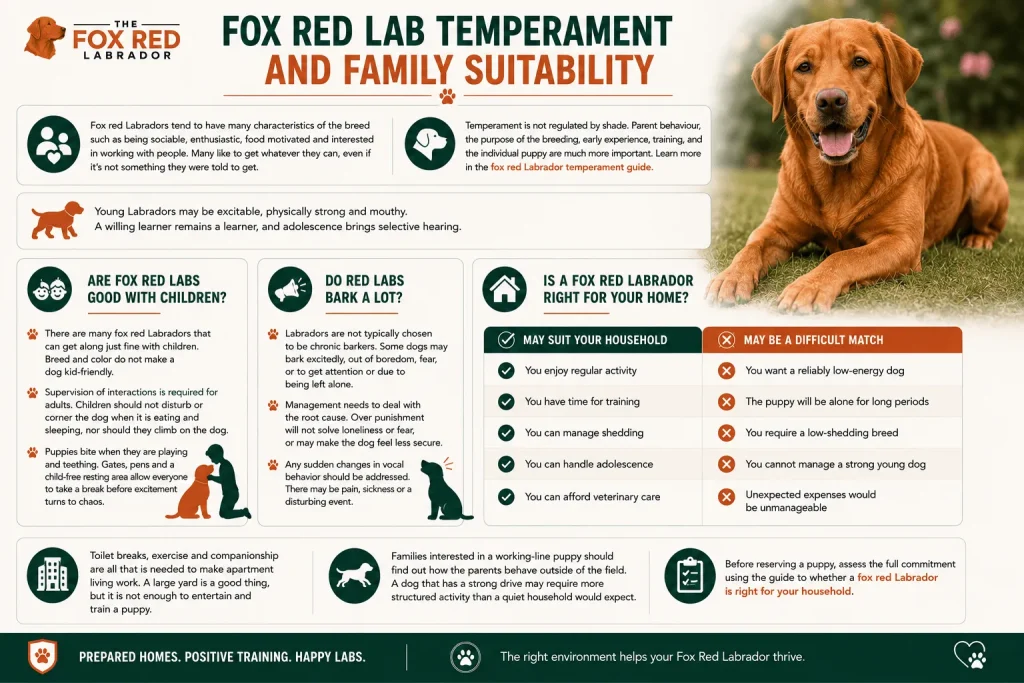
Fox red Labradors tend to have many characteristics of the breed such as being sociable, enthusiastic, food motivated and interested in working with people. Many like to get whatever they can, even if it’s not something they were told to get.
Temperament is not regulated by shade. Parent behaviour, the purpose of the breeding, early experience, training and the individual puppy are much more important. Parent behaviour, breeding line, early experience, and training have more influence, as explained in the fox red Labrador temperament guide.
Young Labradors may be excitable, physically strong and mouthy. A willing learner remains a learner, and adolescence brings selective hearing.
Are Fox Red Labs Good With Children?
There are many fox red Labradors that can get along just fine with children. Breed and color do not make a dog kid-friendly.
Supervision of interactions is required for adults. Children should not disturb or corner the dog when it is eating and sleeping, nor should they climb on the dog.
Puppies bite when they are playing and teething. Gates, pens and a child-free resting area allow everyone to take a break before excitement turns to chaos.
Do Red Labs Bark A Lot?
Labradors are not typically chosen to be chronic barkers. Some dogs may bark excitedly, out of boredom, fear, or to get attention or due to being left alone.
Management needs to deal with the root cause. Over punishment will not solve loneliness or fear, or may make the dog feel less secure.
Any sudden changes in vocal behavior should be addressed. There may be pain, sickness or a disturbing event.
Is A Fox Red Labrador Right For Your Home?
The right home provides sufficient time, supervision, physical activity and training. Budget and physical handling capacity also play a role.
| May suit your household | May be a difficult match |
|---|---|
| You enjoy regular activity | You want a reliably low-energy dog |
| You have time for training | The puppy will be alone for long periods |
| You can manage shedding | You require a low-shedding breed |
| You can handle adolescence | You cannot manage a strong young dog |
| You can afford veterinary care | Unexpected expenses would be unmanageable |
Toilet breaks, exercise and companionship are all that is needed to make apartment living work. A large yard is a good thing, but it is not enough to entertain and train a puppy.
Families interested in a working-line puppy should find out how the parents behave outside of the field. A dog that has a strong drive may require more structured activity than a quiet household would expect. Before reserving a puppy, assess the full commitment using the guide to whether a fox red Labrador is right for your household.
Fox Red Labrador Puppy Development And Socialization
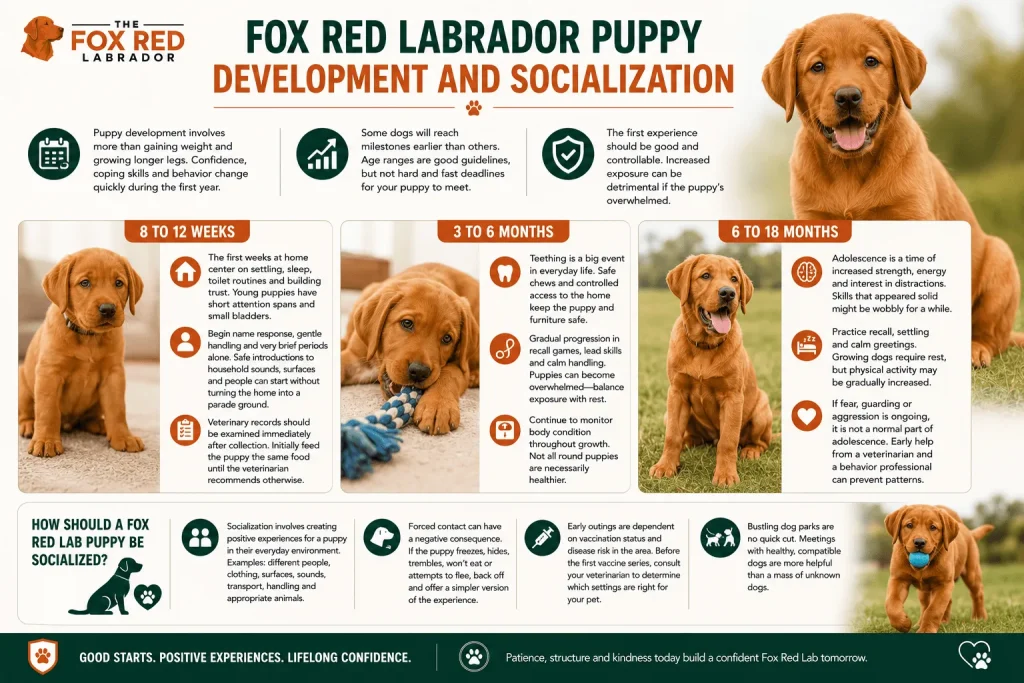
Puppy development involves more than gaining weight and growing longer legs. Confidence, coping skills and behavior change quickly during the first year.
Some dogs will reach milestones earlier than others. Age ranges are good guidelines, but not hard and fast deadlines for your puppy to meet.
The first experience should be good and controllable. Increased exposure can be detrimental if the puppy’s overwhelmed.
Eight To Twelve Weeks
The first weeks at home center on settling, sleep, toilet routines and building trust. Young puppies have short attention spans and have small bladders.
Begin name response, gentle handling and very brief periods alone. Safe introductions to household sounds, surfaces and people can start without turning the home into a parade ground.
Veterinary records should be examined immediately after collection. Initially feed the puppy the same food until the veterinarian recommends otherwise.
Three To Six Months
Teething is a big event in everyday life. Safe chews and controlled access to the home keep the puppy and furniture safe.
Gradual progression in recall games, lead skills and calm handling. Puppies should not be left to be exposed to confidence-building experiences for too long, as this will cause them to become exhausted and in need of rest.
Continue to monitor body condition throughout growth. Not all round puppies are necessarily healthier.
Six To Eighteen Months
Adolescence is a time of increased strength, energy and interest in distractions. Skills that appeared to be solid might be wobbly for a while.
Practice recall, settling and calming greetings. Growing dogs require rest, but physical activity may be gradually increased.
If fear, guarding or aggression is ongoing, it is not a normal part of adolescence. With early intervention from a veterinarian and a qualified behavior professional, a challenging pattern can be avoided.
How Should A Fox Red Lab Puppy Be Socialized?
Socialization involves creating positive experiences for a puppy in their everyday environment. Examples of useful experiences are: different people, clothing, surfaces, sounds, transport, handling and appropriate animals.
Forced contact can have a negative consequence. If the puppy freezes, hides, trembles, won’t eat or attempts to flee, back off and offer a simpler version of the experience.
Early outings are dependent on vaccination status and disease risk in the area. Before the first vaccine series, consult your veterinarian to determine which settings are right for your pet.
Bustling dog parks are no quick cut. Meetings with healthy, compatible dogs are more helpful than a mass of unknown dogs.
Fox Red Lab Puppy Care
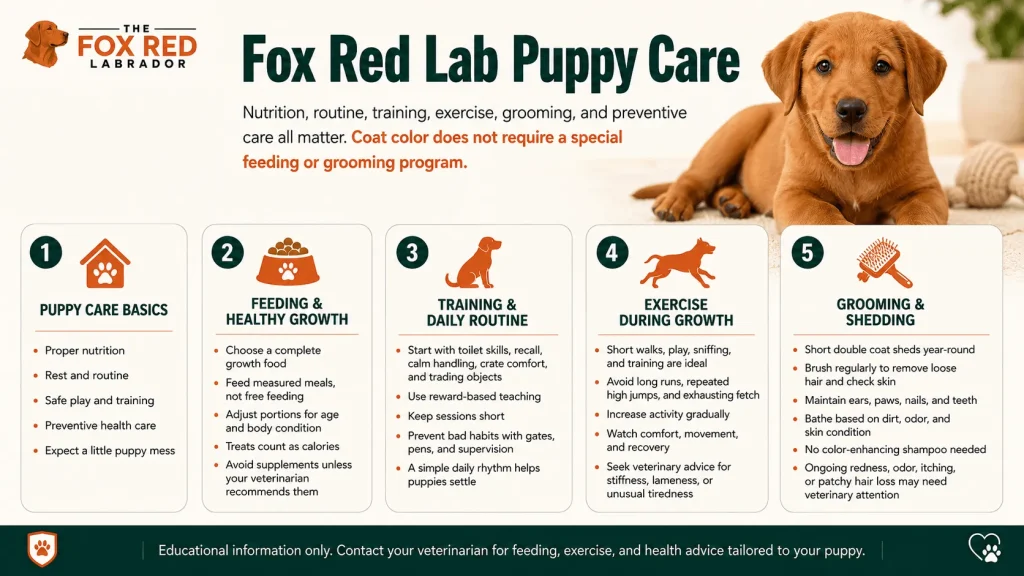
Just like other Labrador puppies, Fox Red puppies need the basic elements of a puppy’s life: proper nutrition, rest, good training, safe play, and preventative health care. The coat does not call for a special feeding or grooming program.
It is helpful to be consistent but puppy life can be messy. The occasional puddle and the stolen slipper can be overcome by a sensible routine.
Red Lab Puppy Feeding Guide And Healthy Growth
Select a complete and balanced food designed for growth and appropriate for the puppy’s adult size. Fashionable ingredient claims do not take precedence over product suitability or the condition of the puppy.
Young puppies will often have multiple measured feedings per day. As they grow older, food, health and veterinary recommendations are taken into account and their frequency is gradually reduced.
Avoid free feeding. The WSAVA nutrition resources help to facilitate regular nutritional assessment, including body condition.
Training is a form of treatment and counts as food intake. Small treats can be disguised as a part of the meal, which can help avoid the “little extra” becoming the “full meal.
Never give calcium, vitamins or joint products unless their veterinarian says it is necessary. It’s not always the more nutrition, the better.
Red Lab Puppy Training And Daily Routine
Begin with skills that are useful in day-to-day life: toilet skills, name response, recall, calm handling, crate comfort and object trading.
Reward-based teaching helps to reinforce a helpful behavior. It is best to have short sessions rather than a long lesson.
Management is as important as training. Rehearsal of habits like bin raiding or chewing electrical cables is prevented through the use of gates, pens and closed doors.
A puppy has a structure of the day: activity, meals, toilet and sleep, which helps him to settle. It doesn’t have to operate on a military schedule.
Red Lab Puppy Exercise During Growth
The level of exercise required depends on the age, health, build and breeding line. There are various types of activities such as short walks, play, sniffing and training.
Long-distance running, repeated high jumps and exhausting fetch are not good exercises for a growing puppy. Slowly ramp up time and intensity.
The “five minutes per month of age” rule isn’t a standard medical guideline. Look at the puppy’s movement, recovery and comfort, not just one calculation.
If your horse is lame, stiff or reluctant to rise or is always tired, seek veterinary advice. Don’t mistake a growing dog for being lazy.
Fox Red Lab Grooming And Rdd Lab Shedding
Labradors have a short, double coat, which sheds all year round. Loose hair from seasonal coat changes can generate sufficient hair to make the vacuum cleaner feel as if it has a personal stake in the game.
Brushing regularly will help to eliminate dead hair and allow you to inspect the skin. Ears and paws, nails and teeth require regular maintenance as well.
Bathing should be done according to the dirt, odor and skin condition. After swimming, use dog shampoo, rinse the coat and ears with it and dry the dog.
There is no need for color enhancing shampoo. If hair loss is patchy, redness, odor or constant itching, it may be a medical issue instead of normal shedding.
Your Fox Red Labrador Puppy’s First Week At Home
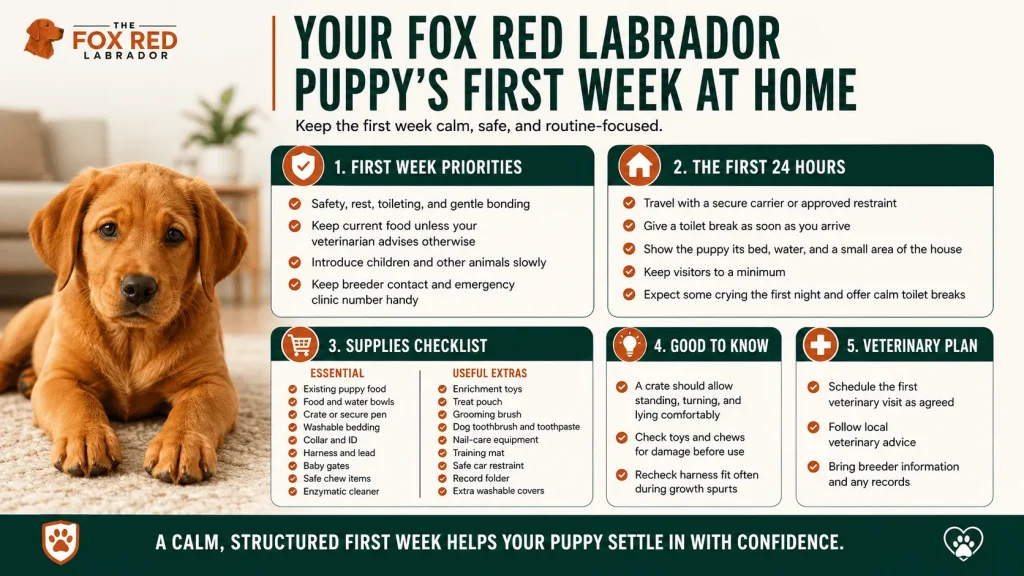
The first week should be easy and routine. It is better to ensure the puppy’s safety, rest, toileting and gentle connection rather than get the puppy to meet every friend and neighbor.
Keep current food until directed otherwise. Introduce children and animals slowly.
Make an appointment with a veterinarian as agreed and seek local advice. Be sure to have the breeder’s contact information and an emergency clinic number handy.
The First 24 Hours
Carry the puppy in a secure puppy carrier or an approved vehicle restraining device. Give a toilet break as soon as you get there.
Introduce the puppy to its sleeping place, water and a small part of the house. Excessive freedom increases the risk of accidents and unsafe chewing.
Keep visitors to a minimum. This is enough change for one day for the puppy, who has already left her mother, litter and familiar surroundings.
There may be some crying and disturbed sleep the first night. Be cool, offer the necessary bathroom breaks and do not make all the sounds playtime.
Fox Red Labrador Puppy Supplies Checklist
Most puppies do not require as many fancy products as advertised. It is better to have a few safe, appropriately sized basics than a pile of novelty toys
| Essential before arrival | Useful during the first weeks |
|---|---|
| Existing puppy food | Enrichment toys |
| Food and water bowls | Treat pouch |
| Crate or secure pen | Grooming brush |
| Washable bedding | Canine toothbrush and toothpaste |
| Collar and identification | Nail-care equipment |
| Harness and lead | Training mat |
| Safe car restraint | Additional washable covers |
| Baby gates | Record folder |
| Safe chew items | Enzymatic cleaner |
A crate should be large enough for the puppy to stand, turn and lie comfortably. It may be necessary to use a divider in large crates for the growing adult to accommodate their size.
Look for damaged toys and chews. If it can be ripped apart or eaten, don’t leave it with an unsupervised puppy. Securely fit the harness and reevaluate during growth spurts. The perfect fit of yesterday can be the squeeze of tomorrow.
Red Fox Labrador Retriever Puppies Health And Parental Screening
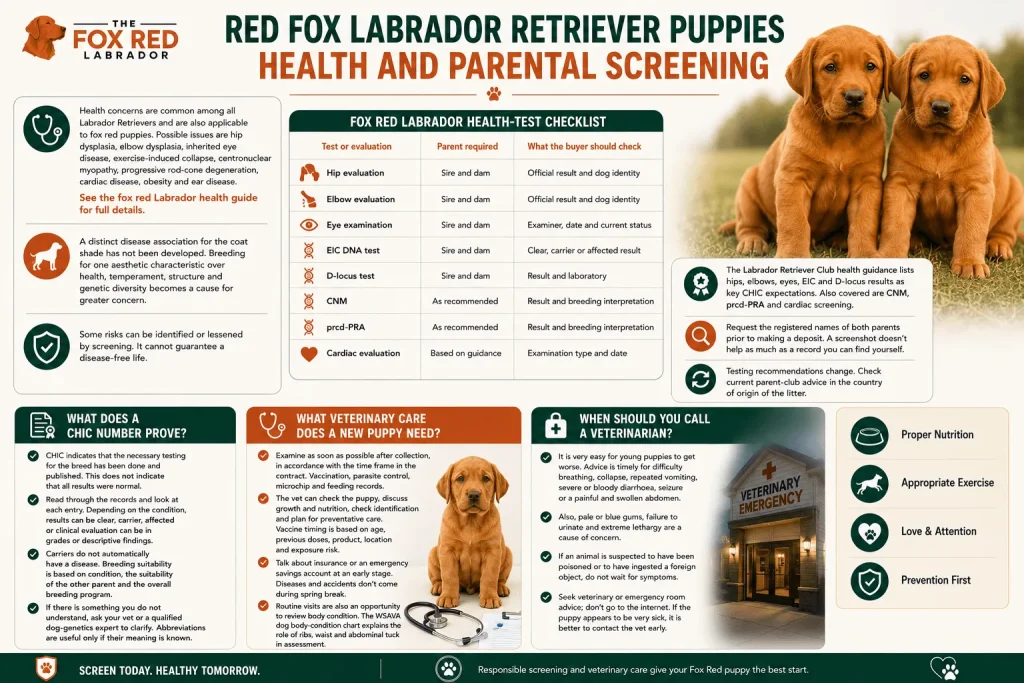
Health concerns are common among all Labrador Retrievers and are also applicable to fox red puppies. Possible issues are hip dysplasia, elbow dysplasia, inherited eye disease, exercise-induced collapse, centronuclear myopathy, progressive rod-cone degeneration, cardiac disease, obesity and ear disease. Screening, preventive care, warning signs, and common conditions are examined in the broader fox red Labrador health guide.
A distinct disease association for the coat shade has not been developed. Breeding for one aesthetic characteristic over health, temperament, structure and genetic diversity becomes a cause for greater concern.
Some risks can be identified or lessened by screening. It cannot guarantee a disease-free life.
Fox Red Labrador Health-Test Checklist
The following is guidance from the Labrador Retriever Club that is useful for US buyers. The requirements and recommendations are different in other countries.
| Test or evaluation | Parent required | What the buyer should check |
|---|---|---|
| Hip evaluation | Sire and dam | Official result and dog identity |
| Elbow evaluation | Sire and dam | Official result and dog identity |
| Eye examination | Sire and dam | Examiner, date and current status |
| EIC DNA test | Sire and dam | Clear, carrier or affected result |
| D-locus test | Sire and dam | Result and laboratory |
| CNM | As recommended | Result and breeding interpretation |
| prcd-PRA | As recommended | Result and breeding interpretation |
| Cardiac evaluation | Based on guidance | Examination type and date |
The Labrador Retriever Club health guidance lists hips, elbows, eyes, EIC and D-locus results as key CHIC expectations. Also covered are CNM, prcd-PRA and cardiac screening.
Request the registered names of both parents prior to making a deposit. A screenshot doesn’t help as much as a record you can find yourself.
Testing recommendations change. Check current parent-club advice in the country of origin of the litter.
What Does A CHIC Number Prove?
CHIC indicates that the necessary testing for the breed has been done and published. This does not indicate that all results were normal.
Read through the records and look at each entry. Depending on the condition, results can be clear, carrier, affected or clinical evaluation can be in grades or descriptive findings.
Carriers do not automatically have a disease. Breeding suitability is based on condition, the suitability of the other parent and the overall breeding program.
If there is something you do not understand, ask your vet or a qualified dog-genetics expert to clarify. Abbreviations are useful only if their meaning is known.
What Veterinary Care Does A New Puppy Need?
Examine as soon as possible after collection, in accordance with the time frame in the contract. Vaccination, parasite control, microchip and feeding records.
The vet can check the puppy, discuss growth and nutrition, check identification and plan for preventative care. Vaccine timing is based on age, previous doses, product, location and exposure risk.
Talk about insurance or an emergency savings account at an early stage. Diseases and accidents don’t come during spring break.
Routine visits are also an opportunity to review body condition. The WSAVA dog body-condition chart provides an explanation of the role of ribs, waist and abdominal tuck in assessment.
When Should You Call A Veterinarian?
It is very easy for young puppies to get worse. Advice is timely for difficulty breathing, collapse, repeated vomiting, severe or bloody diarrhoea, seizure or a painful and swollen abdomen.
Also, pale or blue gums, failure to urinate and extreme lethargy are a cause of concern. If an animal is suspected to have been poisoned or to have ingested a foreign object, do not wait for symptoms.
Seek veterinary or emergency room advice; don’t go to the internet. If the puppy appears to be very sick, it is better to contact the vet early.
How Much Does A Red Fox Labrador Puppy Cost?
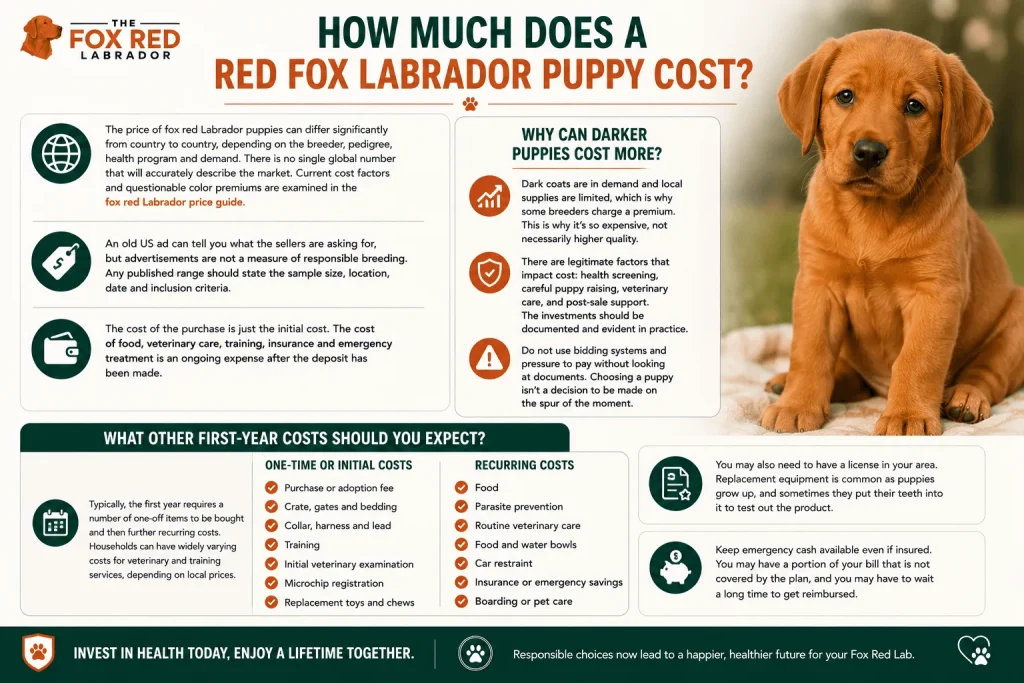
The price of fox red Labrador puppies can differ significantly from country to country, depending on the breeder, pedigree, health program and demand. There is no single global number that will accurately describe the market. Current cost factors and questionable color premiums are examined in the fox red Labrador price guide.
An old US ad can tell you what the sellers are asking for, but advertisements are not a measure of responsible breeding. Any published range should state the sample size, location, date and inclusion criteria.
The cost of the purchase is just the initial cost. The cost of food, veterinary care, training, insurance and emergency treatment is an ongoing expense after the deposit has been made.
Why Can Darker Puppies Cost More?
Dark coats are in demand and local supplies are limited, which is why some breeders charge a premium. This is why it’s so expensive, not necessarily higher quality.
There are legitimate factors that impact cost: health screening, careful puppy raising, veterinary care, and post-sale support. The investments should be documented and evident in practice.
Do not use bidding systems and pressure to pay without looking at documents. Choosing a puppy isn’t a decision to be made on the spur of the moment.
What Other First-Year Costs Should You Expect?
Typically, the first year requires a number of one-off items to be bought and then further recurring costs. Households can have widely varying costs for veterinary and training services, depending on local prices.
| One-time or initial costs | Recurring costs |
|---|---|
| Purchase or adoption fee | Food |
| Crate, gates and bedding | Parasite prevention |
| Collar, harness and lead | Routine veterinary care |
| Food and water bowls | Training |
| Car restraint | Insurance or emergency savings |
| Initial veterinary examination | Boarding or pet care |
| Microchip registration | Replacement toys and chews |
You may also need to have a license in your area. Replacement equipment is common as puppies grow up, and sometimes they put their teeth into it to test out the product.
Keep emergency cash available even if insured. You may have a portion of your bill that is not covered by the plan, and you may have to wait a long time to get reimbursed.
How To Find A Responsible Fox Red Labrador Breeder
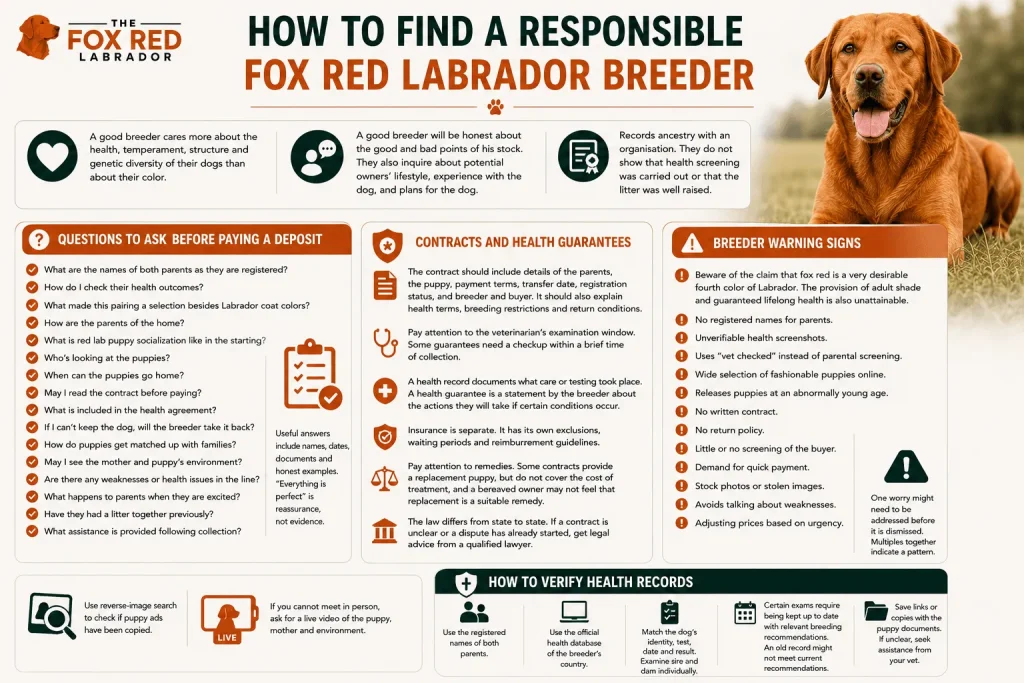
A good breeder cares more about the health, temperament, structure and genetic diversity of their dogs than about their color. There is nothing wrong with producing fox red puppies; it’s when colour becomes the primary breeding goal. Sex can affect average adult size and some reproductive considerations, but individual suitability matters more; see the male vs female red Labrador comparison.
A good breeder will be honest about the good and bad points of his stock. They also inquire about potential owners’ lifestyle, experience with the dog, and plans for the dog.
Records ancestry with an organisation. They do not show that health screening was carried out or that the litter was well raised.
Questions To Ask Before Paying A Deposit
Ask for specific, verifiable information:
- What are the names of both parents as they are registered?
- How do I check their health outcomes?
- What made this pairing a selection besides Labrador coat colors?
- How are the parents of the home?
- What is red lab puppy socialization like in the starting?
- Who’s looking at the puppies?
- When can the puppies go home?
- May I read the contract before paying?
- What is included in the health agreement?
- If I can’t keep the dog, will the breeder take it back?
- How do puppies get matched up with families?
- May I see the mother and puppy’s environment?
- Are there any weaknesses or health issues in the line?
- What happens to parents when they are excited?
- Have they had a litter together previously?
- What assistance is provided following collection?
Useful answers include names, dates, documents and honest examples. “Everything is perfect” is reassurance, not evidence.
The mother should normally be available unless a clear, credible explanation exists. The sire may live elsewhere, so request records and information from his owner.
Contracts And Health Guarantees
The contract should contain details of the parents, the puppy, the payment terms, the transfer date, the status of the puppy’s registration, and the breeder and buyer. It should also include explanations of health terms, breeding restrictions and return conditions.
Pay attention to the veterinarian’s examination window. Some guarantees need a checkup within a brief time of collection.
A health record documents what care or testing took place. A health guarantee is a statement by the breeder regarding the actions they will take when certain conditions occur.
Now insurance is back to being separate. It has its own exclusions, waiting periods and reimbursement guidelines.
Pay attention to remedies. Some contracts provide a replacement puppy, but do not cover the cost of treatment, and a bereaved owner may not feel that replacement is a suitable remedy.
The law differs from state to state. If a contract is unclear or a dispute has already started, get legal advice from a qualified lawyer.
Breeder Warning Signs
Beware of the claim that fox red is a very desirable fourth color of Labrador. The provision of adult shade and guaranteed lifelong health is also unattainable.
Other warning signs include:
- There are no registered names for parents.
- Health screenshots that are not verifiable.
- Instead of parental screening, “vet checked” is used.
- A wide selection of fashionable items online.
- Pupfishers release puppies at an abnormally young age.
- No written contract
- No return policy
- This is the case where little or no screening is done on the buyer.
- The demand for speedy payment
- Photographs on the stock or stolen
- Avoidance of talking about weaknesses
- Adjusting prices according to the level of urgency.
One worry might need to be addressed before it is dismissed. Multiples together indicate a pattern.
You can use reverse-image search to find out if puppy ads have been copied. When it is not possible to meet the puppy in person, a live video of the puppy, mother and environment can be helpful for verification.
How To Verify Health Records
Use the registered names of both parents. Use the official health database of the breeder’s country.
Match the dog’s identity, test, date and result. Examine sire and dam individually.
Certain exams require being kept up to date with relevant breeding recommendations. An old record might indicate that a test was performed, but it did not meet current recommendations.
Save links or copies with the puppy documents. If the result or combination is hard to understand, seek assistance from your veterinarian.
How To Choose The Right Fox Red Labrador Puppy
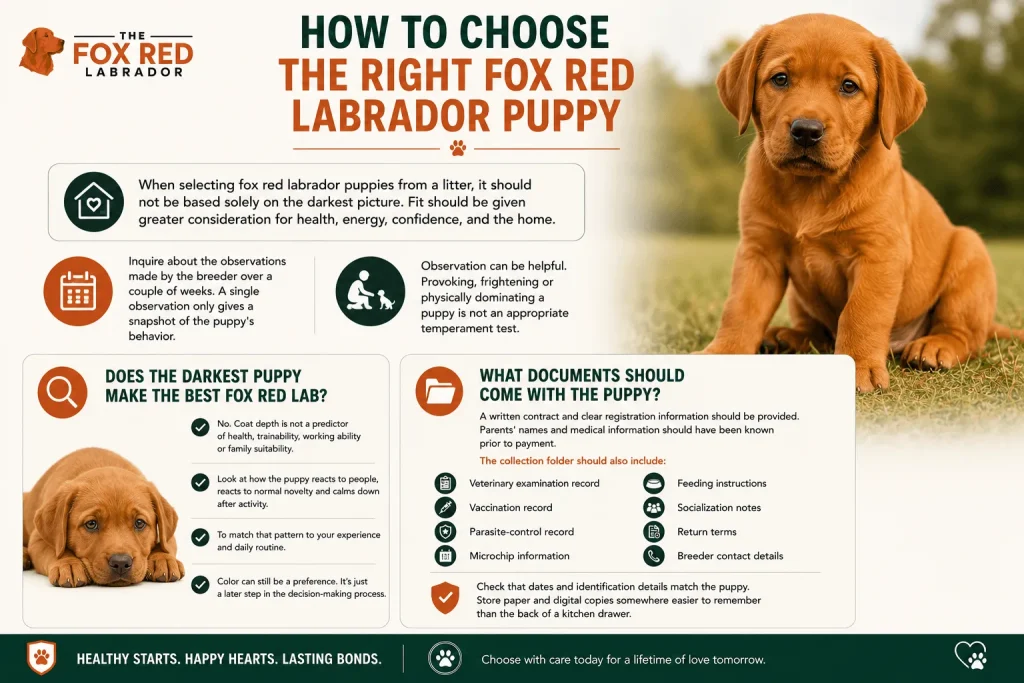
When selecting fox red labrador puppies from a litter, it should not be based solely on the darkest picture. Fit should be given greater consideration for health, energy, confidence, and the home.
Inquire about the observations made by the breeder over a couple of weeks. A single observation only gives a snapshot of the puppy’s behavior.
Observation can be helpful. Provoking, frightening or physically dominating a puppy is not an appropriate temperament test.
Does The Darkest Puppy Make the Best Fox Red Lab?
No. Coat depth is not a predictor of health, trainability, working ability or family suitability.
Look at how the puppy reacts to people, reacts to normal novelty and calms down after activity. To match that pattern to your experience and daily routine.
Color can still be a preference. It’s just a later step in the decision-making process.
What Documents Should Come With the Puppy?
A written contract and clear registration information should be provided. Parents’ names and medical information should have been known prior to payment.
The collection folder should also include:
- Veterinary examination record
- Vaccination record
- Parasite-control record
- Microchip information
- Feeding instructions
- Socialization notes
- Return terms
- Breeder contact details
Check that dates and identification details match the puppy. Store paper and digital copies somewhere easier to remember than the back of a kitchen drawer.
Puppy Vs Adult Labrador: Which Is Right For You?
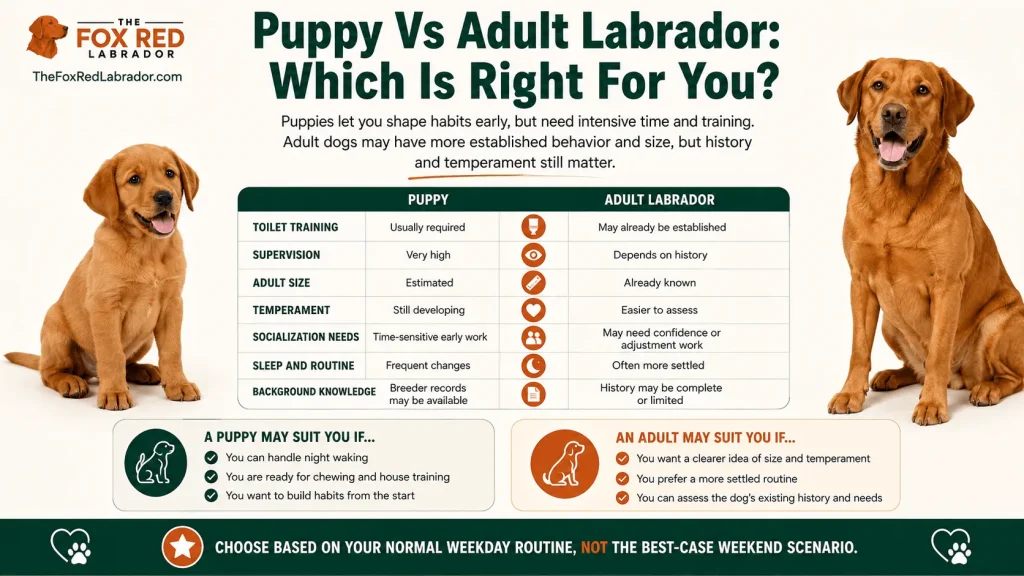
A puppy is a great opportunity to set up good habits in the beginning, but will need lots of attention and training in toilet and months of training. Adult dogs can come in different behaviors and sizes.
Neither option is necessarily simpler. History, health and individual temperament remain important.
| Consideration | Puppy | Adult Labrador |
|---|---|---|
| Toilet training | Usually required | May already be established |
| Supervision | Very high | Depends on history |
| Adult size | Estimated | Already known |
| Temperament | Still developing | Easier to assess |
| Socialization needs | Time-sensitive early work | May need confidence or adjustment work |
| Sleep and routine | Frequent changes | Often more settled |
| Background knowledge | Breeder records may be available | History may be complete or limited |
A puppy might be right for a person who is willing to sacrifice a good night’s sleep, chewing and frequent bathroom breaks. When size at maturity and temperament are more significant, an adult may be more suitable.
Households should select based on normal weekdays and not the best-case scenario of the weekend.
Rescue, Adoption, And Rehoming A Fox Red Labrador
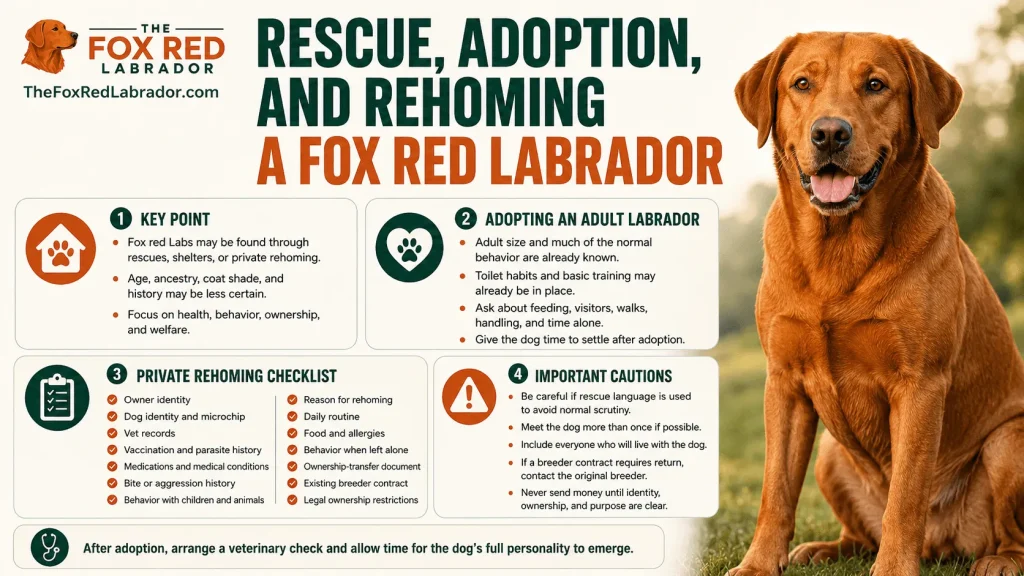
There are other ways to get a fox red Labrador than through a responsible breeder. There may be a suitable dog through recognized rescues, established shelters and private rehoming.
Adoption may not be as reliable when determining exact age, ancestry and coat shade. Medical and behavioural history may also be incomplete.
It doesn’t mean that a dog isn’t worthy or can’t be a great companion because of that uncertainty. It just shifts the focus of the questions that must be answered.
If the commercial seller is employing rescue language to evade normal scrutiny, be careful. Ownership, source and welfare still to be verified.
Adopting An Adult Labrador
The size of the adult Labrador is known and much of its normal behavior is already observed. Toilet routines and basic training may be in place.
Adjustment is influenced by past experience. Some dogs require assistance with separation, new places, new animals and handling.
Inquire about the dog’s behavior at feeding times, resting times, visitors, walks and alone time. Observations in temporary homes may be particularly useful as they capture the normal family life.
Have a vet check it out after adoption. Allow the dog some time to be calm before the dog’s full personality emerges.
It may take a while for an adult to get comfortable. Patience is not a panacea, but it provides opportunities for learning.
Private Rehoming Checklist
Private rehoming can work well when information is honest and ownership is clear. It offers fewer organizational safeguards than an established shelter, so verification matters.
Check the following:
- Current owner’s identity
- Dog’s identity and microchip
- Veterinary records
- Vaccination and parasite history
- Medication and medical conditions
- Bite or aggression history
- Behavior with children and animals
- Reason for rehoming
- Daily routine
- Food and allergies
- Behavior when left alone
- Ownership-transfer document
- Existing breeder contract
- Legal ownership restrictions
If possible, meet the dog more than once. Enlist all those who will live in the home.
If the contract calls for return, contact the original breeder. Some breeders may not allow a private transfer and will take the dog back.
Never give money without knowing who it is and what it is for. The prospect of becoming an adoptive parent can become a messy reality when there is a dispute over who owns the child.
Conclusion: Choose Health And Temperament Before Color
Fox Red Labrador puppies are yellow Labradors that have a striking, darker coat. Color can begin your interest but should not end it.
Start with domestic fit and source. Then evaluate the temperament of the parents, verified health testing, early development and the individual dog.
There are different checks for responsible breeder purchase, rescue and private rehoming. Clear records, honest answers and an early veterinary examination are beneficial to every route.
Select the dog you can take care of on regular days, not just the puppy that’s irresistible in one picture. That choice will be significant for a long time after the coat color is chosen.
FAQ’s
No. A fox red Labrador is a Labrador Retriever with a coat color that is at the darker end of the yellow spectrum of the known range of colors. The dog’s official registration will typically show it as a yellow dog. Shade “Fox red” is not a breed name; it is a shade description.
These may be purebred Labrador Retrievers. Don’t assume that appearance is the only proof of ancestry; check registration details, parentage and pedigree. Purebred status also does not indicate whether or not the parents were screened for health. This must be determined individually.
Some seem lighter or darker as the puppy coat changes to the adult coat. Appearance can also be influenced by the sun, seasonal hair loss, age and photography. No breeder can guarantee 100% purity of one particular shade.
The price ranges depending on the country, the breeder, health program, pedigree and local demand. Any useful range should include the region, currency, sample and collection date. Evaluate the documentation and attention to detail when it comes to the cost. A high-priced coat is not a good indicator of quality.
Young puppies are often fed several small meals a day. Their frequency gradually decreases as they get older, depending on their age, diet, health and veterinarian’s advice. Don’t leave out unlimited food. Labradors may be very excited about eating after their calorie requirements are satisfied.
Needs are different at different ages, health, structure, and breeding line. A balanced starting point is provided through short walks, play, sniffing and training. Do not overrun, overjump and overfetch during growth. Increase activity gradually.
Bathe as needed for dirt, odor and skin condition, not on a schedule. Apply dog shampoo and rinse well. If the smell doesn’t go away, the itching, redness or hair loss does, it may be necessary to have the animal checked by a veterinarian rather than another bath.
There is no evidence at this time to support a distinct disease profile related to the fox-red colour. The health issues are similar to those of all Labradors. It is more important to breed too narrowly for color than to breed too broadly for color. Check the results of both parents and the reason for the pairing.
They live for about 10-13 years, which is the same as other Labradors. No one range can predict a dog’s life. Longevity is affected by genetics, body condition, prevention, disease, injury and environment.
Children can be happily tolerated by many. A safe breed and color are not guaranteed. All interactions should be handled by adults and children should be educated on respecting the dog’s food, sleep and personal space.
Choose a puppy if you can manage intensive supervision, toilet training and adolescent development. An adult may provide clearer information about size, activity and temperament. The better choice depends on the individual dog and your ordinary daily routine.
No. The Vizsla is a separate pointing breed with different ancestry and breed standards. Their reddish coats can look similar from a distance. Structure, head shape and historical purpose distinguish them.
References and Medical Review
- American Kennel Club: Official Standard for the Labrador Retriever
- Labrador Retriever Club: Labrador Breed Standard
- Labrador Retriever Club: Health Issues and Recommended Clearances
- Labrador Retriever Club: Breeders Code of Conduct
- Labrador Retriever Club: Breeder Directory Requirements
- WSAVA Global Nutrition Guidelines
- WSAVA Dog Body Condition Score