Fox Red Lab Care: Complete Guide to Exercise, Feeding, Grooming & Health

It’s a very enthusiastic fox red Labrador in the home. There could also be muddy paws, flying fur, and a definite sense that every meal is several hours late. However, under the rich red coat, this dog remains a Labrador Retriever.
Good red Labrador care includes controlled feeding, adequate exercise, mental stimulation, training with patience, grooming and preventive veterinary treatment. The correct ratio will vary depending on the age, fitness, body condition, health and family history of the dog. Coat shades do not form a separate care system.
Puppies require lots of supervision and mild activity. Older dogs may require shorter walks and more comfort, and healthy adults may be able to do more strenuous work. A schedule that adapts to the dog is more beneficial than a fixed schedule.
How Do You Care For A Red Labrador?
The responsibilities of a red Labrador include meeting its physical, mental, social and medical needs on a daily basis. Offer complete meals in measured amounts, clean water, appropriate exercise, brief training periods, a restful environment, company, and routine grooming.
Monitor for changes in appetite, activity, bowel movements, skin, ears, and energy. Schedule preventive veterinary treatment and seek professional guidance when observing signs of pain, sickness, weight loss, or decreased exercise tolerance. The broader fox red Labrador breed guide explains where these dogs fit within the Labrador Retriever breed.
Red Lab Care At A Glance
A regular schedule helps a red Lab know when to eat, move, learn, play and settle. This is particularly helpful when making decisions during the puppy and adolescent years, when good decisions don’t always come when long legs do.
A practical starting point is provided in the table below. All items should still be modified for the individual dog.
| Care area | Basic requirement | Main owner’s concern |
|---|---|---|
| Food | Measured life-stage meals | Excess weight |
| Exercise | Age-appropriate daily activity | Too little, too much, or poor recovery |
| Mental work | Training and problem-solving | Boredom and over-arousal |
| Grooming | Coat and hygiene routine | Shedding, ears, nails and teeth |
| Health | Observation and preventive care | Delayed response to change |
| Rest | Quiet, predictable recovery | Inability to settle |
| Companionship | Regular social contact | Isolation and unmet needs |
Do Fox Red Labradors Need Special Care?

There is no special diet, shampoo, training or exercise plan for fox red Labradors that is related to their color. Fox red is a dark tone of the yellow Labrador.
Care must be taken in responding to the dog in front of them. A young, field-bred Lab that’s getting ready for a hike won’t require the same regimen as an older dog recovering from joint pain.
What Coat Color Does And Does Not Change
Coat colors do not affect the basic care of the dog. Any statements about feeding or special supplements for red Labs to improve their color should be taken with a grain of salt.
Product selection may still be influenced by skin condition. The decision should be made based on the dryness, irritation, allergy, infection or veterinary advice and not because of a desire to darken the coat.
Factors That Actually Change Care
The frequency of feeding, exercise, toilet use, sleep and supervision is directly affected by age. The daily plan is also influenced by health and fitness, body condition, mobility, climate and housing.
Family background may also be a factor. Fox red Labs can be from working lines and may enjoy challenging mental and physical challenges. Others are more stable companion dogs. The English/American Labrador comparison is offered here to highlight the common lineage differences, but not as a guarantee.
When Individual Veterinary Advice Takes Priority
When a dog is in pain, or has unusual fatigue, digestive problems, obesity, a diagnosed condition or a recent surgery, general advice is no longer sufficient. Individual plans are also needed for pregnancy, convalescence, and for those on a prescribed diet.
Sudden changes should be taken into account. If a dog that was once a good walker is now lagging behind, that doesn’t necessarily mean he’s being lazy. These can include pain, illness, heat, medication and decreased fitness.
Red Labrador Daily Routine Care
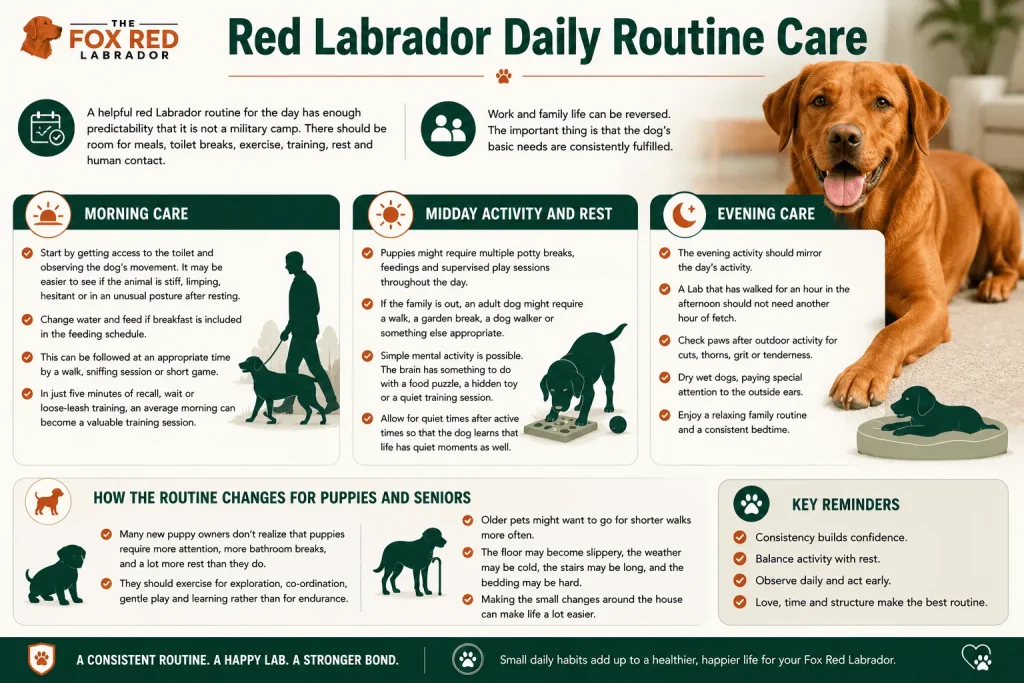
A helpful red Labrador routine for the day has enough predictability that it is not a military camp. There should be room for meals, toilet breaks, exercise, training, rest and human contact.
Work and family life can be reversed. The important thing is that the dog’s basic needs are consistently fulfilled.
Morning Care
Start by getting access to the toilet and observing the dog’s movement. It may be easier to see if the animal is stiff, limping, hesitant or in an unusual posture after resting.
Change water and feed if breakfast is included in the feeding schedule. This can be followed at an appropriate time by a walk, sniffing session or short game. In just five minutes of recall, wait or loose-leash training, an average morning can become a valuable training session.
Midday Activity And Rest
Puppies might require multiple potty breaks, feedings and supervised play sessions throughout the day. If the family is out, an adult dog might require a walk, a garden break, a dog walker or something else appropriate.
Simple mental activity is possible. The brain has something to do with a food puzzle, a hidden toy or a quiet training session. Allow for quiet times after active times so that the dog learns that life has quiet moments as well
Evening Care
The evening activity should mirror the day’s activity. A Lab that has walked for an hour in the afternoon should not need another hour of fetch.
Check paws after outdoor activity for cuts, thorns, grit or tenderness. Dry wet dogs, paying special attention to the outside ears. Enjoy a relaxing family routine and a consistent bedtime.
How The Routine Changes For Puppies And Seniors
Many new puppy owners don’t realize that puppies require more attention, more bathroom breaks, and a lot more rest than they do. They should exercise for exploration, co-ordination, gentle play and learning rather than for endurance.
Older pets might want to go for shorter walks more often. The floor may become slippery, the weather may be cold, the stairs may be long, and the bedding may be hard. Making the small changes around the house can make life a lot easier.
Red Labrador Exercise Needs

The amount of purposeful activity required for a healthy red Labrador is not fixed and varies from dog to dog, but it is important to provide some daily activity. Dogs’ capacity to tolerate varies with age, fitness, health, weather, body condition, lineage, terrain and intensity of exercise.
Physical activity is just one component of the plan. Training, scent work, retrieving tasks, and calm recovery are all factors that help to create a more balanced routine. Excitation and poor settling don’t necessarily go away with an increasing walk.
Red Labrador Puppy Exercise Without Straining A Growing Body
A puppy needs to learn how to move to develop confidence, coordination and socialization in a red Labrador. It’s not about a half marathon for a little dog. A growing dog will get tired at a different rate than a conditioned dog and will keep playing long after good sense has departed.
Observe the puppy when it is active and afterwards when it is rested. If your dog continues to be stiff, lame, unwilling to move, or altered gait, it’s time to see your vet.
Suitable Puppy Activities
Safe freedom to explore allows a puppy to vary pace and to stop naturally. Short play sessions, gentle scent games, basic training and short retrieves can be beneficial but not repetitive.
Social experiences to be managed, not overwhelming. New surfaces, sounds, people, calm dogs and new environments can help to gain confidence when introduced at the puppy’s pace.
Activities That Need Caution
Running, hiking, jumping repeatedly, making sharp turns, chasing balls for hours, and playing on slippery floors can cause an unconditioned puppy to suffer undue stress. This is heightened by hot weather.
Some homes may have stairs, but multiple runs up and down stairs are not an exercise program. Apply gates, supervision and sensible management as necessary.
Let The Puppy’s Condition Guide Progress
Age-based criteria may provide a general frame of reference but cannot assess a puppy’s growth, coordination, health or recovery. Gradually increase the activity and observe how the puppy feels at the end of the day and the next morning.
If there is any soreness that persists, strange tiredness or movement problems, then it is a good idea to have them evaluated by a veterinary professional. When a growing joint is involved, guessing is not of much use.
Working-Line Red Labrador Exercise

There are some fox red Labradors with working or field bloodlines. These dogs are likely to be highly motivated to retrieve, have stamina, focus and a tendency to persist even when it would be prudent to stop.
Lineage is not determined by color. These are much better hints provided by pedigree, breeder information, body type, observed behaviour and the dog itself.
Why A Walk May Not Meet Every Need
Movement in the form of a steady walk is good; some working-line dogs get some tasks in addition. Covering distance is easier than searching, remembering, retrieving, following directions, and waiting for release.
Hunting is not required for useful work. A pet dog can have a job by following scent trails, retrieving dummies, performing obedience, and participating in carefully planned search games.
Balance Drive With Recovery
If a dog enjoys working, it will not stop easily. Make pauses during retrieval sessions and end when movement is still comfortable and controlled.
Some dogs that are active need to learn to settle on a mat, to be quiet and to sleep after activity. Lighter days or rest days may be required following strenuous outings.
Judge The Individual, Not The Coat
High drive, sensitivity, and limitless energy are not a given with a deep red coat. Some red Labs are active field dogs; others are easy going family pets.
Plan for the needs that have been observed, not the stereotypical needs found on the internet. If behavior, fitness or recovery shifts, change the routine; don’t try to force the dog to fit a label.
Mental Stimulation For A Red Labrador

Mental stimulation is a great outlet for a Lab’s nose, memory, food drive and retrieving instincts. It can enhance satisfaction without the body being subjected to the same physical stress as running or jumping.
The dog should not be kept busy all day long. Passive observation, chewing, sleep and doing nothing are healthy parts of the day as well.
Training As Daily Enrichment
Useful mental work is created from everyday skills. Short sessions can be used for Recall, Leash Walking, Waiting, Cooperative Handling, Dropping Objects and Settling.
Move the distraction or change the cue instead of repeating it over and over. It’s easy to forget what you know when you’re in a different place, particularly if a squirrel showed up to join the lesson.
Scent And Search Activities
Put a toy or a few of the dog’s portioned meals in a secure room. Natural searching behavior can be encouraged by scent trails, supervised scatter feeding, and by locating a family member.
Start with the easy ones. Interest is fostered by success and frustration or enthusiastic furniture inspection is fostered by a difficult puzzle.
Food And Puzzle Enrichment
Slow feeders and food puzzles can extend an activity to a meal. Select equipment appropriate to the dog’s size and chewing patterns and supervise until it is known to be safe for the dog.
Enrichment food is still considered food. Don’t give it to the dog as part of his diet, but rather as a treat that doesn’t count towards his calories.
Signs Mental Needs May Be Unmet
When a dog does not have adequate activity, it can become persistent in seeking attention, destructive, restless, repeatedly request attention, and fail to settle. They may also be caused by anxiety, pain, illness, lack of sleep, or training deficiencies.
Before adding more excitement, review the entire routine. In some cases, a trained trainer or vet may be required if the behavior is extreme, sudden, or if it is hard to understand.
Retrieving Games That Build Control
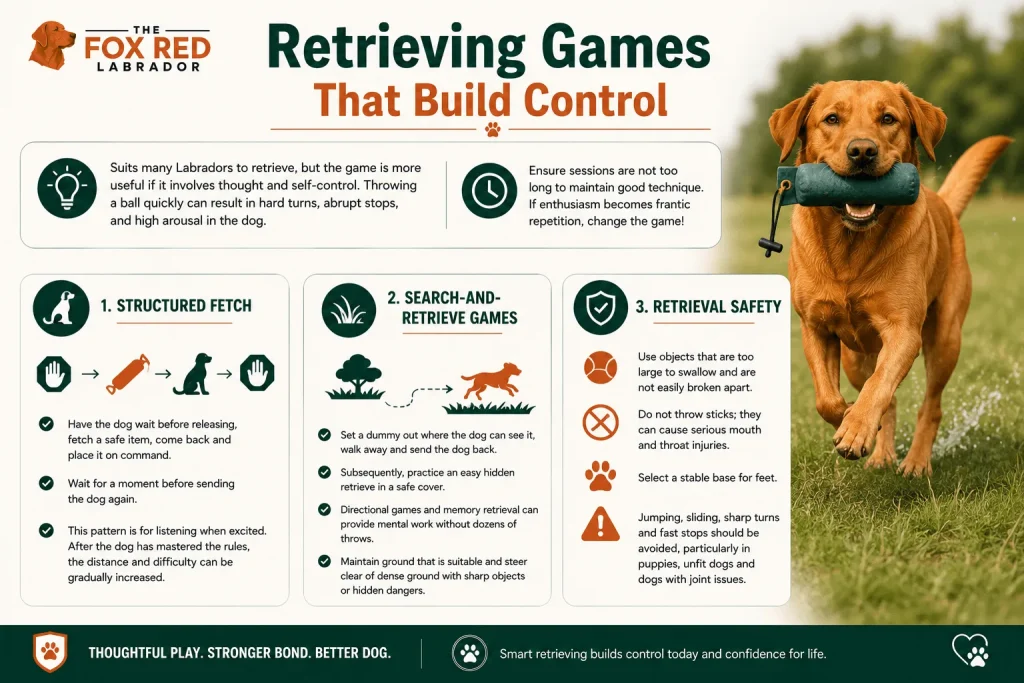
Suits many Labradors to retrieve, but the game is more useful if it involves thought and self-control. Throwing a ball quickly can result in hard turns, abrupt stops, and high arousal in the dog.
Ensure sessions are not too long to maintain good technique. If enthusiasm becomes frantic repetition, change the game!
Structured Fetch
Have the dog wait before releasing, fetch a safe item, come back and place it on command. Wait for a moment before sending the dog again.
This pattern is for listening when excited. After the dog has mastered the rules, the distance and difficulty can be gradually increased.
Search-And-Retrieve Games
Set a dummy out where the dog can see it, walk away and send the dog back. Subsequently, practice an easy hidden retrieve in a safe cover.
Directional games and memory retrieval can provide mental work without dozens of throws. Maintain ground that is suitable and steer clear of dense ground with sharp objects or hidden dangers.
Retrieval Safety
Use objects that are too large to swallow and are not easily broken apart. Do not throw sticks; they can cause serious mouth and throat injuries.
Select a stable base for feet. Jumping, sliding, sharp turns and fast stops should be avoided, particularly in puppies, unfit dogs and dogs with joint issues.
Swimming And Water Safety
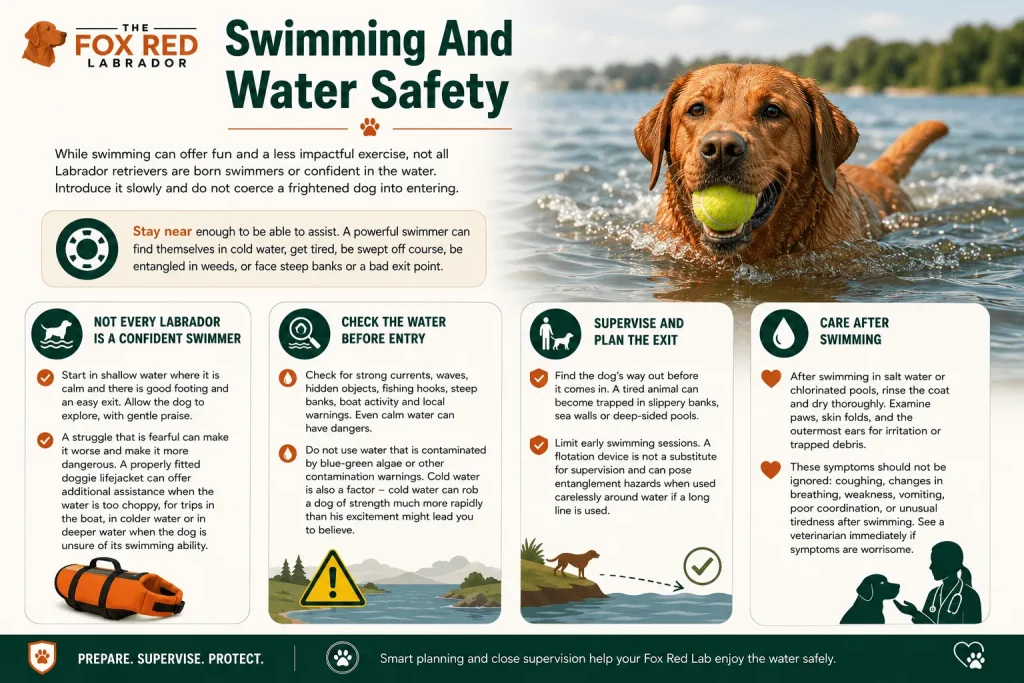
While swimming can offer fun and a less impactful exercise, not all Labrador retrievers are born swimmers or confident in the water. Introduce it slowly and do not coerce a frightened dog into entering.
Stay near enough to be able to assist. A powerful swimmer can find themselves in cold water, get tired, be swept off course, be entangled in weeds, or face steep banks or a bad exit point.
Not Every Labrador Is A Confident Swimmer
Start in shallow water where it is calm and there is good footing and an easy exit. Allow the dog to explore, with gentle praise.
A struggle that is fearful can make it worse and make it more dangerous. A properly fitted doggie lifejacket can offer additional assistance when the water is too choppy, for trips in the boat, in colder water or in deeper water when the dog is unsure of its swimming ability.
Check The Water Before Entry
Check for strong currents, waves, hidden objects, fishing hooks, steep banks, boat activity and local warnings. Even calm water can have dangers.
Do not use water that is contaminated by blue-green algae or other contamination warnings. Cold water is also a factor – cold water can rob a dog of strength much more rapidly than his excitement might lead you to believe.
Supervise And Plan The Exit
Find the dog’s way out before it comes in. A tired animal can become trapped in slippery banks, sea walls or deep-sided pools.
Limit early swimming sessions. A flotation device is not a substitute for supervision and can pose entanglement hazards when used carelessly around water if a long line is used.
Care After Swimming
After swimming in salt water or chlorinated pools, rinse the coat and dry thoroughly. Examine paws, skin folds, and the outermost ears for irritation or trapped debris.
These symptoms should not be ignored: coughing, changes in breathing, weakness, vomiting, poor coordination, or unusual tiredness after swimming. See a veterinarian immediately if symptoms are worrisome.
Hot-Weather Exercise Safety
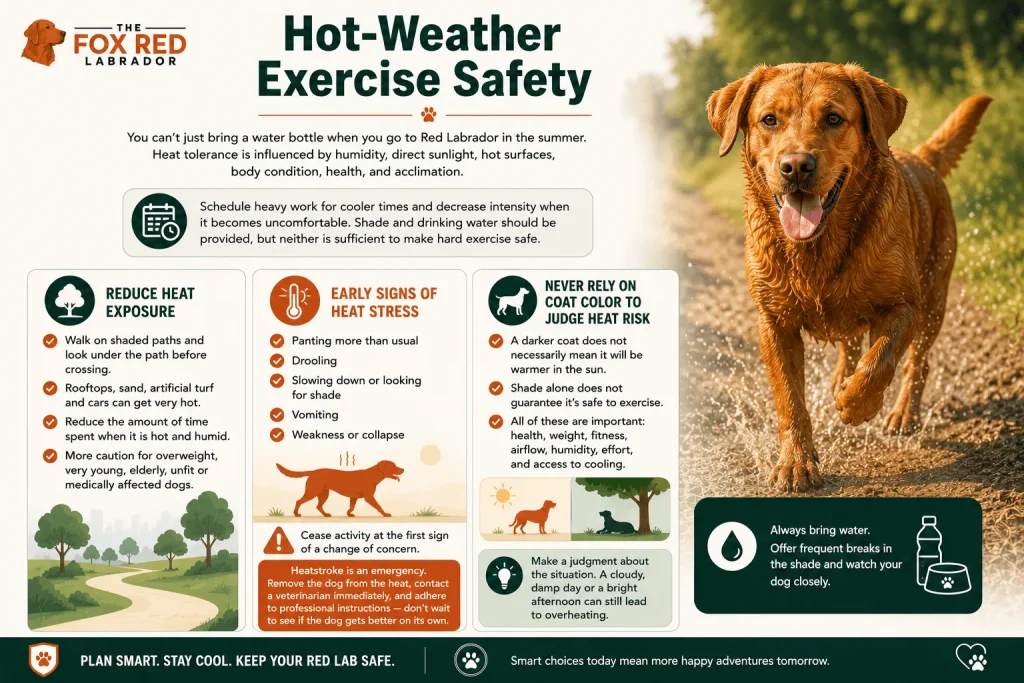
You can’t just bring a water bottle when you go to Red Labrador in the summer. Heat tolerance is influenced by humidity, direct sunlight, hot surfaces, body condition, health, and acclimation.
Schedule heavy work for cooler times and decrease intensity when it becomes uncomfortable. Shade and drinking water should be provided, but neither is sufficient to make hard exercise safe.
Reduce Heat Exposure
Walk on shaded paths and look under the path before crossing. Rooftops, sand, artificial turf and cars can get very hot.
Reduce the amount of time spent when it is hot and humid. More caution needs to be taken with overweight, very young, elderly, unfit or medically affected dogs.
Early Signs Of Heat Stress
If the dog is panting more than usual, drooling, slowing down, looking for shade, vomiting, or showing weakness or collapse may indicate that the dog is in danger of overheating. Cease activity at the first sign of a change of concern.
Heatstroke is an emergency. Remove the dog from the heat, contact a veterinarian immediately, and adhere to professional instructions not waiting to see if the dog gets better on its own.
Never Rely On Coat Color To Judge Heat Risk
A darker coat does not necessarily mean it will be warmer in the sun, and shade does not necessarily mean it’s safe for a dog to exercise. All of these are important: health, weight, fitness, airflow, humidity, effort, and access to cooling.
Make a judgment about the situation. It can be a cloudy, damp day or a bright afternoon, but a dog can still overheat.
Cold-Weather Exercise Safety
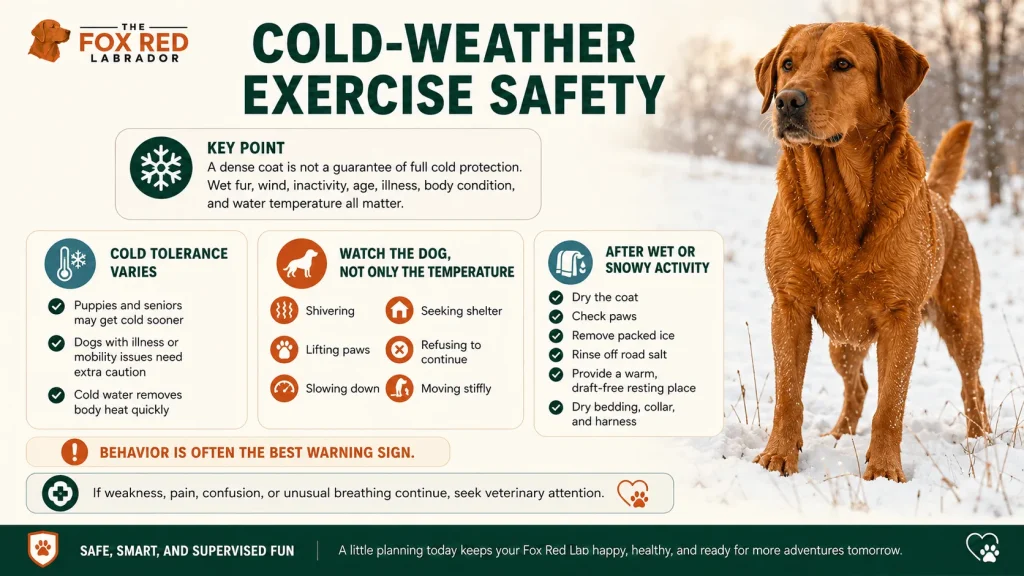
A dense coat is not a guarantee of protection from the cold, as most healthy adult Labradors have a dense coat. What feels comfortable can change rapidly because of wet fur, wind, inactivity, age, illness, body condition and water temperature.
Caring for a red Labrador should be based on the dog’s personality. It would be too simplistic to have just one temperature limit.
Cold Tolerance Varies
An adult moving slowly or steadily may react to the condition differently from an older adult who is standing still. Due to medical or mobility issues, puppies and dogs may be uncomfortable earlier.
There is an added degree of caution when it comes to the cold-water swimmers. Water will take heat away from the body rapidly and a dog that is very motivated to retrieve will do so even when tired.
Watch The Dog, Not Only The Temperature
If the dog shivers, lifts paws, slows down, goes into cover, refuses to go further or moves stiffly, it is time to stop or shorten the walk. The warning to watch for is usually behavior.
Move to a warm, dry place and watch for symptoms of recovery. If weakness, pain, confusion or unusual breathing persist, it requires professional attention.
Care After Wet Or Snowy Activity
Dry off and check paws after rainy, snowy or icy conditions. Sweep up packed ice and flush road salt or de-icing materials.
Offer a warm resting area that is out of drafts. See if damp bedding, collars or harnesses must be dried before next use.
Hiking With A Labrador

Hiking with a Labrador can be a great shared experience once the dog is physically, mentally and emotionally ready. It’s not best to find out that memory goes out the window around animals or that paws aren’t used to walking on hard surfaces in a long trail.
Gradually increase distance and difficulty. Make the return trip as well planned as the outward trip.
Build Fitness Before Distance
Add more walks, hills and uneven surfaces slowly. If the dog has been used to short, flat walks, he may not be able to make it up a steep trail even if he is excited about it.
Fitness includes recovery. Wait until later in the day and the next morning to see how the dog moves before adding more outings.
Check Whether The Route Is Suitable
Ensure that dogs are permitted and if so, whether they must be on a leash. Discuss terrain, elevation, weather, shade, water, livestock, wildlife, trail crowding and emergency exit options.
Natural water sources should not be considered safe. Bring plenty of clean water for the dog and don’t rely on a stream or pond.
Carry Appropriate Supplies
Carry water, a collapsible bowl, a leash, identification, waste bags, and simple dog first aid items. When heat, ice, sharp stones, or abrasive surfaces are involved, paw protection can be helpful if the dog has been introduced to the terrain before.
Bring any necessary medication. If the dog gets lost, it is important that it can be identified and that there is up-to-date contact information.
Monitor The Dog During And After The Hike
Observe pace, breathing, gait, paw condition, willingness to go on and reaction to rest. If a dog is lagging or continually lying down, he is saying something valuable.
Inspect paws and gait upon return home. If the route is too difficult for the athlete to handle, it may result in stiffness, limping, soreness, or poor recovery.
Signs Of Overexertion
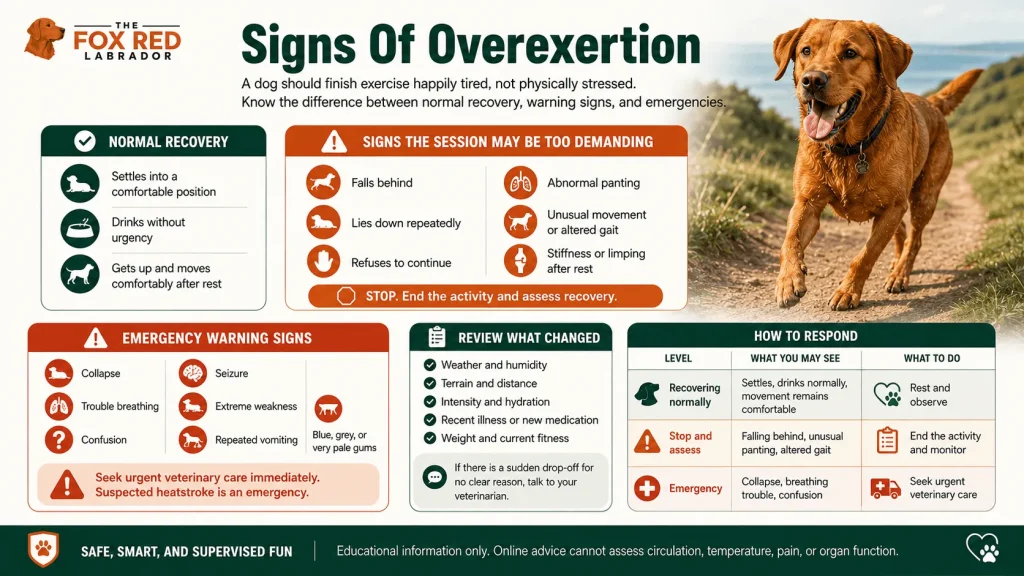
A dog should be happily exhausted, but not physically stressed, after an exercise session. Normal recovery involves settling into a comfortable position, drinking without urgency, and getting up and around after resting.
Overexertion may be noticed while playing or up to several hours afterward. It’s important to recognize when you are feeling tired and when you are experiencing a warning sign so that you can take steps to keep things from escalating.
Signs The Session May Be Too Demanding
If the animal falls behind, lies down repeatedly, refuses to go on, pants abnormally, or moves in an unusual manner, or is very tired, STOP. Stiffness or limping after rest should be considered as well.
Never force a dog to “complete the route.” Conduct a safe end to the activity and a recovery assessment.
Emergency Warning Signs
If your dog collapses, has trouble breathing, is confused, has a seizure, is very weak, vomits several times, or their gums turn blue, grey, or very pale, they need immediate veterinary attention. Suspected heatstroke should also be considered an emergency.
While arranging transportation, call the closest veterinarian or emergency clinic. Online advice is not able to evaluate circulation, temperature, pain or organ function.
Review What Changed
Following a non-emergency event, think about weather, humidity, terrain, distance, intensity, hydration, recent illness, new medication, weight, and current fitness. If a sudden drop-off for no apparent reason is noticed, it should be discussed with a veterinarian.
Apply the event to modify future activity. It is not to see how far a Labrador can run; it is to walk the dog home happy and comfortable.
| Level | Examples | Action |
|---|---|---|
| Recovering normally | Settles, drinks normally, movement remains comfortable | Rest and observe |
| Stop and assess | Falling behind, unusual panting, altered gait | End the activity and monitor |
| Emergency | Collapse, breathing trouble, confusion | Seek urgent veterinary care |
Red Labrador Feeding And Managing Weight
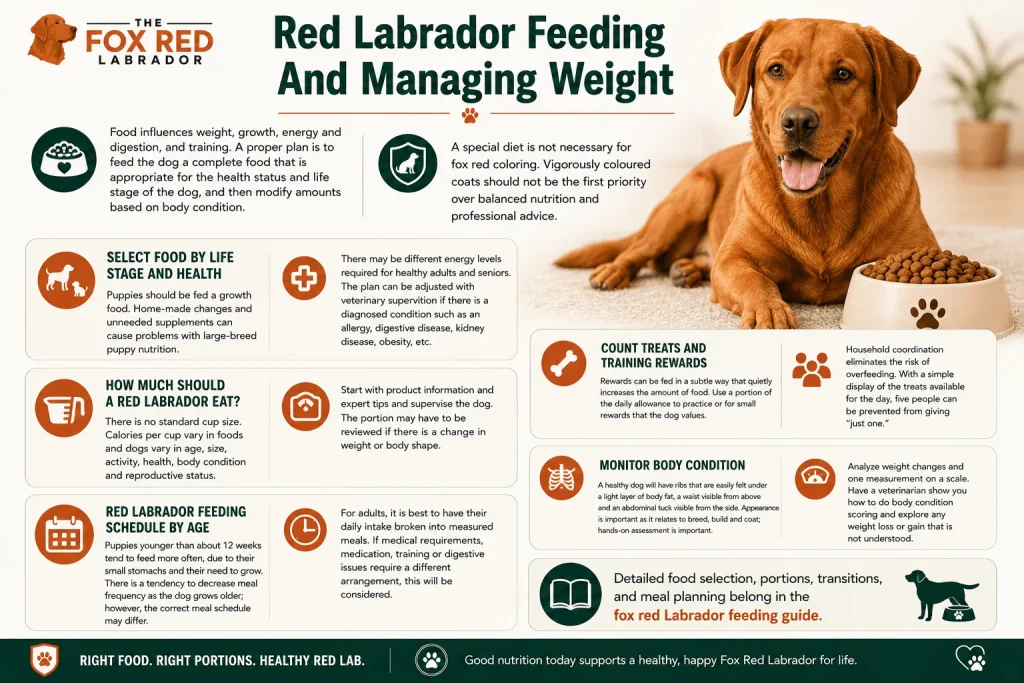
Food influences weight, growth, energy and digestion, and training. A proper plan is to feed the dog a complete food that is appropriate for the health status and life stage of the dog, and then modify amounts based on body condition.
A special diet is not necessary for fox red coloring. Vigorously coloured coats should not be the first priority over balanced nutrition and professional advice.
Select Food By Life Stage And Health
Puppies should be fed a growth food. Home-made changes and unneeded supplements can cause problems with large-breed puppy nutrition.
There may be different energy levels required for healthy adults and seniors. The plan can be adjusted with veterinary supervision if there is a diagnosed condition such as an allergy, digestive disease, kidney disease, obesity, etc.
How Much Should A Red Labrador Eat?
There is no standard cup size. Calories per cup vary in foods and dogs vary in age, size, activity, health, body condition and reproductive status.
Start with product information and expert tips and supervise the dog. The portion may have to be reviewed if there is a change in weight or body shape.
Red Labrador Feeding Schedule By Age
Puppies younger than about 12 weeks tend to feed more often, due to their small stomachs and their need to grow. There is a tendency to decrease meal frequency as the dog grows older; however, the correct meal schedule may differ.
For adults, it is best to have their daily intake broken into measured meals. If medical requirements, medication, training or digestive issues require a different arrangement, this will be considered.
Count Treats And Training Rewards
Rewards can be fed in a subtle way that quietly increases the amount of food. Use a portion of the daily allowance to practice or for small rewards that the dog values.
Household coordination eliminates the risk of overfeeding. With a simple display of the treats available for the day, five people can be prevented from giving “just one.”
Monitor Body Condition
A healthy dog will have ribs that are easily felt under a light layer of body fat, a waist visible from above and an abdominal tuck visible from the side. Appearance is important as it relates to breed, build and coat; hands-on assessment is important.
Analyze weight changes and one measurement on a scale. Have a veterinarian show you how to do body condition scoring and explore any weight loss or gain that is not understood.
Red Labrador Training And Calm Behaviour
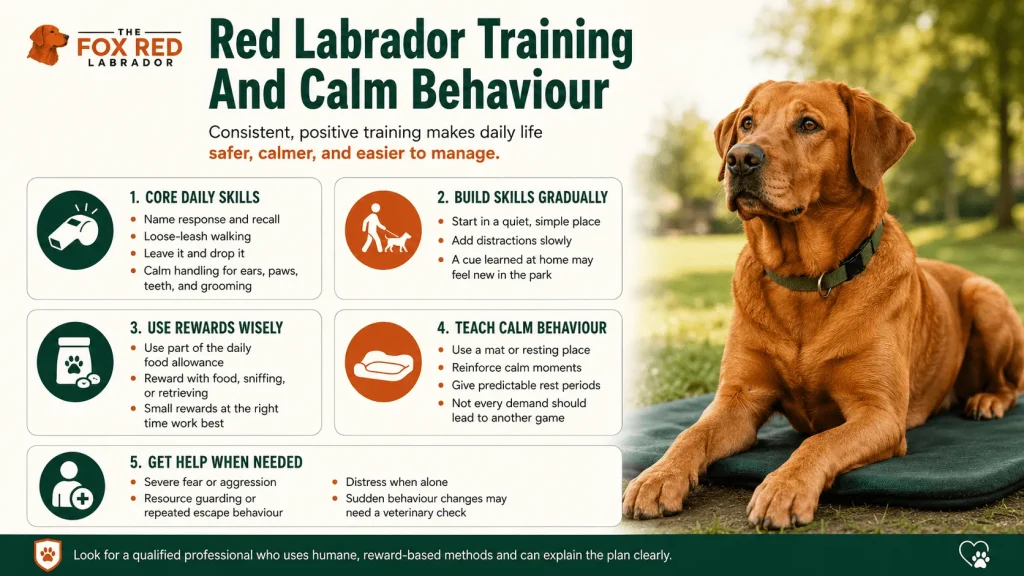
Each day with training is safer and less stressful. A dog that can come when called, walk on a leash without pulling, let go of something and be calm when being handled is easier to control when going about their daily lives.
Red Labrador training must be consistent, positive and appropriate to the dog’s learning history. A dog’s intelligence doesn’t automatically translate to their understanding of the rules in the house.
Skills That Support Daily Care
Start with name response, recall, loose-leaf walking, waiting, leaving unsafe items and dropping objects. Cooperative handling facilitates ears, paws, teeth, grooming and vet checks.
Practice in a simple environment first, then add distractions. You might have a cue that you have taught in the kitchen that you think is completely new in the park with all the dogs and interesting smells.
Use Rewards Without Overfeeding
Food can be a good reward for a food-motivated Labrador, but it should be from the daily allowance as much as possible. Rewarding, allowing sniffing access, and retrieving can also be used for reinforcement.
The size of the reward is more important than visual drama. A small amount at the right time is better than a large amount at the wrong time, and that small amount is a biscuit that fits in the lunch break.
Teach Activity And Rest
Excited dogs must learn to calm down. A comfortable mat and calm reinforcement, predictable rest periods and less stimulation can help.
Don’t respond to every demand by another game. But sometimes it’s not about exercise; it’s about relaxation.
Know When Professional Help Is Needed
If fear, aggression, repeated escape behavior, resource guarding or distress when alone is severe, it requires qualified assistance. Sudden behavioral changes can also be due to a medical condition.
Look for a professional who employs humane and reward-based techniques and who can explain the plan clearly.
Red Labrador Grooming And Shedding Care
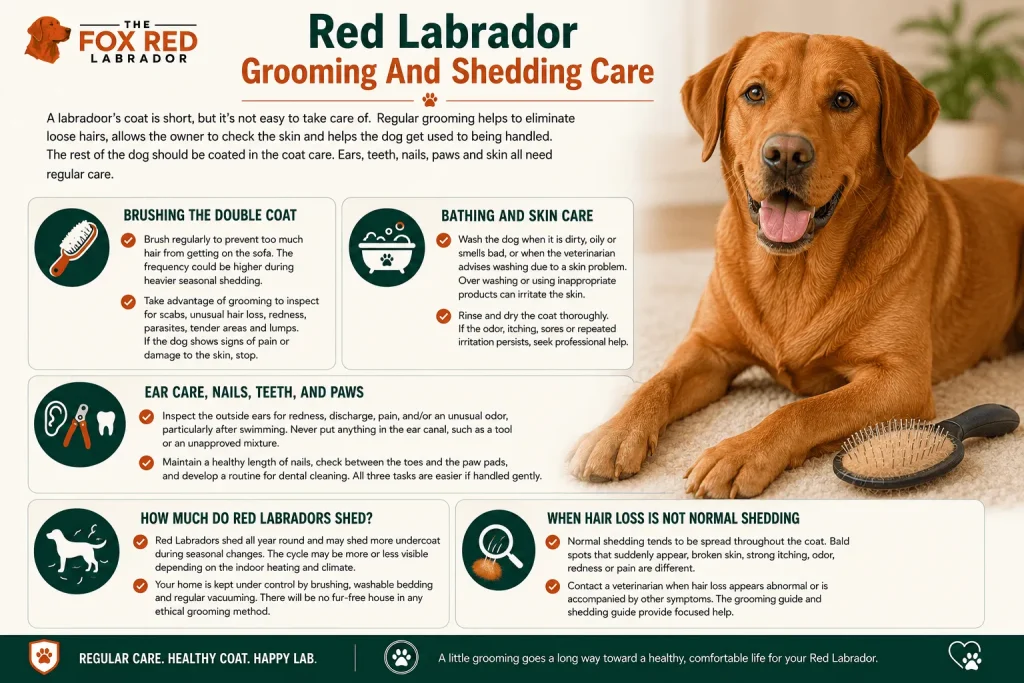
A labradoodle’s coat is short, but it’s not easy to take care of. Regular grooming helps to eliminate loose hairs, allows the owner to check the skin and helps the dog get used to being handled.
The rest of the dog should be cared for. Ears, teeth, nails, paws and skin all need regular care.
Brushing The Double Coat
Brush regularly to prevent too much hair from getting on the sofa. The frequency could be higher during heavier seasonal shedding.
Take advantage of grooming to inspect for scabs, unusual hair loss, redness, parasites, tender areas and lumps. If the dog shows signs of pain or damage to the skin, stop.
Bathing And Skin Care
Wash the dog when it is dirty, oily or smells bad, or when the veterinarian advises washing due to a skin problem. Overwashing or using inappropriate products can irritate the skin.
Rinse and dry the coat thoroughly. If the odor, itching, sores or repeated irritation persists, seek professional help.
Ear Care, Nails, Teeth, And Paws
Inspect the outside ears for redness, discharge, pain, and/or an unusual odor, particularly after swimming. Never put anything in the ear canal, such as a tool or an unapproved mixture.
Maintain a healthy length of nails, check between the toes and the paw pads, and develop a routine for dental cleaning. All three tasks are easier if handled gently.
How Much Do Red Labradors Shed?
Red Labradors shed all year round and may shed more undercoat during seasonal changes. The cycle may be more or less visible depending on the indoor heating and climate.
Your home is kept under control by brushing, washable bedding and regular vacuuming. There will be no fur-free house in any ethical grooming method.
When Hair Loss Is Not Normal Shedding
Normal shedding tends to be spread throughout the coat. Bald spots that suddenly appear, broken skin, strong itching, odor, redness or pain are different.
Contact a veterinarian when hair loss appears abnormal or is accompanied by other symptoms.
Preventive Health Care For A Red Labrador
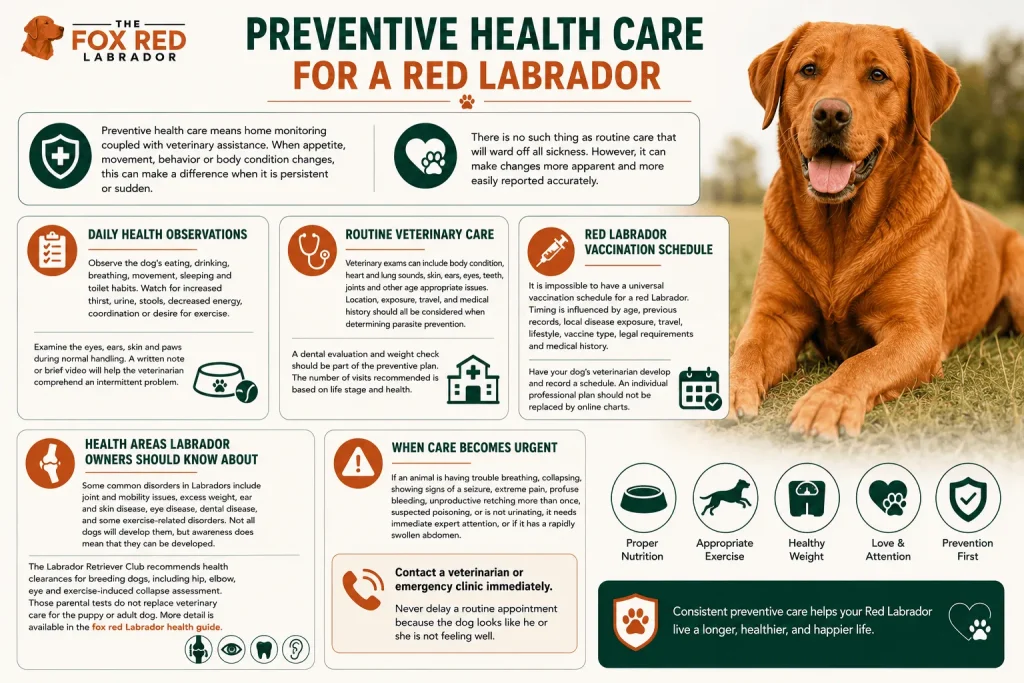
Preventive health care means home monitoring coupled with veterinary assistance. When appetite, movement, behavior or body condition changes, this can make a difference when it is persistent or sudden.
There is no such thing as routine care that will ward off all sickness. However, it can make changes more apparent and more easily reported accurately.
Daily Health Observations
Observe the dog’s eating, drinking, breathing, movement, sleeping and toilet habits. Watch for increased thirst, urination, stools, decreased energy, coordination or desire for exercise.
Examine the eyes, ears, skin and paws during normal handling. A written note or brief video will help the veterinarian comprehend an intermittent problem.
Routine Veterinary Care
Veterinary exams can include body condition, heart and lung sounds, skin, ears, eyes, teeth, joints and other age appropriate issues. Location, exposure, travel, and medical history should all be considered when determining parasite prevention.
A dental evaluation and weight check should be part of the preventive plan. The number of visits recommended is based on life stage and health.
Red Labrador Vaccination Schedule
It is impossible to have a universal vaccination schedule for a red Labrador. Timing is influenced by age, previous records, local disease exposure, travel, lifestyle, vaccine type, legal requirements and medical history.
Have your dog’s veterinarian develop and record a schedule. An individual professional plan should not be replaced by online charts.
Health Areas Labrador Owners Should Know About
Some common disorders in Labradors include joint and mobility issues, excess weight, ear and skin disease, eye disease, dental disease, and some exercise-related disorders. Not all dogs will develop them, but awareness does mean that they can develop.
The Labrador Retriever Club recommends health clearances for breeding dogs, including hip, elbow, eye and exercise-induced collapse assessment. Those parental tests do not replace veterinary care for the puppy or adult dog. More detail is available in the fox red Labrador health guide.
When Care Becomes Urgent
If an animal is having trouble breathing, collapsing, showing signs of a seizure, extreme pain, profuse bleeding, unproductive retching more than once, suspected poisoning, or is not urinating, it needs immediate expert attention, or if it has a rapidly swollen abdomen.
Contact a veterinarian or emergency clinic immediately. Never delay a routine appointment because the dog looks like he or she is not feeling well.
Red Labrador Care Through Every Life Stage

The basic tenets are still the same: food, movement, training, comfort, observation and companionship, but the proportions change.
Planning for each stage helps to avoid putting an adult routine on a puppy or a senior dog.
Red Labrador Puppy Care
Puppies require frequent toilet breaks, appropriate feeding, lots of sleep, appropriate outlets for their chewing, gentle handling and close supervision. Socialization should be gradual and not overwhelm the puppy with scary experiences.
Name response, recall, toileting, calm greetings and being handled can be taught in short training sessions. Movement should be used to explore, not endure. The fox red Labrador puppy guide provides a fuller starting plan.
Adolescent Red Labrador Care
During adolescence, there may be increased strength, confidence, distraction and selective hearing. Skills that are completed may become unreliable when the environment becomes more interesting.
Ongoing recall, leash training, boundaries, controlled greetings, mental activity and calm settling. Keep an eye on food when it slows down to avoid puppy portions becoming adult weight gain.
Adult Red Labrador Care
Adult care should keep people fit, but not neglect their recovery. Walks, training, purposeful play, social contact, grooming and preventive health checks can be integrated into a stable routine.
Continue to use acquired skills. It’s easier to keep training than to rebuild after a few years of happy rule bending.
Senior Red Labrador Care
A senior red Labrador may require shorter walks, softer surfaces, better footing, closer access to cars and more frequent checks on weight and muscle condition. Nails and paws are important – discomfort can impact balance.
If sleep, awareness, hearing, vision, toilet habits, mobility and social behavior change, consult a veterinarian.
Common Red Labrador Care Mistakes
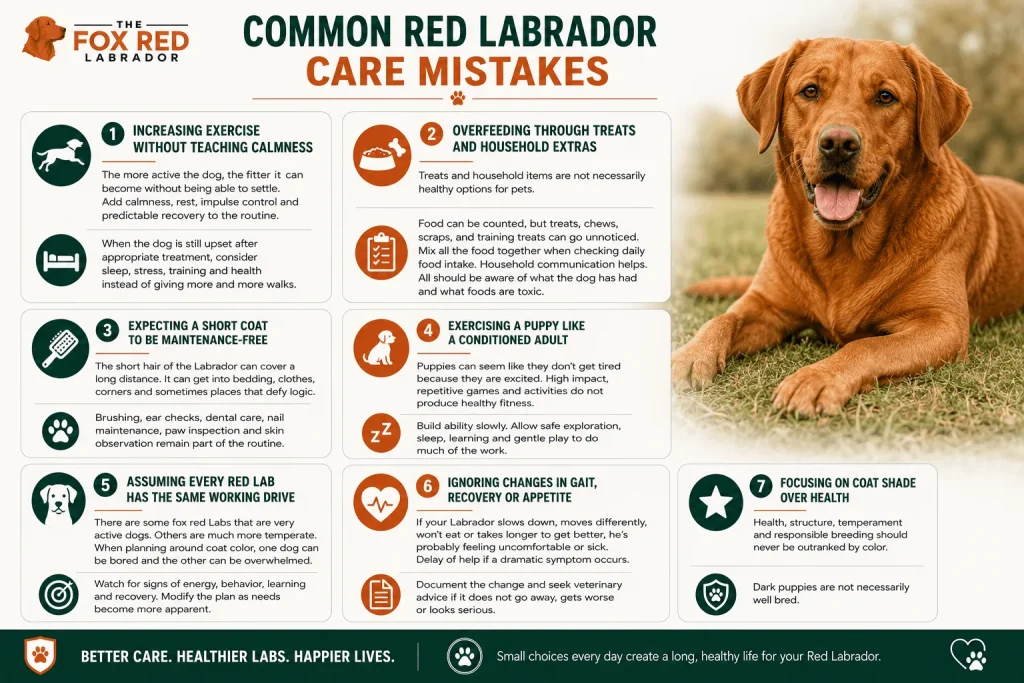
The majority of care errors are due to well-intentioned care that is insufficiently informed. Owners may over-exercise, over-feed, and add activities because they want the dog to be happy.
Increasing Exercise Without Teaching Calmness
The more active the dog, the fitter it can become without being able to settle. Add calmness, rest, impulse control and predictable recovery to the routine.
When the dog is still upset after appropriate treatment, consider sleep, stress, training and health instead of giving more and more walks.
Overfeeding Through Treats And Household Extras
Treats and household items are not necessarily healthy options for pets.
Food can be counted, but treats, chews, scraps, and training treats can go unnoticed. Mix all the food together when checking daily food intake. Household communication helps. All should be aware of what the dog has had and what foods are toxic.
Expecting A Short Coat To Be Maintenance-Free
The short hair of the Labrador can cover a long distance. It can get into bedding, clothes, corners and sometimes places that defy logic.
Brushing, ear checks, dental care, nail maintenance, paw inspection and skin observation remain part of the routine.
Exercising A Puppy Like A Conditioned Adult
Puppies can seem like they don’t get tired because they are excited. High impact, repetitive games and activities do not produce healthy fitness.
Build ability slowly. Allow safe exploration, sleep, learning and gentle play to do much of the work.
Assuming Every Red Lab Has The Same Working Drive
There are some fox red Labs that are very active dogs. Others are much more temperate. When planning around coat color, one dog can be bored and the other can be overwhelmed.
Watch for signs of energy, behavior, learning and recovery. Modify the plan as needs become more apparent.
Ignoring Changes In Gait, Recovery Or Appetite
If your Labrador slows down, moves differently, won’t eat or takes longer to get better, he’s probably feeling uncomfortable or sick. Delay of help if a dramatic symptom occurs.
Document the change and seek veterinary advice if it does not go away, gets worse or looks serious.
Focusing On Coat Shade Over Health
Health, structure, temperament and responsible breeding should never be outranked by color. Dark puppies are not necessarily well bred.
Are Red Labradors Easy To Care For?
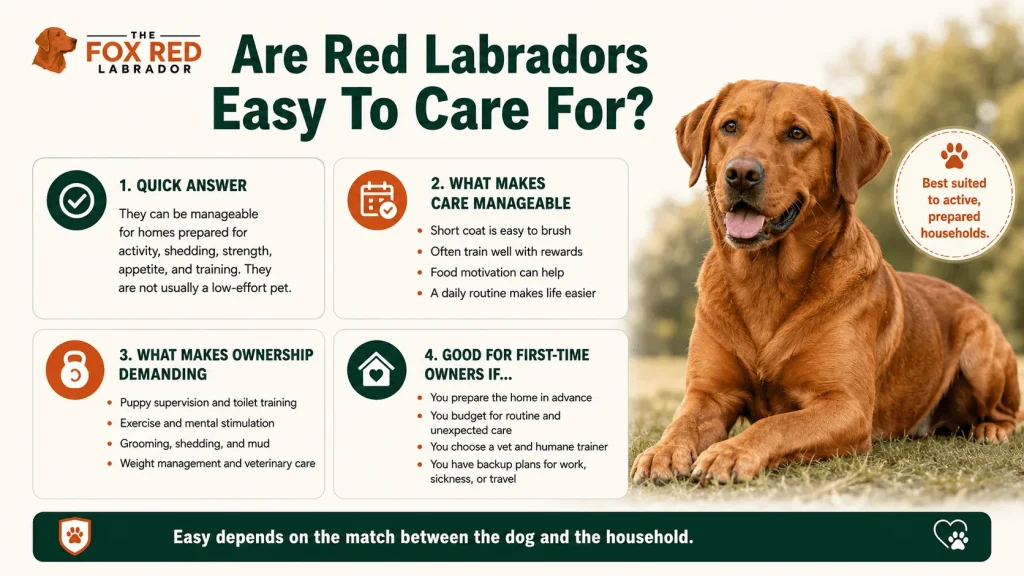
With a bit of preparation, red Labradors can be manageable pets for homes that are ready for their activity, shedding, strength, appetite, and training. They have a short coat that is easy to brush, but the full brushing process takes time.
Easy is dependent on the match between the dog and the household. For an active family, needs may seem challenging to a person who wants a low-exercise pet.
What Makes Daily Care Manageable
A lot of Labradors are good at being trained with rewards and are involved in family routines. Rewards can be measured in terms of food motivation.
A routine is also helpful. If exercise, eating, training, and sleeping have a consistent daily routine, it is easier to structure daily life.
What Makes Ownership Demanding
Puppy supervision, toilet training, puppy socialization and sleep are very important. Adolescents may be strong, excitable and briefly confused about rules they seemed to understand the day before.
Exercise, mental stimulation, grooming, weight management, companionship, and veterinary care are still necessary for adults. Shedding and mud are not serious issues but certainly committed ones.
Red Lab Care For A First-Time Owner
Before issues arise, a first-time red Labrador owner should get the home ready, budget for routine and unexpected care, find a vet and select a humane trainer.
Arrangements for backup are important when work, sickness or travel disrupts the regular schedule. The ownership guide and suitability guide can assist in determining the entire commitment.
Red Labrador Care Checklist
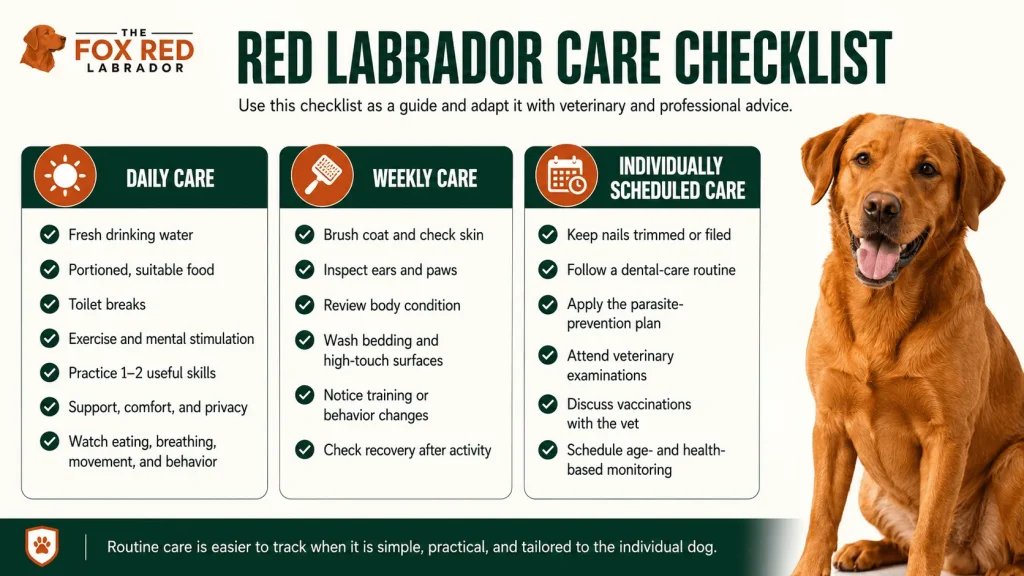
Having a checklist makes routine care more easily tracked without making the dog a project plan. Certain tasks are daily; others, medical and grooming, are based on each individual.
Use the list as a guide and modify with veterinary and professional advice.
Daily Care
- Provide fresh drinking water.
- Provide portioned and sized foods.
- Provide appropriate toilet facilities.
- Include physical activity and mental stimulation.
- Do one or two practical skills.
- Offer support and privacy.
- Watch eating, breathing, movement and behavior.
Weekly Care
- Brush and check coat and skin.
- Inspect ears and paws.
- Review body condition.
- Wash bedding and high touch surfaces.
- Observe any changes in training or behaviour.
- Check the dog’s recovery from activity.
Individually Scheduled Care
- Keep nails trimmed or filed as necessary.
- Follow a dental-care routine.
- Apply the agreed parasite-prevention plan.
- Attend veterinary examinations.
- Discuss vaccination requirements with the vet.
- Schedule age/health monitoring.
Conclusion
Fox Red Labradors need no special training method due to their colour. They require patience, boundaries, proper rewards, and age-appropriate confidence practice.
Some will inherit the energy and retrieving drive that is found in working lines. Teach these instincts to be useful, using recall, scent work, controlled retrieving and calmness training. Do not assume your dog is being stubborn if the exercise doesn’t go as planned: If they are not making progress, you can make the exercise easier.
Select one skill and start in a quiet area. Praise minor progress, document results and slowly build up the difficulty. However, with consistent training, it is possible that that little dog can become a responsive, fun-to-be-around dog.
FAQ’s
A red Lab needs water, measured food, toilet access, physical movement, mental engagement, social contact, and adequate sleep. A brief health observation should also be part of the routine. Puppies need more supervision and toilet trips. Seniors may require shorter activity and extra physical support.
There is no single duration suitable for every red Labrador. Age, health, fitness, lineage, weather, terrain, and exercise intensity all change what is appropriate. Combine physical movement with mental activity and recovery. Increase demands gradually and stop when movement, breathing, coordination, or willingness changes.
Puppy exercise should emphasize free exploration, gentle play, short training, sniffing, and safe social experiences. It should not resemble an adult endurance program. Watch coordination and recovery rather than relying only on age. Limping, persistent stiffness, or unusual fatigue warrants veterinary advice.
Combine suitable physical exercise with tasks involving scent, memory, retrieval, direction, and self-control. Structured work often provides more satisfaction than distance alone. Include pauses, settling practice, sleep, and recovery days. The dog’s actual behavior and condition should guide the plan.
Falling behind, repeatedly lying down, unusual panting, altered gait, poor coordination, reluctance to continue, or prolonged fatigue can indicate excessive demand. Collapse, breathing difficulty, confusion, seizure, or pale, grey, or blue gums require urgent veterinary care. End exercise whenever the dog shows concerning changes.
Yes, controlled retrieving can combine movement, training, memory, and impulse control. Short structured sessions are usually more useful than endless high-speed ball chasing. Choose safe objects and reliable ground. Limit repeated jumps, sharp turns, sliding, and hard stops.
No. Some Labradors lack confidence, skill, fitness, or safe access to water. Check currents, temperature, water quality, hidden hazards, and exit points. Supervise closely, consider flotation support, and stop before fatigue affects swimming ability.
A healthy, conditioned adult may enjoy hiking when the route, weather, terrain, and distance are suitable. Fitness should be built gradually before attempting a demanding trail. Carry water, identification, a leash, waste bags, and basic first-aid supplies. Monitor paws, movement, breathing, and recovery.
There is no single interval for every grooming task. Brushing may be needed more often during heavy shedding, while bathing depends on dirt, odor, swimming, and skin condition. Ears, paws, nails, teeth, and skin require their own checks. Pain, discharge, irritation, or unusual hair loss should be assessed professionally.
The right amount depends on the food’s calorie content, age, body condition, activity, health, and reproductive status. A universal cup measurement would be unreliable. Measure meals, count treats, and monitor body shape and weight trends. Ask a veterinarian for help when weight changes unexpectedly.
Regular brushing, clean bedding, and routine vacuuming can reduce loose hair around the home. Shedding cannot be stopped completely because coat renewal is normal. Sudden bald patches, itching, redness, odor, or broken skin are not ordinary shedding. Those changes need veterinary attention.
Yes, some can, provided their exercise, toilet, training, enrichment, and companionship needs are met consistently. Floor space alone does not determine welfare. Noise, shared access, stairs, landlord rules, and safe outdoor opportunities should be considered. A garden does not replace walks or interaction either.
A fox red Lab can suit a committed first-time owner who is prepared for training, activity, shedding, food management, adolescent behavior, and long-term costs. Early support from a veterinarian and humane trainer can make ownership easier. Choosing the dog for lifestyle and health rather than color gives the household a better starting point.
References:
- The Labrador Site: Fox Red Labrador
- Labrador Retriever Club: Health Issues
- OFA: CHIC Program
- ASPCA: General Dog Care
- RSPCA: Dog Care And Welfare