Fox Red Lab Colors: Shades, Genetics, and Coat Changes Explained
A red Labrador can halt people in the middle of the walk. The dog is copper-colored and reflects the light. Someone asks what breed the dog is and the conversation starts. However, the color is not as enigmatic as it may seem.
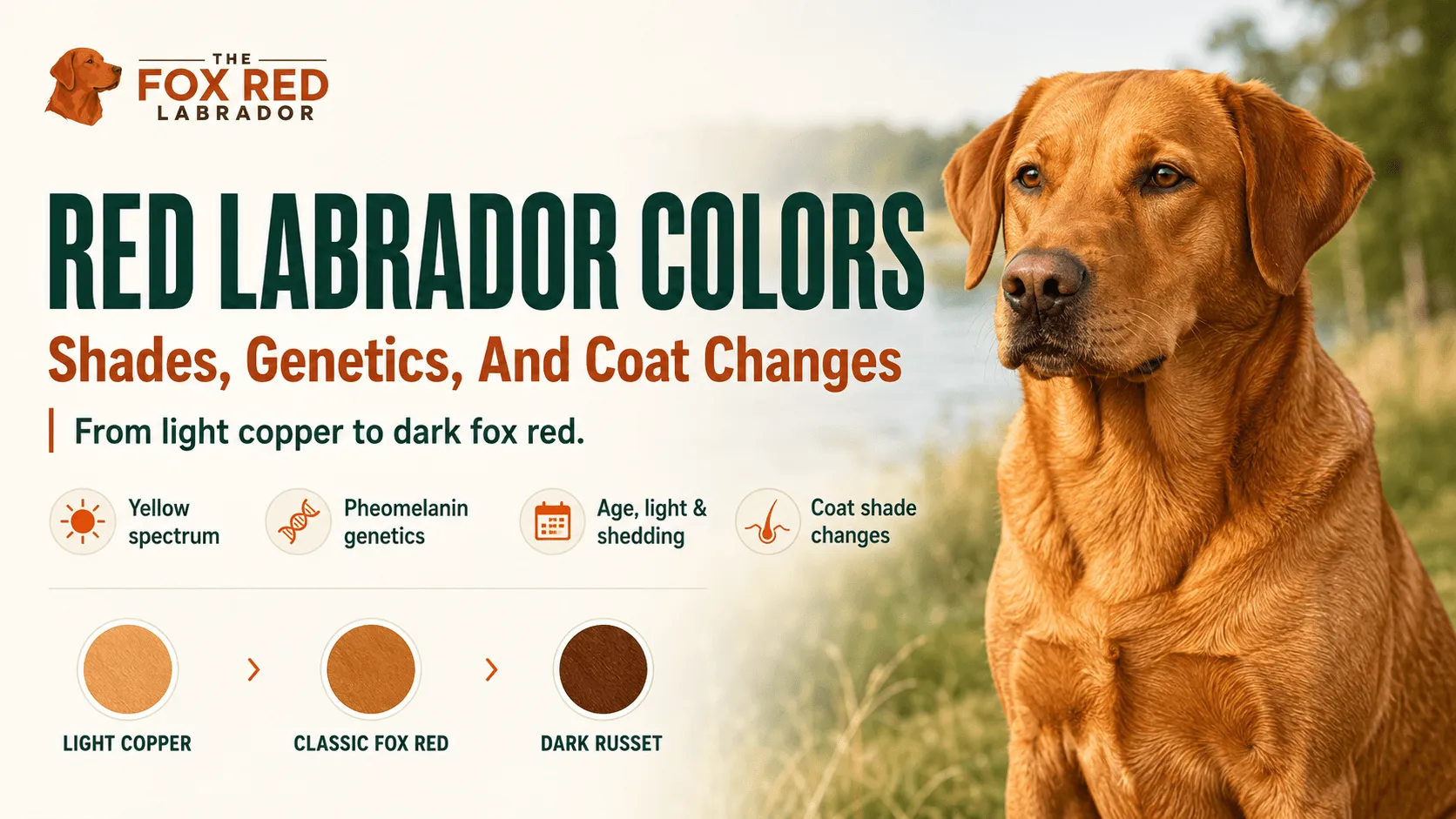
The red colours are part of the yellow Labrador spectrum. Fox red is not a fourth Labrador colour or a separate breed. It is the darkest shade of yellow, from warm gold to copper to rich russet.
Shade is a natural result of the intensity of the pigment inherited. That shade can change color based on age, sunlight, shedding and even camera settings. The full-color story comes together as follows.
What Color Is A Red Labrador?
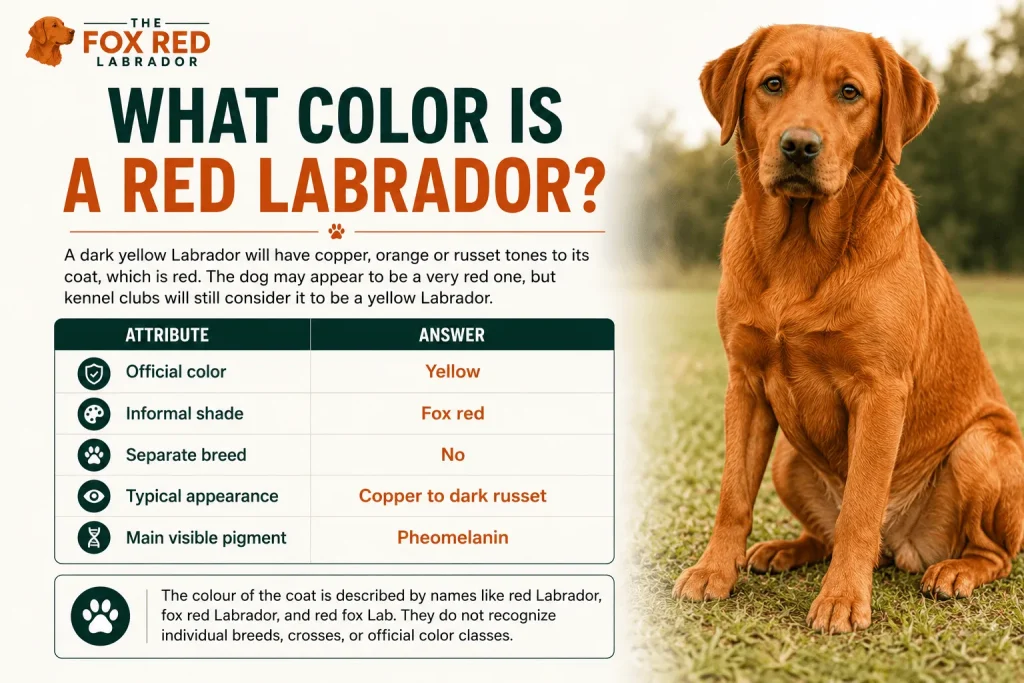
A dark yellow Labrador will have copper, orange or russet tones to its coat, which is red. The dog may appear to be a very red one, but kennel clubs will still consider it to be a yellow Labrador.
| Attribute | Answer |
|---|---|
| Official color | Yellow |
| Informal shade | Fox red |
| Separate breed | No |
| Typical appearance | Copper to dark russet |
| Main visible pigment | Pheomelanin |
The colour of the coat is described by names like red Labrador, fox red Labrador, and red fox Lab. They do not recognize individual breeds, crosses, or official color classes.
What Are The Different Shades Of Red Labradors?
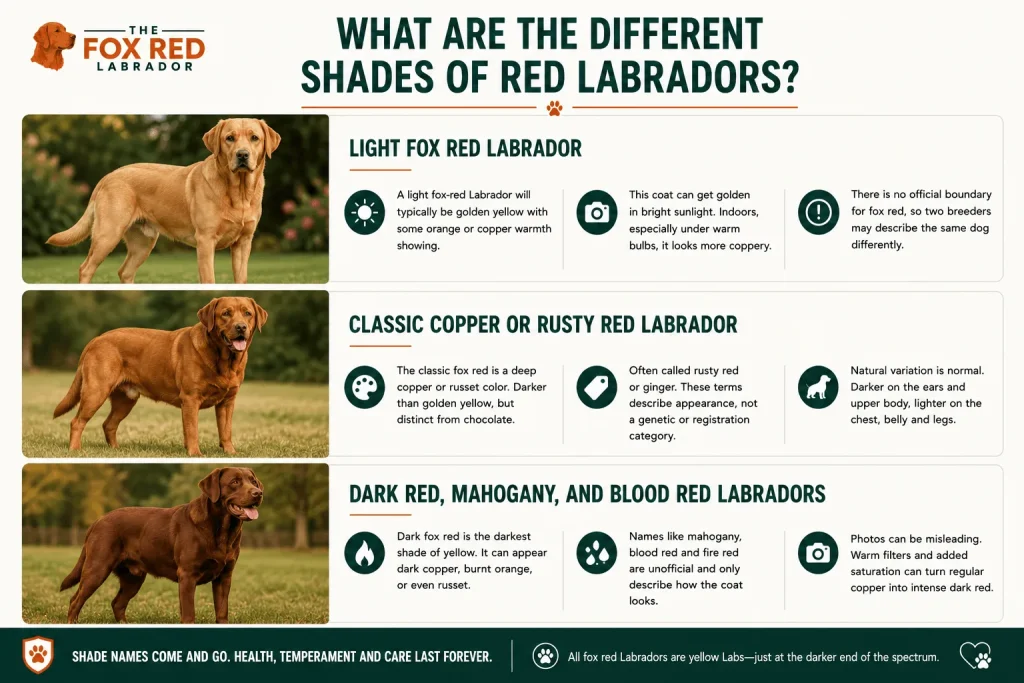
There is no formal shade grouping of fox-red Labradors for any kennel club. Light fox red, copper, mahogany, and rusty red are all informal terms used by the owners and breeders.
Natural coats tend not to be a solid, uniform color. The ears and back may be darker, and the chest, belly and inside of the legs lighter. These differences can be accentuated by lighting, particularly in photos.
Light Fox Red Labrador
A light fox-red Labrador will typically be golden yellow with some orange or copper warmth showing. The red color tones can be most intense at the ears, shoulders, back, tail and hocks.
This coat can get golden in bright sunlight. The same dog will look much more coppery indoors, especially under warm bulbs. That little colour trick has fooled more than a few puppy photo comparisons.
Not every light copper coat is a fox red coat, as a loose definition of fox red may include any light copper. There is no official boundary so two breeders can have two different descriptions of the same dog.
Classic Copper Or Rusty Red Labrador
The classic fox red is a deep copper or russet color. This color is darker than the typical golden yellow, but still distinct from the brown color of a chocolate Labrador.
This is sometimes referred to as shade rusty red or ginger. The terms used for these labels refer to the appearance of the coat, not to the genetic or registration category.
Variations from one part of the body to another are normal. Dogs can be darker with darker colored ears and upper body, with a lighter-colored undercoat and not have an uneven or faulty coat.
Dark Red, Mahogany, And Blood Red Labradors
Dark fox red is the darkest shade of yellow. They can look dark copper, burnt orange, or even russet, particularly when taken outdoors in soft light.
The unofficial names for these colors are mahogany, blood red and fire red. They are frequently seen in puppy advertisements but not in individual genetic colors. Blood red is a pretty dramatic color for a Labrador that may only be worried about an unattended sandwich.
Photographs require a careful eye. An ordinary copper coat can be transformed into an intense dark red with the use of warm filters and added saturation. Neutral daylight images provide a more accurate image.
How Can You Identify A Fox-Red Labrador Coat?

Consider the overall appearance of the coat, not just one dark spot. The fox-red Labrador is a reddish-gold or copper color on its body with a white belly and legs. The ears, upper back and tail may be a darker colour.
Many dogs are lighter in color on the chest, belly and inside of their legs. Most are also darkly pigmented around the nose and eyes; the pigment is also inherited separately from the visible depth of the body coat.
Fur that is wet tends to be darker. A good amount of sunlight will reveal golden highlights, and an old winter coat will look duller after it sheds.
Looks do not necessarily prove pedigree or purity. A photo of a puppy will not accurately predict what color the puppy will be as an adult. Better evidence is provided by registration records, parentage and appropriate genetic testing.
Red Lab vs Yellow Lab Color: What Is the Difference?

A fox red Lab is a yellow Lab. The difference is in the strength of the yellow/red colour, rather than in breed identity or official status.
There is a wide range of yellow Labrador coats. Pale cream dogs are at one end. Medium colors are yellow or golden and the darkest colors are copper or fox red.
Both dogs have the genetic basis for a yellow coat. The fox-red dog just has a higher level of pheomelanin.
This relationship can appear more complex than it really is thanks to color names. A puppy that is described as “yellow fox red” is still a yellow Labrador dog but has a darker shade visible. This dark-yellow shade has existed throughout the breed’s development, as covered in the history and origin of the fox red Labrador.
Red Lab vs Chocolate Lab Color
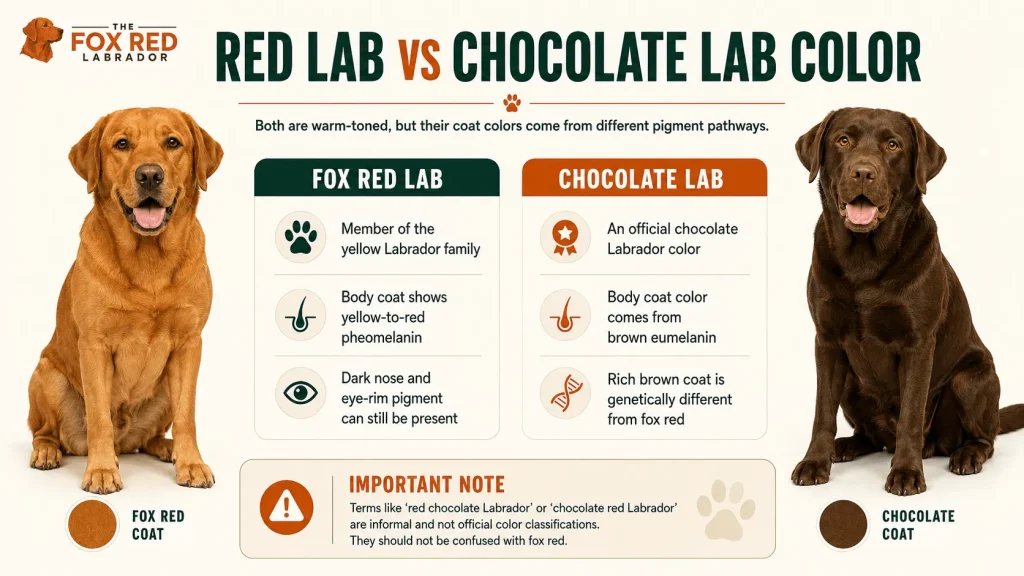
Fox red and chocolate are both warm toned, but the coat is created in different ways. Fox red is a member of the yellow family, and chocolate is an official color.
Brown eumelanin is present in chocolate fur. Pheomelanin is found in the body hair instead of fox-red, as yellow to red. Although eumelanin does not constitute the major color of the body coat, dark nose and eye-rim pigment can still be observed on a fox-red dog.
These are not official classifications; for instance, red chocolate Labrador or chocolate red Labrador. They can be used randomly for a warm brown dog, but should not be mistaken for fox red.
How Do Red Labrador Colors Fit Within All Labrador Coat Colors?
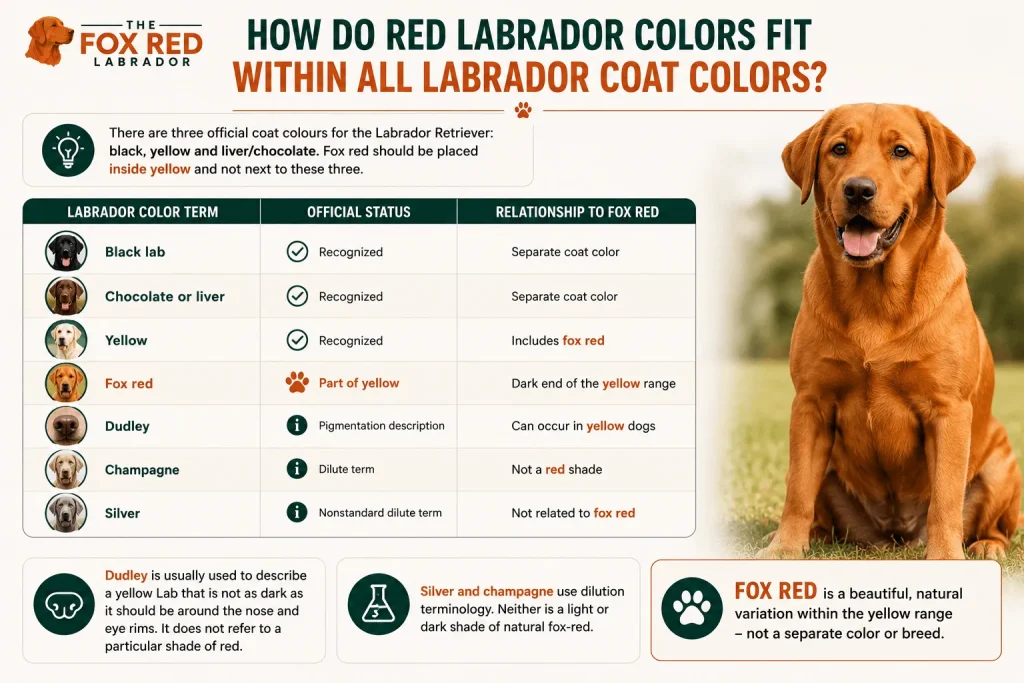
There are three official coat colours for the Labrador Retriever: black, yellow and liver/chocolate. Fox red should be placed inside yellow and not next to these three.
| Labrador Color Term | Official Status | Relationship to Fox Red |
|---|---|---|
| Black lab | Recognized | Separate coat color |
| Chocolate or liver | Recognized | Separate coat color |
| Yellow | Recognized | Includes fox red |
| Fox red | Part of yellow | Dark end of the yellow range |
| Dudley | Pigmentation description | Can occur in yellow dogs |
| Champagne | Dilute term | Not a red shade |
| Silver | Nonstandard dilute term | Not related to fox red |
Another word that can be confusing is Dudley. It is usually used to describe a yellow Lab that is not as dark as it should be around the nose and eye rims. It does not refer to a particular shade of red.
Silver and champagne use dilution terminology. Neither is a light or dark shade of natural fox-red.
Is Fox Red An Official Or Rare Labrador Color?
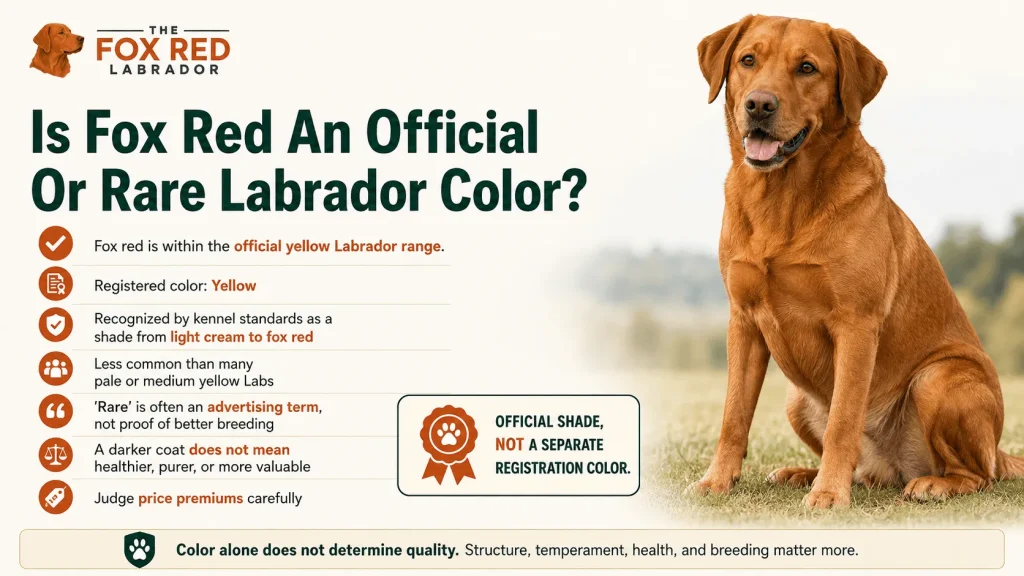
Fox red is within the official yellow range. It is not a stand-alone registration option and therefore, a fox-red puppy is registered as yellow.
The Royal Kennel Club breed standard refers to yellow as being a light cream to fox red. The depth of the coat is not the only factor that determines whether or not a dog conforms to the standard. Structure, movement, condition, temperament and pigmentation remain important.
Fox-red coats are not as prevalent as many pale and medium yellow coats. That is why they’re less common these days, and “rare” is used in advertising more than it actually is.
The fact that it is scarce does not prove that it is better breeding. A darker puppy is not necessarily healthier, more valuable or more pure than a lighter yellow littermate. Color-based premiums should be assessed carefully.
Why Are Red Labradors Red?
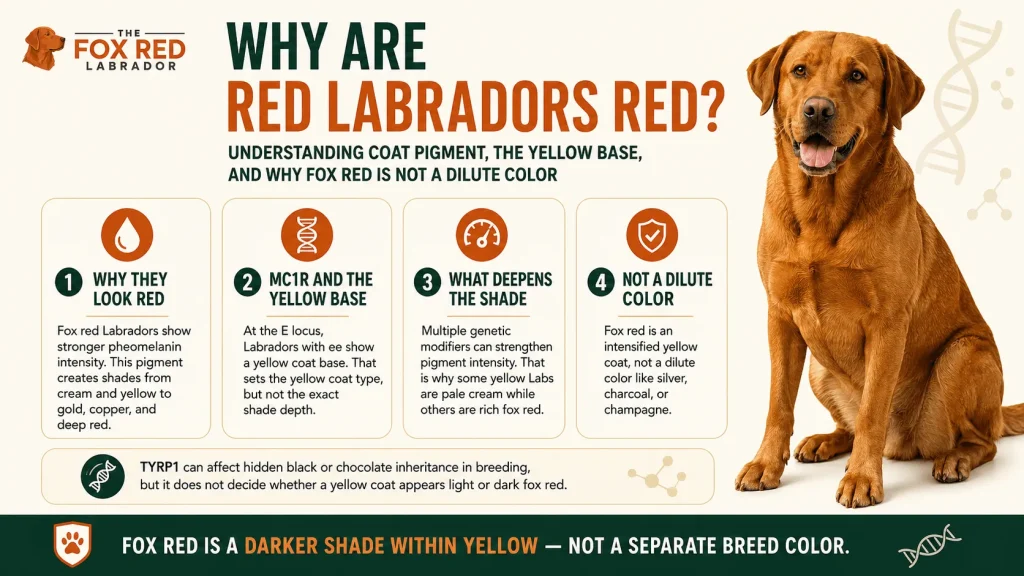
The red Labradors have a high intensity of pheomelanin in their body hair and therefore are red in color. Pheomelanin gives shades of light cream, yellow, gold, copper and deep red.
The finished look is due to several genes. Some decide the general type of the coat and some affect the intensity of a pigment.
MC1R and the Yellow Labrador Foundation
MC1R is associated with the E locus. The yellow body coat is a recessive trait in a Labrador and requires two e alleles (ee).
As a result of this combination, dark eumelanin is not deposited in the body hair as normal. Instead, pheomelanin is the pigment that is seen in the coat.
The dog’s genotype is ee, which accounts for its yellow colour. It does not independently determine the colour of the coat, which may be cream, golden, copper or dark fox red.
Pheomelanin And Red Color Intensity
The entire yellow-to-red range is due to the pigment pheomelanin. Less visible intensity creates light cream or light yellow. Gold, copper and fox-red coats are produced by stronger expression.
It has been suggested that there are several genetic modifiers in the depth of pigment. This makes the inheritance of exact shade more complex than a single dominant or recessive “red gene.”
Dark puppies may be more likely to occur when the darker yellow lines are bred together. Nevertheless, there can be some variation in nature within a litter.
TYRP1 and Hidden Black or Chocolate Inheritance
TYRP1 is often referred to as the B locus. It determines the color of eumelanin when it is expressed in the coat, whether it be black or brown.
A yellow lab can still be a carrier for black- or chocolate associated variants. Their effect is not visible in the yellow body coat, but the variants can affect the colors the dog can produce when bred.
TYRP1 thus contributes to the understanding of general litter results. It does not affect the color of a yellow puppy, whether it will be light gold or dark fox red.
Why Fox Red Is Not A Dilute Color
Fox red is a result of the more intense expression of yellow to red pigment. It is not caused by a dilution mechanism like silver, charcoal or champagne.
Other color pathways are less intense when diluted. Fox red is the opposite visual direction, with the display of richer pheomelanin.
It is wrong to coat a fox red with dilute chocolate. Both look warm, but arrive at the warmth by different pigment processes.
Can Yellow Labs Produce Red Labs?
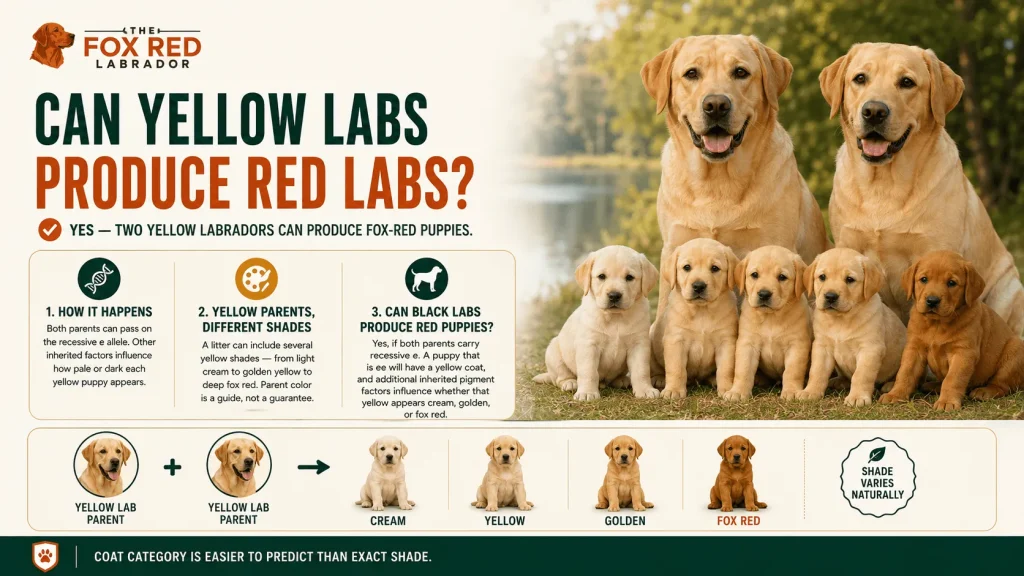
Yes. Fox-red Labradors may be produced by two yellow Labradors. The recessive e allele is passed on by both parents and other inherited factors determine the degree of paleness or darkness for each puppy.
Predicting the basic coat category is easier than predicting the exact shade. A simple genetic square can indicate that puppies will be yellow, but not which ones will be deep copper adult dogs. Parent color is a guide, not a rule. Several generations can be looked at for more context, but there is still natural variation.
Can Two Yellow Labs Have A Fox-Red Puppy?
If the puppy has a combination that leads to more expression of pheomelanin, two yellow Labs can produce a fox-red puppy. The parents do not have to be the same color.
Littermates can also have different shades. One may turn a golden yellow color, while the other will start to turn a distinct red color.
Can Black Labs Produce Red Puppies?
If both parents are recessive e, then they can produce yellow or fox-red puppies. A puppy that gets e from both parents is ee and will have a yellow body coat.
If this puppy is cream, golden, or fox red will depend on additional pigment-intensity inheritance. A black parent does not mean that all the puppies will be red.
Can DNA Testing Predict Red Labrador Colors?
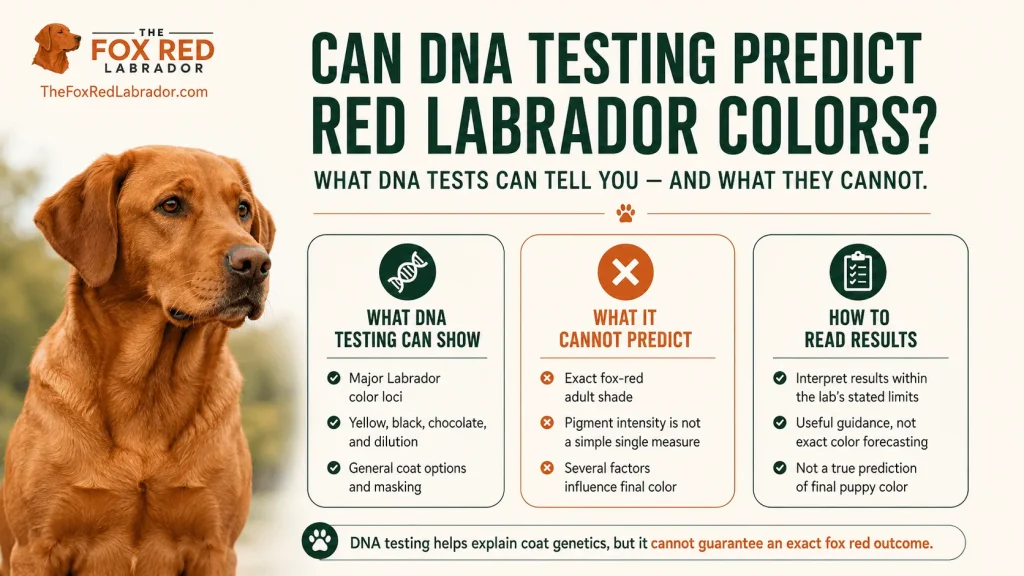
Major Labrador color loci can be identified with DNA testing, such as those associated with yellow, black, chocolate, and dilution. It can suggest general coat options and whether a dog is masked.
The standard panels are not certain to produce the fox-red adult color. Pigment intensity is a result that is not a simple measure of several factors.
Various variants are also tested in laboratories. The results need to be interpreted within the limits of the test company’s statement, not as a true prediction of puppy color.
Do Red Labs Change Color As They Grow?

Yes. As the puppy’s soft coat changes to the adult coat, a red Labrador puppy can turn lighter, darker, or more mottled.
There are a lot of changes that are visible in the first year. The surface appearance of the coat can also be influenced by the season, fresh coat growth, exposure to sunlight, and nutrition.
Dark ears can indicate a puppy’s depth, but aren’t a certain indicator. It is also possible that adult coloring will still leave everyone with a little shock.
Why Is My Red Lab Getting Lighter?
The outer coat may become bleached by sun exposure, especially if exposed to the sun for long periods. Shedding can also take place during the season and cause a lighter shade to be visible for a brief period.
The color can be softened at various stages of life due to puppy maturation and facial graying. Gradual, even change is typically cosmetic.
If the fading is patchy and there is itching, redness, broken hair or hair loss, it is different. The changes are not a normal color change and should be addressed by a veterinarian. Persistent skin irritation or patchy coat loss requires attention beyond normal color changes, as explained in the fox red Labrador health guide.
When Do Red Labs Reach Their Full Color?
As the mature coat grows in the first year, a lot of the coloring of a red Lab becomes more apparent. Some dogs go beyond that to deepen or soften.
No one’s birthday fixes the coat into a single color. It is constantly changing in appearance as a result of summer sun, winter growth, shedding cycles and aging.
Using the puppy, parents, and pedigree, breeders can make a good guess as to what color the puppy will be. A 100% lifetime match of a shade is not guaranteed.
Do American And British Fox-Red Labradors Have Different Colors?
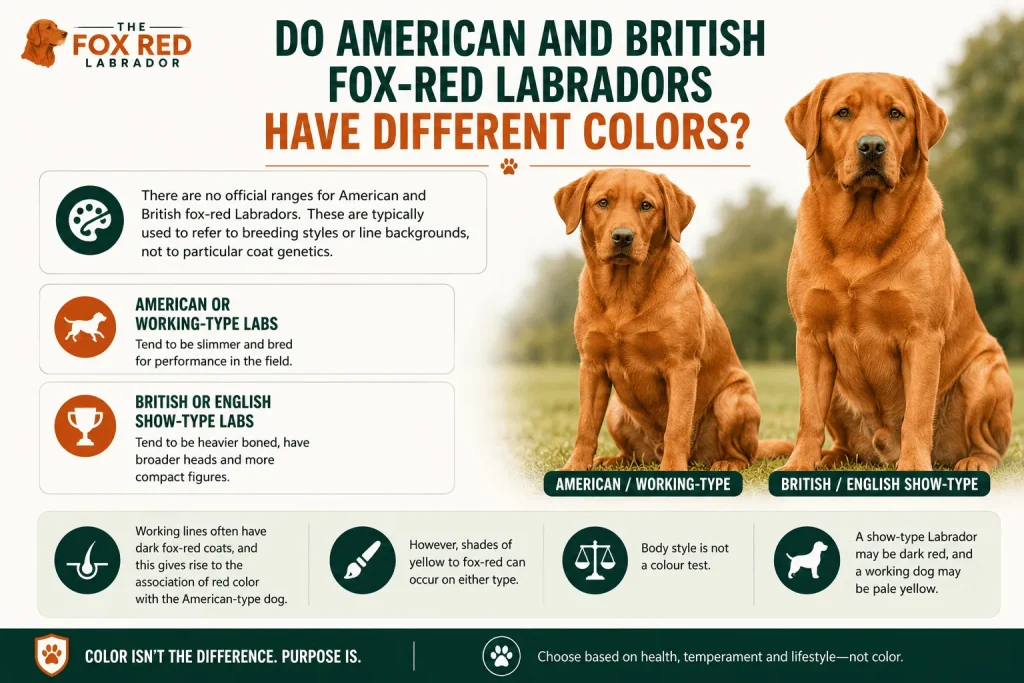
There are no official ranges for American and British fox-red Labradors. These are typically used to refer to breeding styles or line backgrounds, not to particular coat genetics.
American or working-type Labs tend to be slimmer and bred for performance in the field. British or English show-type dogs tend to be heavier boned, have broader heads and more compact figures.
Working lines often have dark fox-red coats, and this gives rise to the association of red color with the American-type dog. However, shades of yellow to fox-red can occur on either type.
Body style is not a colour test. A show-type Labrador may be dark red, and a working dog may be pale yellow.
Where Did The Fox-Red Labrador Color Come From?

Black dogs were more likely to be cared for first, and yellow puppies were less likely to be cared for. The first known yellow Labrador is believed to be Ben of Hyde, born in 1899.
Many of the early yellow dogs had darker coats than the ones that are seen today. They are described in the past as dark gold, butterscotch, or yellow with a reddish tinge.
Lighter shades of yellow started to become popular in the twentieth century, particularly in the post-World War II period. The color of darker coats faded in the breed but never went away.
Fox red was then revived by British breeders. Working lines maintained the darker shade and Wynfaul Tabasco and Balrion Red Alert were influential names in many recorded red pedigrees.
With that said, modern fox red isn’t a new designer shade. It is a part of the yellow legacy in Labrador.
Does Red Coat Color Affect Health Or Temperament?
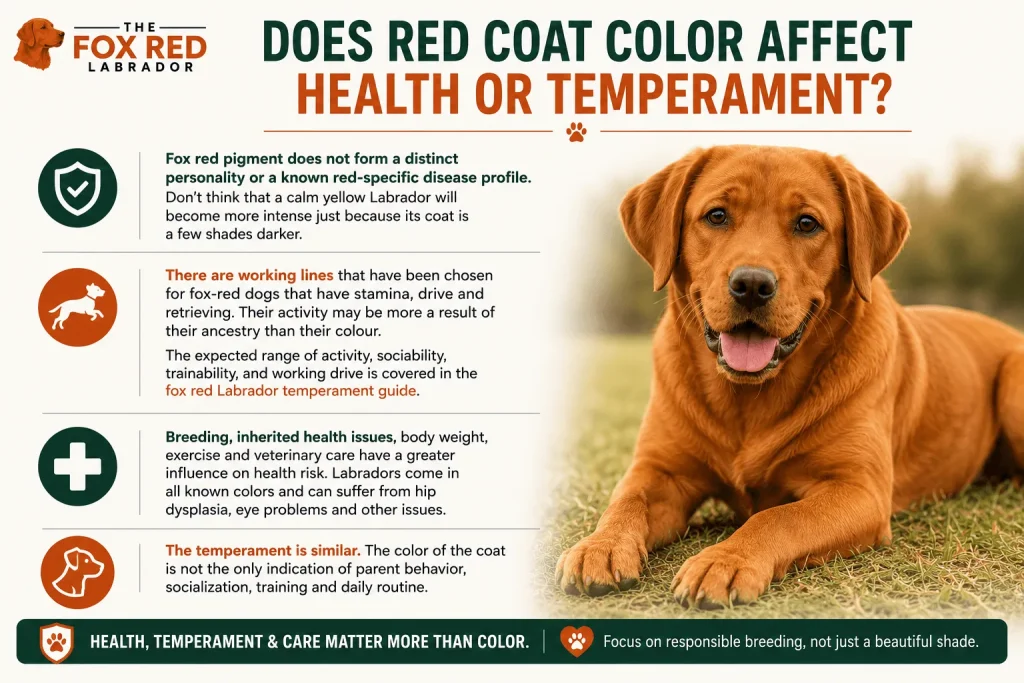
Fox red pigment does not form a distinct personality or a known red-specific disease profile. Don’t think that a calm yellow Labrador will become more intense just because its coat is a few shades darker.
There are working lines that have been chosen for fox-red dogs that have stamina, drive and retrieving. Their activity may be more a result of their ancestry than their colour.The expected range of activity, sociability, trainability, and working drive is covered in the fox red Labrador temperament guide.
Breeding, inherited health issues, body weight, exercise and veterinary care have a greater influence on health risk. Labradors come in all known colors and can suffer from hip dysplasia, eye problems and other issues.
The temperament is similar. The color of the coat is not the only indication of parent behavior, socialization, training and daily routine.
How Should Buyers Evaluate A Red Labrador Breeder?
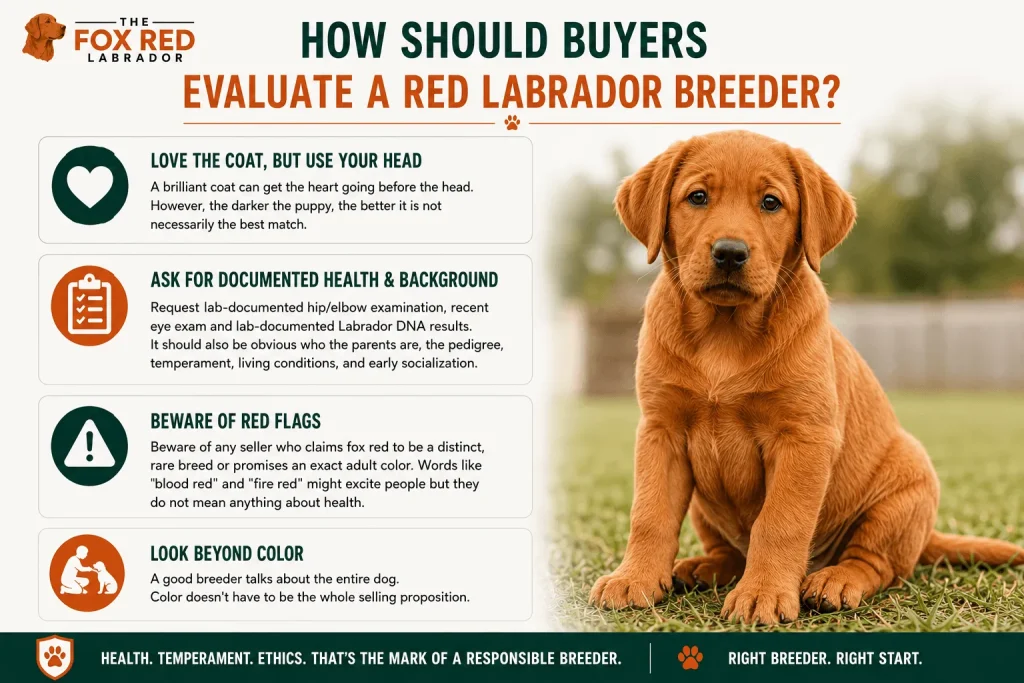
A brilliant coat can get the heart going before the head. However, the darker the puppy, the better it is not necessarily the best match.
Request lab-documented hip/elbow examination, recent eye exam and lab-documented Labrador DNA results. It should also be obvious who the parents are, the pedigree, temperament, living conditions, and early socialization.
Beware of any seller who claims fox red to be a distinct, rare breed or promises an exact adult color. Words like “blood red” and “fire red” might excite people but they do not mean anything about health.
A good breeder talks about the entire dog. Color doesn’t have to be the whole selling proposition.
Conclusion: Red Labrador Colors Are Part Of The Yellow Spectrum
The colour of the red Labrador is from a light golden-copper to a deep russet. All shades fall into the acknowledged category of yellow Labrador and are not considered to be a separate breed or fourth official color.
Though a rich coat is beautiful, it’s just one attribute. The dog to its right tells a much more complete story than just its sound health, steady temperament, documented ancestry, and responsible breeding.
FAQ’s
Yes, a red Lab can be a 100% purebred. Fox red is not a crossbred colour; it is a natural variation of a yellow Labrador. Documented ancestry and registration records are the basis for purebred status. It cannot be substantiated or refuted by the darkness alone.
Pale and medium yellow Labradors are more common than fox-red Labradors. They are available in different regions, bloodlines and from different breeders. Rare is a marketing term and shouldn’t be the reason for a high price. The importance of health testing and temperament far outweighs.
Yes. Genetically and officially, a fox-red Labrador is a yellow Labrador. Yellow coats come in light cream to deep fox red. The dog will generally be registered as yellow even if the fur appears copper or russet.
The natural fox-red coat color varies from warm golden-red to deep copper and russet. Some are darker around the ears, back and tail. The terms blood red, fire red and mahogany are informal descriptions. The coat may appear more red than it actually is, due to lighting and photo editing.
The darkest natural color is typically called dark fox red. These dogs can be rich copper, burnt orange or dark russet. Another name sometimes used by breeders for Mahogany is mahogany mahi mahi. There is no official distinction between these shades from a kennel club.
Yes. A light fox-red Labrador can be slightly copper or orange in color. The upper back and ears may be darker than the rest of its body. There is no official distinction between light fox red and dark golden yellow, and differing descriptions among breeders.
Red chocolate is not a true Labrador colour. The word can be applied to a chocolate Lab that has warm brown coloring. Brown eumelanin is found in chocolate coats and yellow-to-red pheomelanin in fox-red coats. The two colours are on different pigment lines.
Temperament is not consistent with coat shade. Some fox-red Labradors are energetic as they are bred from working lines that are bred for drive and stamina. Parent behavior, bloodline, socialization, training, and daily exercise are more important to the pigment intensity than the pigment intensity itself.
Major color variations such as the ee combination that leads to a yellow Labrador coat, can be confirmed by DNA testing. It can also detect hidden black, chocolate or dilution variants. Most standard tests will not guarantee the exact adult fox-red shade as there are multiple factors involved in pigment intensity.