
Red Labrador Ownership: Everything You Need to Know
A Fox Red Labrador can make a great pet for an active family. Be prepared for daily exercise, patient training, shedding and a dog that wants to be a part of family life, not in another room.
There is a dark shade of yellow Labrador that is called fox red. It is not a different breed, and color does not guarantee health, intelligence or temperament. Much more is revealed by the parents, breeding line, and early socialization and by the individual dog.
TLDR;
A fox red Labrador is a yellow Labrador with a deep copper or reddish coat. It’s a good breed for active owners who have time to exercise, train, and play. Not all fox red dogs are working line dogs; many are. Pick health, temperament and house-temperament before picking the darkest puppy.
Fox Red Labrador Ownership At A Glance
Consider this dog as a Labrador first, a fox red dog second. It is not the length of its coat that is responsible for its basic physical and behavioral needs; the Labrador breed is the source of its needs.
The American Kennel Club standard does not provide separate measurements for a fox red dog, but instead provides measurements for male and female Labs.
| Ownership Factor | What To Expect |
|---|---|
| Breed | Labrador Retriever |
| Official color | Yellow, ranging from pale cream to dark fox red |
| Common informal names | Fox Red Lab, Red Fox Lab, Red Labrador and Ruby Lab |
| Male height | 22½–24½ inches at the shoulder |
| Female height | 21½–23½ inches at the shoulder |
| Male weight | Approximately 65–80 pounds in working condition |
| Female weight | Approximately 55–70 pounds in working condition |
| Coat type | Short, dense, weather-resistant double coat |
| Typical personality | Social, energetic, trainable and people-oriented |
| Exercise needs | Substantial daily physical and mental activity |
| Shedding | Regular shedding with heavier seasonal periods |
| Grooming | Straightforward, but brushing and routine care are necessary |
| Alone time | Must be developed gradually; repeated long isolation is a poor fit |
| Children | Often suitable with training and adult supervision |
| Cats and dogs | Compatibility depends on the individual and introductions |
| Small pets and birds | Secure separation and careful management may be necessary |
| Apartment living | Possible when activity, toilet and settling needs are met |
| First-time owners | Suitable for prepared, active beginners |
| Typical lifespan | Commonly around 11–13 years |
| Rescue availability | Possible through Labrador rescues, shelters and private rehoming |
| Best fit | Active households wanting an involved companion |
| Poor fit | Homes seeking a quiet, independent or low-effort dog |
These descriptions are helpful but they are not guarantees. A well-behaved adult rescue can be easier to deal with than a very motivated puppy, despite their identical appearance.
What Makes A Fox Red Labrador Different?
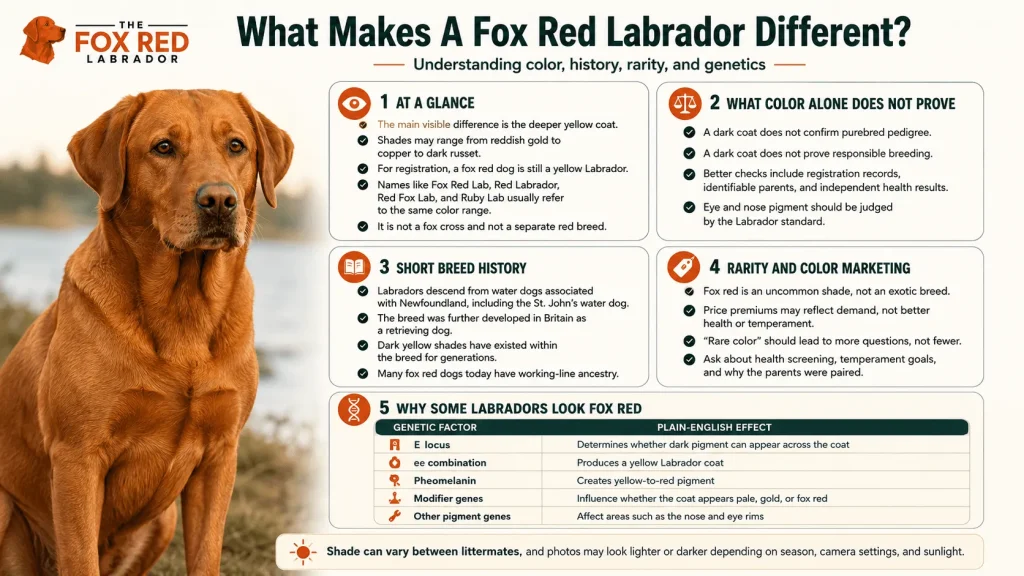
The visible difference is in the depth of the coat. Fox red coats can come in a variety of shades, including reddish gold, rich copper and dark russet. The dog will still be a yellow lab for the purpose of registration.
The same general color variation is referred to as Red Fox Lab, Fox Red Lab, Red Labrador and Ruby Lab. None is a cross with a fox or an independent red breed.
A purebred puppy’s appearance is no guarantee of its pedigree. A dark coat doesn’t necessarily indicate responsible breeding either. Registration records, identifiable parents and independent health results are much better.
Eye colour and nose colour should be judged in relation to the Labrador standard and not a “red Lab” standard. A good breeder should be able to talk about pigmentation, structure and health without making one of the three the dog.
Short Breed History Callout
The modern Labrador is a result of the water dogs which came with Newfoundland, including the St. John’s water dog. They were used around water and were later bred in Britain to be good retrieving dogs.
That history continues in normal conduct. Lots of Labradors love to swim, carry things and follow a scent. It might not be as puzzling when a retriever moves in when the towel is damp and gone from the bathroom.
Within the breed, dark yellow shades have been around for generations. In some show circles, lighter yellow was becoming popular and many working and field lines were still a deeper red colour. That history is what makes it so that a large portion of the fox red dogs today have working ancestry.
Rarity And Color Marketing
Fox red is not a common lighter yellow color but it is not an uncommon exotic breed. Availability varies by region and breeding line.
Some breeders have higher prices due to the demand for dark puppies. A premium price does not indicate superior health, structure or temperament, but may be due to scarcity.
Use “rare color” to give yourself more questions, not less. A well-thought-out breeding program should be able to provide an explanation for health screening, temperament objectives and why the specific parents were bred together.
Why Do Some Labradors Have A Fox Red Coat?
Most yellow Labradors have two recessive alleles at the E locus (ee). This will ensure that the coat is not tinted with dark eumelanin, and will show up as yellow-to-red pheomelanin.
Other inherited factors affect the colour of this pigment. The geneticists haven’t narrowed every difference in color down to a single switch, so exact puppy color cannot be predicted as you would choose a fabric sample.
| Genetic Factor | Plain-English Effect |
|---|---|
| E locus | Determines whether dark pigment can appear across the coat |
| ee combination | Produces a yellow Labrador coat |
| Pheomelanin | Creates yellow-to-red pigment |
| Modifier genes | Influence whether the coat appears pale, gold or fox red |
| Other pigmentation genes | Affect areas such as the nose and eye rims |
It is possible for puppies in the same litter to finish at different shades. The color of a dog may also change in photos due to the color of the seasons, camera settings, and the amount of sunlight.
What Is Fox Red Labrador Ownership Really Like?
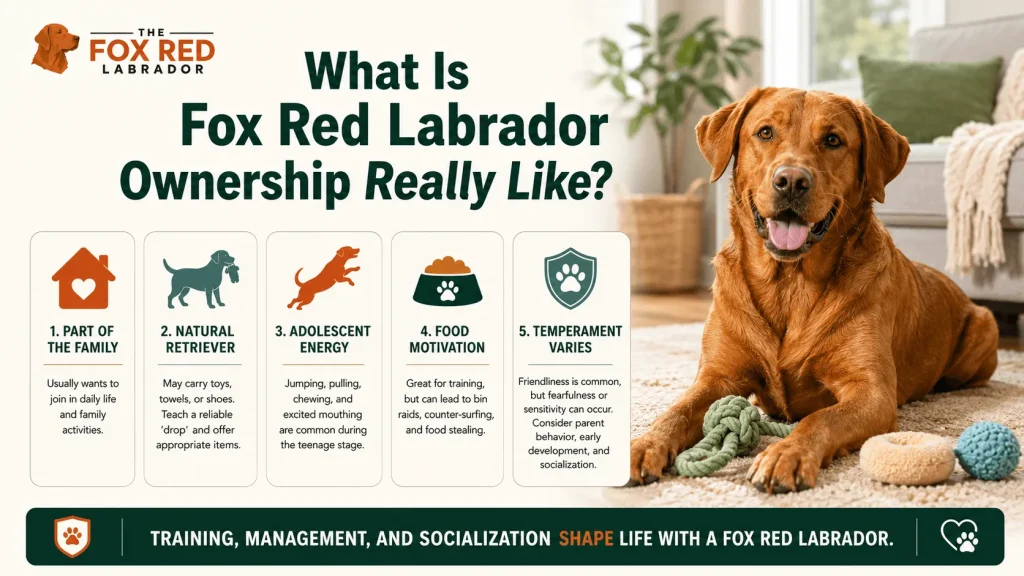
A Fox Red Labrador usually wants to be a part of the family. Supervised activities may include cooking, gardening, walking to the post box and folding laundry.
Retrieving is found in regular times. Your dog might bring toys, towels or a shoe that he or she does not plan to wear. Rather than beginning a daily “drop” around the dining table, it is better to teach “drop” and give them appropriate objects to carry.
Adolescence can be a very athletic time. Owners often request assistance with jumping, pulling, chewing, excited mouthing and selective hearing. They do not make the dog a bad dog but they are not going to go away if you just wish them to.
Training can be facilitated by food motivation. It can also cause bin raids, counter-surfing and a display of tragic starvation just after breakfast. Weigh food and put away goodies.
Friendliness is not guaranteed and is common. Fearfulness, sensitivity or reactivity may be found in any line. Prior to selecting a puppy, consider parent behavior as well as early development and thoughtful socialization.
Fox Red Labrador Pros And Cons
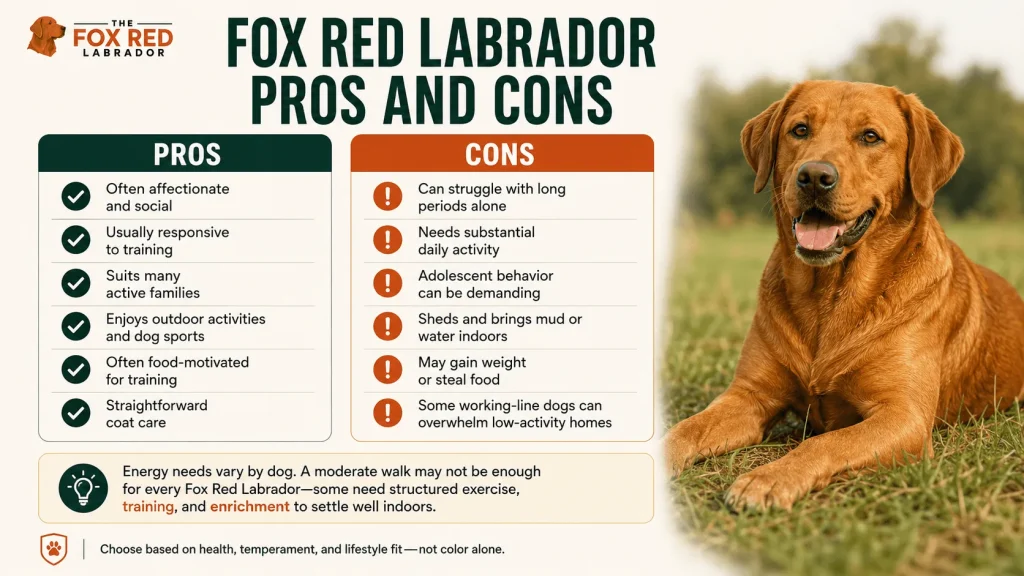
The good attributes are genuine. So are the demands. It’s better to consider both sides before you select a puppy than to find out later that there are some rough edges.
| Pros | Cons |
|---|---|
| Often affectionate and social | Can struggle with long periods alone |
| Usually responsive to training | Adolescent behavior can be demanding |
| Suitable for many active families | Requires substantial daily activity |
| Enjoys outdoor activities | Brings hair, water and mud indoors |
| Often food-motivated | Can gain weight or steal food |
| Can participate in dog sports | Working-line drive may overwhelm some homes |
| Straightforward coat care | Sheds throughout the year |
| Often adaptable with preparation | Not a low-maintenance dog |
| Often enjoys training and shared activities | Needs owners who can maintain a routine |
| Can suit outdoor and sporting households | May chase birds or small animals |
| May adapt to several housing types | Apartment success requires more owner effort |
| Can train for specialized work | Not every dog has a suitable working temperament |
After a moderate walk, one dog can get a bit of a rest. It may need more organized work before it is ready to stay inside. No coat will indicate you are meeting a puppy.
A Realistic Daily Routine For A Fox Red Labrador

A viable schedule involves activity, education, interaction and rest. There’s no such thing as constant entertainment and it’s not healthy.
The example below is for a healthy adult. Puppies require more potty breaks, less activity and a lot more sleep. The elderly can maintain the same tempo but at a slower speed.
Morning Responsibilities
Start with a toilet break and age appropriate movement. A walk, scent search or a short training game can get the day off to a good start.
Measure breakfast. Recall and calm behavior or lead manners may be rewarded as part of the meal. Give your dog time to digest food before exercising.
Look for paws, movement and overall comfort. Plan may change if new stiffness or reluctance to walk is noted.
Daytime Responsibilities
An adult who is not working must have fresh water, a safe resting place, and appropriate enrichment. Food puzzles, scent games and safe chews can offer interests without the constant noise.
There is a need for support when working long hours. A trusted visitor, walker and appropriate daycare may be required. The home cameras can tell you if the dog is resting comfortably or if he or she is distressed.
The concept of rest is a component of good care. A tired puppy may be wild, mouthy and seemingly running on a private generator.
Evening Responsibilities
Select an activity to go with the morning. Variety can be provided through walking, swimming, scent work, training or controlled retrieval.
Check ears, coat and paws after going outside. Dry the dog thoroughly after swimming, particularly around the ears.
Conclude with a portioned feeding and a soothing bedtime ritual. A bed or mat can be a good indicator that the busy time of the day is over.
How Much Exercise And Mental Stimulation Does A Fox Red Lab Need?
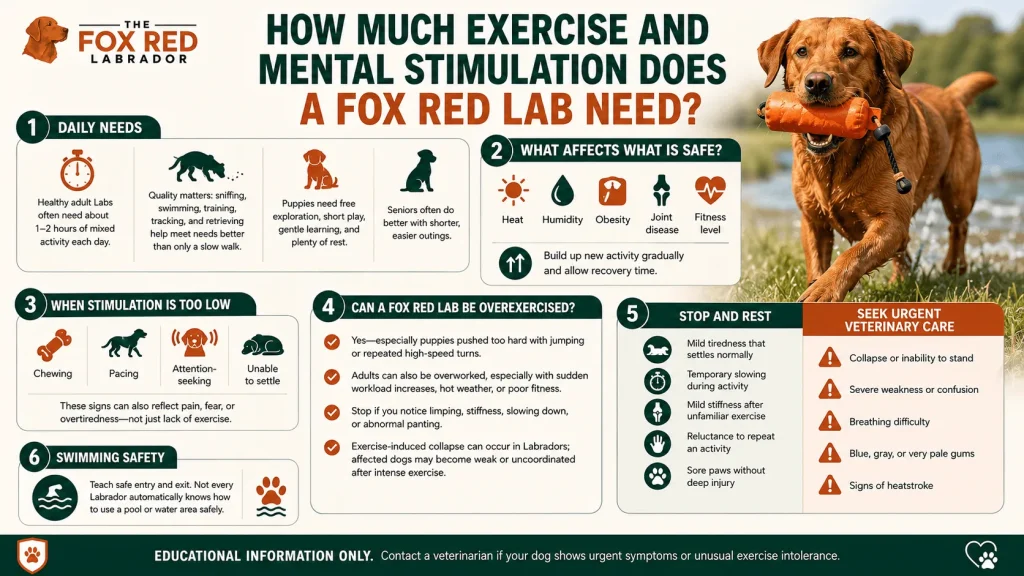
Large amounts of exercise are typically required for healthy adult Labradors. Some are fine with about an hour of mixed activity and training; others, particularly high drive adults, require more like two hours, spread throughout the day.
Quality matters. A slow pavement walk provides movement, but it might not be enough for a young field-bred dog. Different needs can be met through sniffing, swimming, training, tracking and retrieving.
An adult endurance plan should not be followed by puppies. They should be encouraged to engage in free exploration, short play, gentle learning and rest. For senior dogs, it might be best to keep activities to a minimum and outings shorter.
What is safe is affected by heat, humidity, obesity, joint disease and fitness. Gradually construct new activities and permit recuperation.
Lack of stimulation can manifest itself as chewing, pacing, attention seeking or inability to settle. These can also be a symptom of pain, fear or over tiredness and more exercise is not always the solution.
Can A Fox Red Labrador Be Overexercised?
Yes. Rushing young pups, jumping and endless high-speed turns are all damaging strains for them.
The adults can also be pushed too far. Risk increases with sudden workload increases, hot weather and poor condition. Stop if they show signs of limping, stiffness, slowing down or abnormal panting.
Exercise-induced collapse is an inherited disorder that occurs in Labradors. Affected dogs can be weak or uncoordinated following intense exercise.
| Stop And Rest | Seek Urgent Veterinary Care |
|---|---|
| Mild tiredness that resolves normally | Collapse or inability to stand |
| Temporary slowing during activity | Severe weakness or confusion |
| Mild stiffness after unfamiliar exercise | Breathing difficulty |
| Reluctance to repeat an activity | Blue, gray or very pale gums |
| Sore paws without deep injury | Signs of heatstroke |
Educate swimming safely using an entry and exit. Even though family legend might say otherwise, not all Labradors come with the knowledge of how to use a pool safely.
Is A Working-Line Fox Red Labrador A Good Family Pet?

A working-line fox red Labrador can make a great family dog for families that like to train and live an active outdoor lifestyle. These dogs can offer stamina, fast learning and good retrieving abilities.
It’s usually the level of effort, not the level of love. Two short walks on a leash and an empty yard may seem too little, too late for a working dog.
Ask the breeder:
- Do both parents settle calmly indoors?
- How do they respond to unfamiliar people?
- Are they comfortable around other dogs?
- Are they sensitive to noise or new places?
- What work were they bred to perform?
- What were earlier puppies like as adults?
- Does the breeder match puppies by temperament?
- Can you meet adult relatives from the line?
Drive, fear and overarousal are different traits. A nervous dog is not simply “high energy,” and exhausting it will not resolve fear.
Working-Line Vs Show-Line Fox Red Labradors
The working and field lines are, in general, selected for performance. More emphasis is placed on conformation in show or bench lines. There are still plenty of dogs that love the family and things outside of the kennel.
| Factor | Working Or Field Line | Show Or Bench Line |
|---|---|---|
| Typical build | Often lighter and athletic | Often broader and heavier-set |
| Activity tendency | Often higher | Frequently more moderate |
| Retrieving drive | Commonly strong | Varies |
| Training needs | Purposeful and structured | Consistent daily training |
| Household match | Active or working homes | Often adaptable family homes |
| Individual variation | Always applies | Always applies |
| Typical indoor settling | May require more deliberate teaching | Often easier, though individual variation remains |
| Sensitivity and arousal | Can be higher in some lines | Varies by pedigree and individual |
| Best owner questions | Ask about drive, work and earlier litters | Ask about health, structure and everyday temperament |
The informal style description terms are “American Lab” and “English Lab”. They aren’t distinct breeds.
Appearance is a hint and not a fact. A show-bred dog of any type can be a lot of fun; a working dog can be a cuddle-bug right up beside the sofa.
Are Fox Red Labradors Good For First-Time Owners?
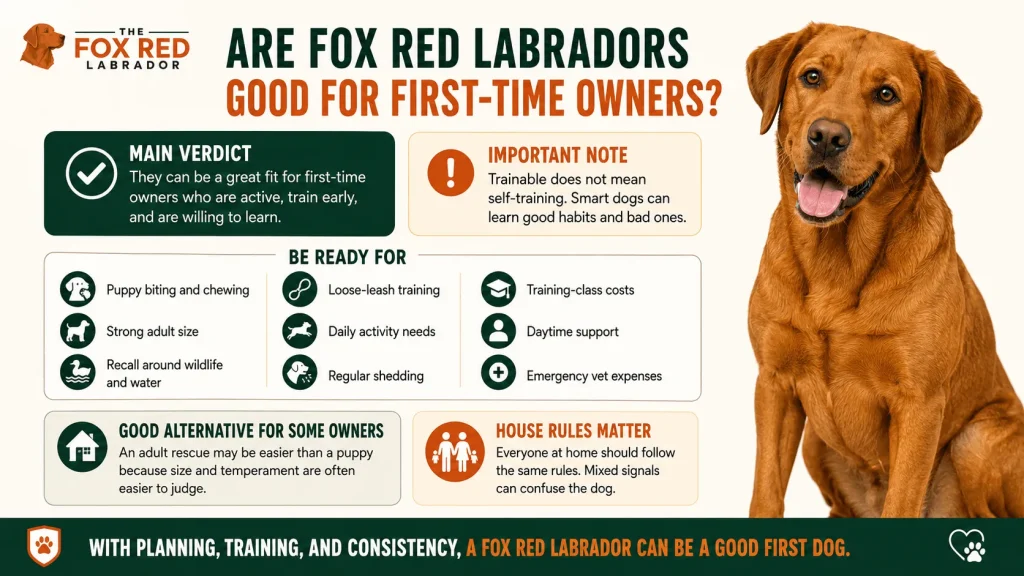
They can be. First-time owners who are learning-oriented, train early and are active can do very well.
Trainability should not be confused with self-training. A clever kid can pick up good habits in no time and come up with less convenient ones as well.
Prepare for:
- Puppy biting and chewing
- A strong adult body
- Recall around wildlife and water
- Loose-leash training
- Daily activity
- Regular shedding
- Training-class costs
- Daytime support
- Emergency veterinary expenses
For some first-time owners, an adult rescue might be better suited than a puppy. It’s a known size and its common disposition can be more easily judged.
Check with everyone in the home if they will follow the rules before committing. If one person is rewarding calm greetings and another is rewarding jumping, the dog is likely to be confused.
Are Fox Red Labradors Good For Families With Children?
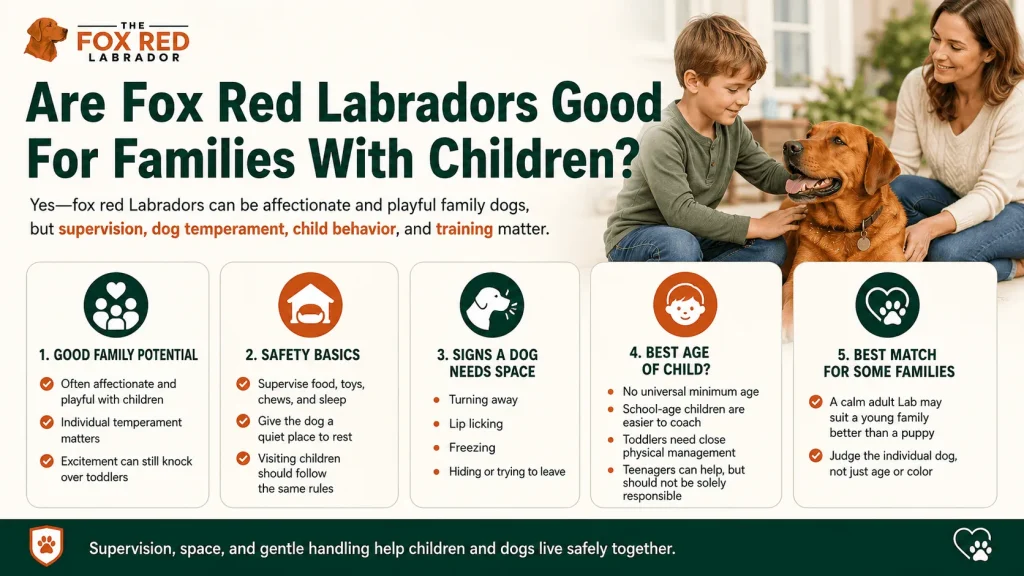
Many are affectionate and playful with children. They are still too small and excited to be handled by adults.
A friendly dog can knock over a toddler, even if it is not aggressive. Other common issues are puppy teeth, wagging tails, dropped food and loud play.
Provide a quiet place for the dog not to be followed by children. Supervise contact with food, chews, toys and sleep. Visiting children should adhere to the same rules.
Look for signs of turning away, lip licking, freezing, hiding or attempting to leave. These signals indicate that the dog is in need of space.
Children will not hug the dog tightly, climb on top of the dog, or take items out of the dog’s mouth. Family photos are nice to have warm; a dog under an enthusiastic hug is not the one to frame.
What Age Of Child Is Best Suited To A Fox Red Lab?
There is no universal minimum age. One number is not enough; adult supervision, dog temperament and child behavior are also important.
Close physical management is required with toddlers as they are unpredictable. School-age children can more easily be coached to follow safety rules. Teenagers may help with dog training, but not be solely responsible for it.
A young family might be better suited to a calm adult Lab than a puppy. Do not judge by age or color – judge the individual dog.
Can Fox Red Labradors Live With Cats And Other Dogs?

There are many cats who can live peacefully with dogs. Compatibility is related to temperament, previous experience and gradual introductions.
Where possible, dogs should meet in a neutral area. Limit early sessions and don’t over-stimulate. Provide individual feeding and high value chews.
Cats require raised places and spaces that the dog cannot access. Chasing should be avoided from start to finish as the more it is practiced, the more it is rewarded.
Play styles matter. A large, physical lab can overwhelm a smaller and/or older dog. Adolescence may also be a time of renewed interest in chases.
Get professional assistance if there is continued staring, stalking, guarding, lunging or fighting. A potentially harmful trend can be established by waiting for animals to “sort it out”.
How Should A Fox Red Lab Be Introduced To A Cat?
Take care to set up cat-only areas prior to the dog’s arrival. Start by using scent and sound before the animals come together.
Follow this order:
- Replace bed linens or fragrances.
- Give visual access (through secure barrier).
- Use a leash for initial dog introductions.
- Praise for looking away and responding to its name.
- Provide an easy way for the cat to get away.
- Share time only when both are relaxed.
Never hold the cat in front of the dog. Go back to a previous step if either animal gets stressed.
Can Fox Red Labradors Live With Small Pets And Birds?
Small mammals and birds need more intensive management than cats and dogs. Even the friendliest Labrador can become excited and chase or grab something if it is moving quickly.
A dog staring at a rabbit or guinea pig enclosure may cause stress in them. Cage bars do not always provide enough protection from paws, teeth or a tipped enclosure.
For small animals, use secure dog free rooms. Birds can be released from their cage behind a closed door when the dog is away.
While training can help to enhance control, it cannot eliminate all instincts or mistakes. Introductions must not be up to the children.
| Animal | Recommended Supervision Level |
|---|---|
| Familiar, compatible adult dog | Routine supervision |
| Confident cat with safe exits | Controlled introduction and continued monitoring |
| Rabbit or guinea pig | High caution with physical separation |
| Hamster or other small rodent | Secure enclosure in a dog-free area |
| Caged bird | Secure enclosure and controlled room access |
| Free-roaming bird | Complete physical separation |
| Chickens or poultry | Controlled training plus secure dog-proof housing |
Are Fox Red Labs Safe Around Chickens And Poultry?
Some get used to being around birds. Never assume that a dog is safe just because it is a Labrador.
Start off at a distance, with the dog on a leash. Praise quiet watching and redirecting. Don’t allow play chasing to become a good habit.
Even if the training has been successful, the poultry require secure housing. A dog that is calm on a leash does not necessarily mean it is reliable off a leash.
There are local rules regarding dogs worrying or injuring livestock. Owners should consult their legal obligations in their own country.
Can A Fox Red Labrador Live In An Apartment?
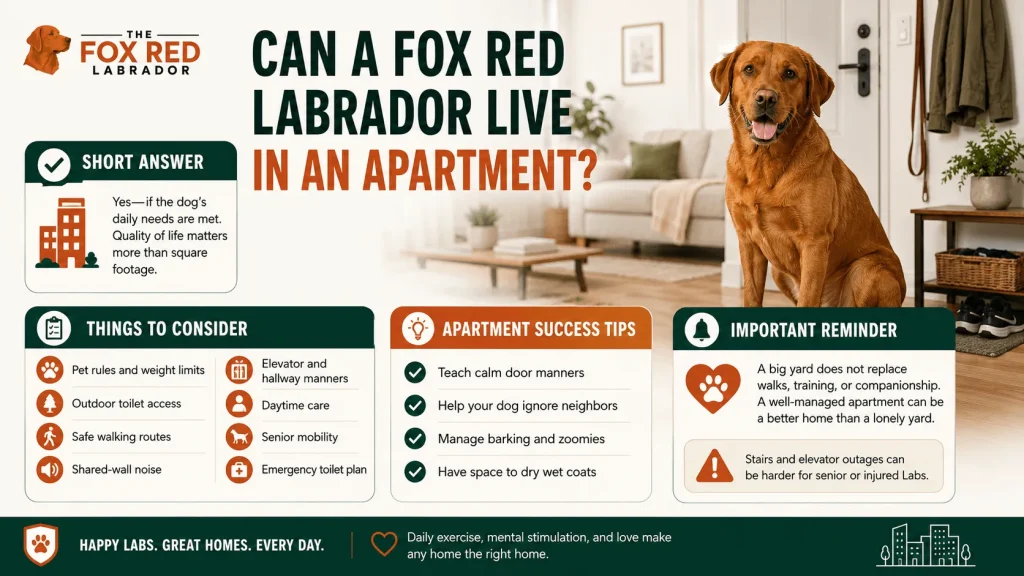
Yes, if the owner is able to take care of the dog’s needs in an apartment setting. Quality of life is more important than just square footage.
Consider:
- Building pet rules and weight limits
- Outdoor toilet access
- Safe walking routes
- Shared-wall noise
- Elevator and hallway manners
- Senior mobility
- Daytime care
- Space to dry wet coats
- Emergency toilet plans during severe weather
It is important for a young dog to learn to ignore neighbors and wait at doors. If it’s a wall-sharing house, barking and zoomies are more apparent.
Stairs may be challenging for an injured and/or an older Lab. If the apartment is located a few floors above, then it is worth considering to think about the outages of the elevator.
It is good to have a large yard, but it can’t compensate for walking, training or companionship. A good house can be a better home than a solitary garden.
How Long Can A Fox Red Labrador Be Left Alone?

There is no set limit that works for all dogs. This is important for age, health, toilet, history and emotional comfort.
| Life Stage | Main Alone-Time Limitation |
|---|---|
| Young puppy | Toilet, feeding, supervision and emotional development |
| Adolescent | Activity, chewing, training and settling |
| Healthy adult | Individual comfort, toilet needs and daily routine |
| Senior | Mobility, medication, continence and health |
Crates can provide a secure resting place. It should not be used for a whole day of storage.
Help from walkers, trusted visitors or appropriate day care. The cameras show if the dog is sleeping, barking, pacing or attempting to escape.
Destruction does not always mean boredom. Separation-related distress may be signaled by drooling, frantic pacing, toileting, vocalization and refusal of food.
How Can Owners Teach Comfortable Alone Time?
Practise calm separation while you are still home. Use a gate or safe room and provide positive reinforcement for the dog settling on his own.
Start with short absences that don’t cause anxiety. Build up the time slowly and not from a few minutes to several hours.
Provide water, bedding and suitable enrichment. Adjust departure signals smoothly to avoid the association of picking up keys with long absences.
Setbacks can occur when a move, sickness or significant change in the schedule occurs. Panic, injury and destruction of exits require veterinary and qualified behavioral assistance.
Are Fox Red Labradors Easy To Train?

They are fast learners. Owners have a number of useful rewards to offer, including food, play and social attention.
Begin by practicing skills to keep life safe:
- Name response
- Recall
- Loose-leash walking
- Leave and drop cues
- Waiting at doors
- Settling on a mat
- Visitor manners
- Cooperative handling
- Safe crate or pen use
Gradually practice around water and wildlife. What you learned in the kitchen, you might not recognize by a pond of ducks.
It is not necessary to greet all the dogs and all the people. Often it is better to sit back and observe quietly than to interact all the time.
Normal responses may become less effective at times in adolescence. Don’t assume the dog is being stubborn; go back to simpler practice.
Common Fox Red Labrador Training Problems
The majority of problems are a normal behavior in an inconvenient location. Management keeps practice at bay and training develops a more effective response.
| Problem | Likely Cause | Helpful Response |
|---|---|---|
| Jumping on people | Excitement and rewarded greetings | Reward four paws on the floor and manage entrances |
| Pulling on the lead | Fast pace and environmental interest | Practise in quiet areas before adding distractions |
| Mouthing | Play, teething, excitement or fatigue | Redirect to toys and provide calm rest |
| Counter-surfing | Accessible food and previous success | Clear counters and reward staying on a mat |
| Destructive chewing | Teething, boredom or poor supervision | Puppy-proof the area and provide safe chews |
| Poor recall | Distractions exceed training history | Use a long line and build rewards gradually |
| Inability to settle | Overarousal or missing calm practice | Reinforce quiet behavior before frustration rises |
| Resource guarding | Fear of losing valued items | Stop forced removal and seek qualified guidance |
| Chasing animals | Movement and inherited drive | Prevent rehearsal and train at a safe distance |
| Scavenging | Food motivation and easy access | Manage the environment and teach a strong leave cue |
| Water overexcitement | High reward value and poor impulse control | Use distance, calm entries and structured breaks |
| Fear or reactivity | Genetics, pain or difficult experiences | Increase distance and seek professional assessment |
Warning suppression with punishment may not resolve the underlying emotion. If a dog is growling, snapping, or suddenly changing her routine, take the time to think about what is wrong.
Can A Fox Red Labrador Become A Service Or Therapy Dog?
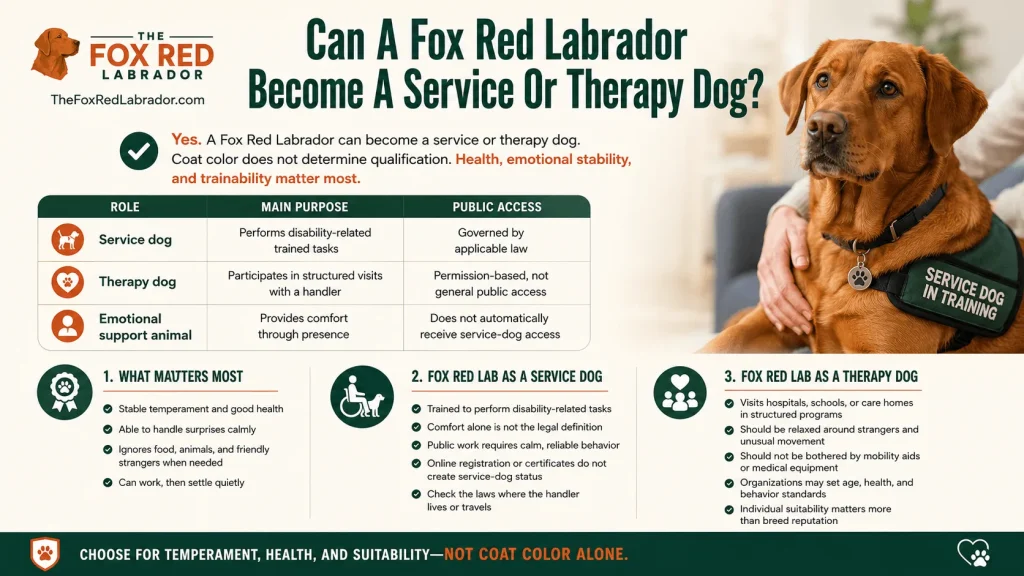
A dog of the Fox Red Labrador breed can be used as a service or therapy dog. The colour of the coat does not affect qualification.
The health, emotional stability and ability to deal with surprises are important. The dog should also ignore food, animals and friendly strangers when required for the work.
A highly motivated dog can pick up on tasks very quickly but may not be able to wait quietly for a long time. Breed reputation is not as important as individual selection.
| Role | Main Purpose | Public Access |
|---|---|---|
| Service dog | Performs disability-related trained tasks | Governed by applicable law |
| Therapy dog | Participates in structured visits with a handler | Permission-based, not general public access |
| Emotional support animal | Provides comfort through its presence | Does not automatically receive service-dog access |
Fox Red Lab As A Service Dog
A service dog is a dog that is trained to do work or tasks for a person with a disability under the Americans with Disabilities Act (ADA) of the United States. Comfort is not that definition.
Tasks may include anything the handler needs. A Labrador can retrieve, break a trained task or do something else appropriate to his or her ability.
When working in the public sector, it is important that you are calm and reliable. Service-dog status is not established by online registration or purchase of a certificate.
Rules vary in other countries. Look into the law in the handler’s home and travel locations.
Fox Red Lab As A Therapy Dog
A therapy dog is a dog that visits a hospital, school or care home in a structured visit. Service dogs do not have public access rights to service dogs.
A good dog is comfortable and relaxed in the presence of strangers, and is not troubled by mobility aids, medical equipment or odd movements.
Each organization has its own needs. For instance, Pet Partners assesses animal-handler teams and has standards for dogs’ age, health, and behavior.
Simple obedience is helpful but so is the dog’s emotional comfort. It should not be a dog’s job to be put on the job just because people like the look of them.
Fox Red Labrador Grooming And Shedding

The short coat is easier to take care of than some long coats. It continues to shed periodically.
Brush several times weekly, and more often in the season when they shed. Bathing should be based on need and not a schedule.
| Timing | Care Task |
|---|---|
| Weekly | Brush coat, check ears, inspect paws and examine skin |
| Monthly | Review nail length, dental routine and body condition |
| After swimming | Dry coat and ears; check for irritation or debris |
| Seasonally | Increase brushing during heavier shedding |
| As needed | Bathe with a dog-safe product and seek care for skin changes |
Regular care should be given to nails, teeth and ears. Consult your veterinarian about how often your dog’s ears should be cleaned. It is not usually necessary to shave a healthy double coat and it will not prevent shedding. Fox Red Labradors are not hypoallergenic.
Does A Fox Red Lab’s Coat Change Color?
A puppy may grow up lighter or darker than expected. The color of the ears may be darker than the body.
The visual appearance may vary with different lighting conditions, seasons and camera settings. Photographs do not guarantee the shade that the adult will be.
Loss, redness, odor, sores or ongoing itching are not normal changes in color. Those symptoms should be evaluated by a vet.
What Should A Fox Red Labrador Eat?
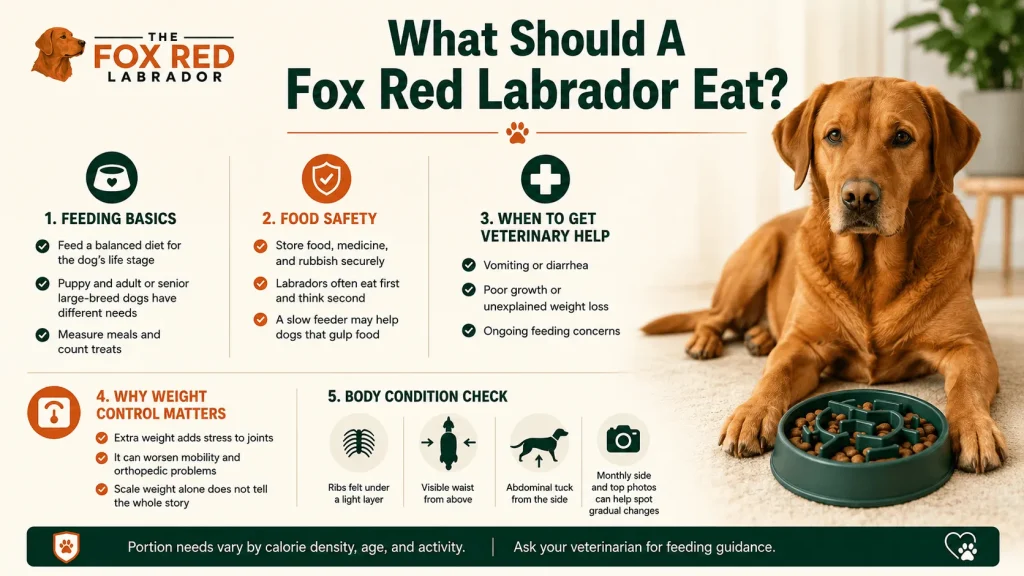
Feed a well-balanced diet suitable for the dog’s age. Puppy and adult/senior large breed dogs have different growth requirements.
Use a measuring cup to measure food and count training treats. Treats can be a second dinner when multiple family members are involved.
Securely store food, medicine and rubbish. Labradors are known to be “eaters first, thinkers second”.
For dogs that gulp their food, a slow feeder might be useful. If your pet is vomiting, has diarrhea, is not growing or losing weight for no known reason, you should get veterinary help.
The amount of food can’t be determined just by cups. Products vary in calorie density and people differ in their calorie requirements based on activity level and age.
Why Is Weight Control Important For Labradors?
Extra weight puts pressure on joints and can make it harder to move. It can also exacerbate the impact of orthopedic disease.
The ribs should be felt under a light layer, a waist should be visible from above and an abdominal tuck should be visible from the side.
Scale weight and Body Condition are not equivalent. Two dogs that are the same weight but one is a muscular working dog and the other is overweight, may be carrying the same weight, but in very different ways.
Take monthly side and overhead photographs. Gradual changes are more noticeable when comparing images.
What Health Problems Can Affect Fox Red Labradors?
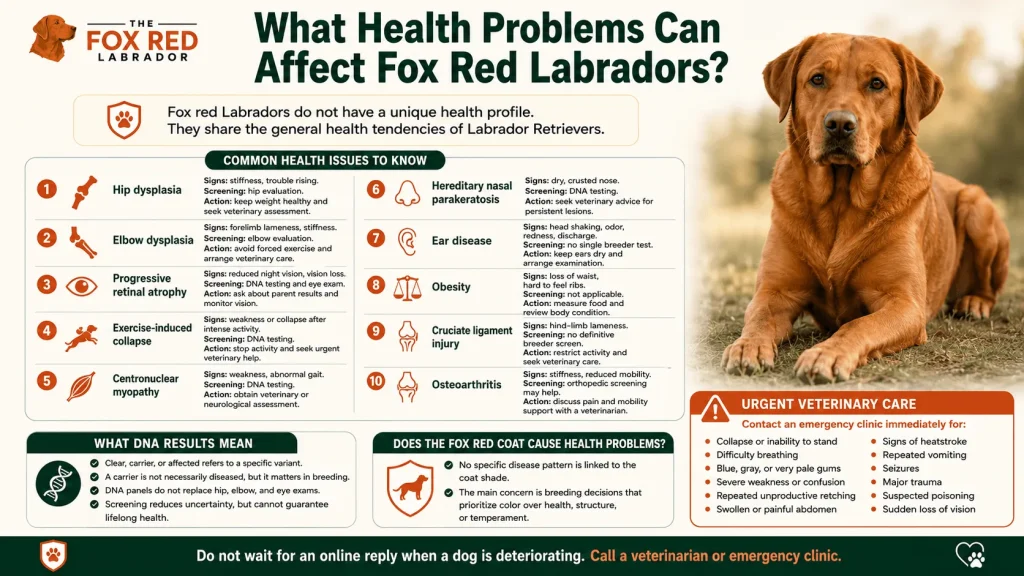
There is no unique health profile for fox red. These dogs have the overall Labrador tendencies.
| Condition | Possible Signs | Breeder Screening | Owner Action |
|---|---|---|---|
| Hip dysplasia | Stiffness, difficulty rising, altered gait | Hip evaluation | Maintain healthy weight and seek veterinary assessment |
| Elbow dysplasia | Forelimb lameness, stiffness, reduced activity | Elbow evaluation | Avoid forced exercise and arrange veterinary care |
| Progressive retinal atrophy | Reduced night vision, gradual vision loss | DNA testing and eye examination | Ask about parent results and monitor vision |
| Exercise-induced collapse | Weakness or collapse after intense activity | DNA testing | Stop activity and seek urgent veterinary help |
| Centronuclear myopathy | Weakness, abnormal gait, reduced exercise tolerance | DNA testing | Obtain veterinary and neurological assessment |
| Hereditary nasal parakeratosis | Dry, crusted nose | DNA testing | Seek veterinary advice for persistent lesions |
| Ear disease | Head shaking, odor, redness, discharge | No single breeder test | Keep ears dry and arrange examination |
| Obesity | Loss of waist, difficulty feeling ribs | Not applicable | Measure food and review body condition |
| Cruciate ligament injury | Sudden or progressive hind-limb lameness | No definitive breeder screen | Restrict activity and seek veterinary care |
| Osteoarthritis | Stiffness, reduced mobility, reluctance to jump | Related orthopedic screening may help | Discuss pain and mobility support with a veterinarian |
A dog can be clear, carrier or affected for a particular variant, as indicated by a DNA result. The carrier is not necessarily diseased, but it does have significance in breeding.
DNA panels are not a substitute for hip, elbow and eye exams. Prospective owners may check health results that have been submitted to the OFA database for identified dogs. Orthopedic Foundation for Animals. Screening lowers uncertainty. It cannot guarantee a lifetime of health. Screening, warning signs, preventive care, and common conditions are examined in the main fox red Labrador health guide.
Does The Fox Red Coat Cause Health Problems?
There is no specific disease pattern for the shade. The dog is a fox red Labrador Retriever and is subject to the general health issues of this breed.
The worry is in breeding decisions. Limited choice and then going back to deepen the color can be detrimental to attention to health, structure or temperament.
Discuss the purpose or objectives of the breeding other than appearance. A good answer needs to include more than just the answer of “people love dark puppies.”
When Does A Fox Red Lab Need Urgent Veterinary Care?
Contact an emergency clinic for:
- Collapse or inability to stand
- Difficulty breathing
- Blue, gray or very pale gums
- Severe weakness or confusion
- Repeated unproductive retching
- A swollen or painful abdomen
- Signs of heatstroke
- Repeated vomiting
- Seizures
- Major trauma
- Suspected poisoning
- Sudden loss of vision
- Self-injury during panic
Do not wait for an online reply when the dog is deteriorating. A clinic can advise whether immediate travel is necessary.
How Much Does A Fox Red Labrador Cost?
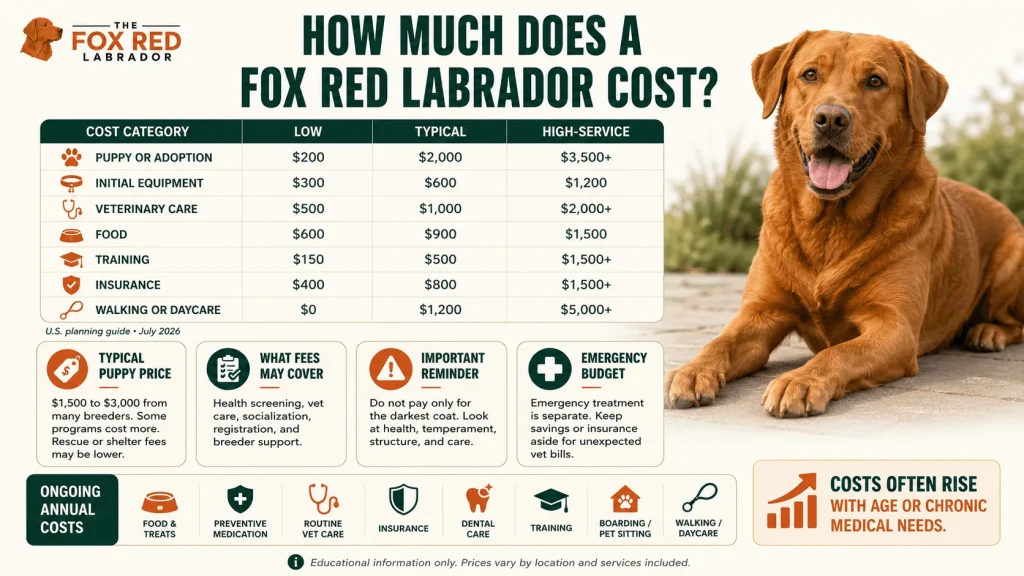
There is considerable variation in prices in the United States. Well-bred Labrador puppies are typically advertised by breeders at $1500 to $3000, and some programs are more expensive. Rescue and shelter fees may be less.
These are market prices and not a price recommendation. Check local programmes and what is covered in each fee.
Some of the costs associated with responsible breeding may be parent health screening, parent reproductive care, veterinary care, puppy socialization, registration and support. Those steps don’t necessarily mean that they were taken at a high price.
Demand is a factor in determining color premiums. Do not pay for breeding and responsible care decisions, just the darkest coat.
First-Year Fox Red Labrador Costs
The following table provides general planning guidance for the U.S. for July 2026. The overall amount can be significantly affected by local prices, insurance, medical requirements and professional services.
| Cost Category | Low Estimate | Typical Estimate | High-Service Estimate |
|---|---|---|---|
| Puppy or adoption | $200 | $2,000 | $3,500+ |
| Initial equipment | $300 | $600 | $1,200 |
| Veterinary care | $500 | $1,000 | $2,000+ |
| Food | $600 | $900 | $1,500 |
| Training | $150 | $500 | $1,500+ |
| Insurance | $400 | $800 | $1,500+ |
| Walking or daycare | $0 | $1,200 | $5,000+ |
Emergency treatment is not covered. Keep savings or insurance separate as one injury can be more than a normal annual budget.
While ASPCA figures are a good historical reference, the ASPCA’s published cost table was last updated in 2021 and should not be used as a current quote. It calculated the annual cost of a dog, based on recurring expenses, to be $1,391, plus a few add-on costs and surprise veterinary visits. Pet-care cost guide from the ASPCA.
Ongoing Annual Costs
Regular expenses include:
- Food and treats
- Preventive medication
- Routine veterinary care
- Insurance
- Dental care
- Training or activities
- Replacement equipment
- Grooming supplies
- Boarding or pet sitting
- Walking or daycare
- Pet deposits where applicable
There may be an increase in costs as age increases. The budget may vary significantly depending on chronic medication, diagnostic testing and mobility assistance.
Keep emergency money in a separate account from regular expenses. That decreases the likelihood of unplanned veterinary visits that could become a household emergency.
What Monthly Budget Does A Fox Red Labrador Need?

A monthly plan gives a more useful answer than one dramatic lifetime total.
| Budget Type | Household Example | Included Services |
|---|---|---|
| Basic planned care | Owner provides most exercise and grooming | Food, prevention and routine-care savings |
| Supported ownership | Regular walker or training classes | Basic care plus support services |
| High-service plan | Daycare, boarding or ongoing medical care | Wider professional support |
Build your local estimate from:
| Monthly Input | Your Amount |
|---|---|
| Food | $ |
| Insurance | $ |
| Preventive medication | $ |
| Routine veterinary savings | $ |
| Emergency savings | $ |
| Training | $ |
| Toys and chews | $ |
| Walker or daycare | $ |
| Boarding reserve | $ |
| Regular medication | $ |
| Estimated monthly total | $ |
A home that offers the greatest amount of exercise can spend much less than a home that uses daily daycare. Medical requirements may suddenly change either budget.
Re-check the calculator annually. The cost of food, insurance and the care of the dog will not be frozen.
How Do Fox Red Labradors Handle Travel And Boarding?
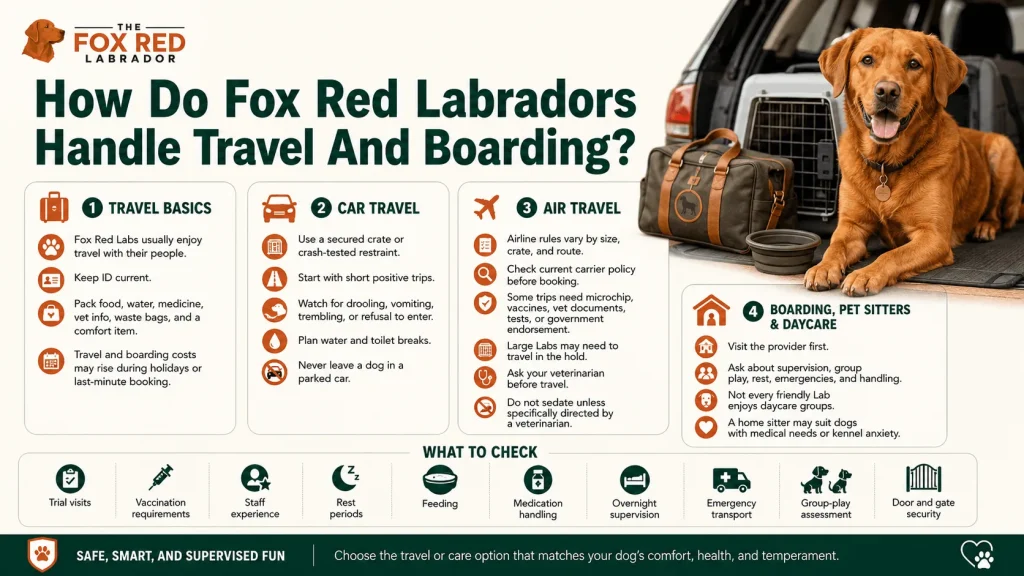
Fox Red Labs love traveling as they love being with their people. Even when in a car or an unknown building, there is still a learning curve to comfort.
Keep identification current. Bring food, water, medicine, vet information, waste bags, and a comfortable item to rest your body.
Fares for travel and boarding are also included. Holiday care can be costly if booked last minute or during peak times.
Car Travel With A Fox Red Labrador
Secure the crate or use a crash-tested restraint that is suitable for the size of the dog. A loose Labrador can cause a distraction to the driver and cause serious injury in a collision.
Start short trips to nice locations. Drooling, vomiting, trembling or refusal to enter may be signs of fear or motion sickness.
Make plans for water and toilet stops for longer trips. Even if the weather seems mild, never leave a dog in a parked car.
Air Travel With A Fox Red Labrador
Each airline has its own size, crate and route rules. Please read the current carrier policy before booking.
It may be necessary to have a microchip, vaccination, veterinary documents, tests or government endorsement for international travel. USDA APHIS offers up-to-date information about where animals are coming from.
If the airline’s service-dog policy does not allow a large Labrador to travel in the aircraft hold, then it must be transported in the aircraft hold. Not all dogs are physically or mentally ready for that experience.
Consult your veterinarian before you travel. Never sedate a dog for air travel except under specific veterinary direction.
Boarding, Pet Sitters And Daycare
Check out the provider prior to leaving your dog. Inquire about animal supervision, grouping, resting and handling in emergencies.
Check:
- Trial visits
- Vaccination requirements
- Staff experience
- Rest periods
- Feeding procedures
- Medication handling
- Overnight supervision
- Emergency transport
- Group-play assessment
- Door and gate security
Not all friendly Labs are daycare friendly. Some get overstimulated or get uncomfortable in large groups.
A home sitter may be appropriate for a dog that has medical issues or kennel anxiety. Check references, insurance, access and emergency plans.
How To Choose A Healthy Fox Red Labrador Puppy
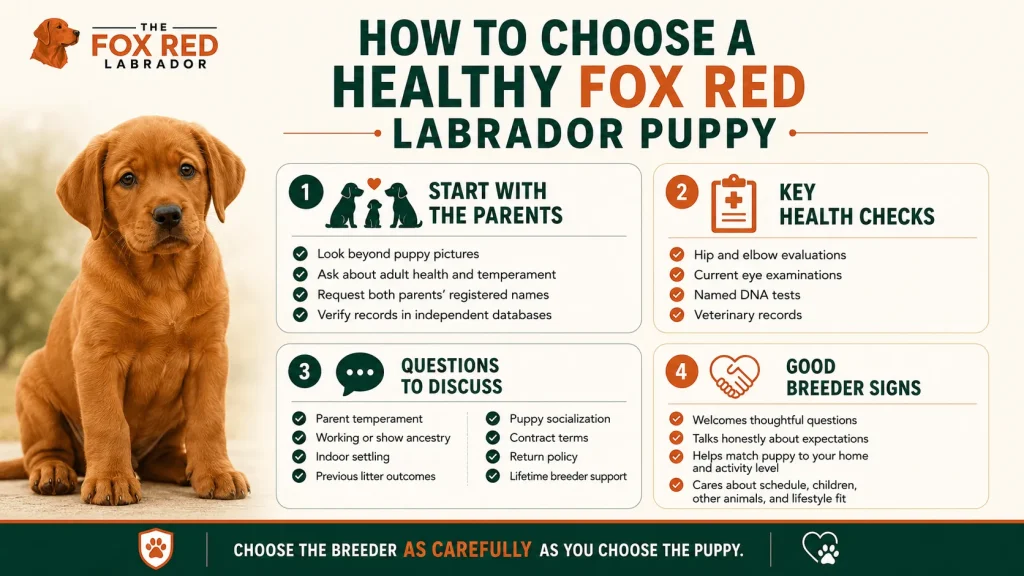
Start with the parents, not the puppy pictures. A good breeder won’t be able to tell you if the adults have good temperament or good health.
Request the parents’ registered name. Use independent databases to search and link each search result to the right dog.
Discuss:
- Hip and elbow evaluations
- Current eye examinations
- Named DNA tests
- Parent temperament
- Working or show ancestry
- Indoor settling
- Previous litter outcomes
- Puppy socialization
- Veterinary records
- Contract terms
- Return policy
- Lifetime breeder support
A good breeder thinks about questions too. You should be able to influence their schedule, their children, their animals, their level of activity and expectations.
Rescue And Adult Fox Red Labradors
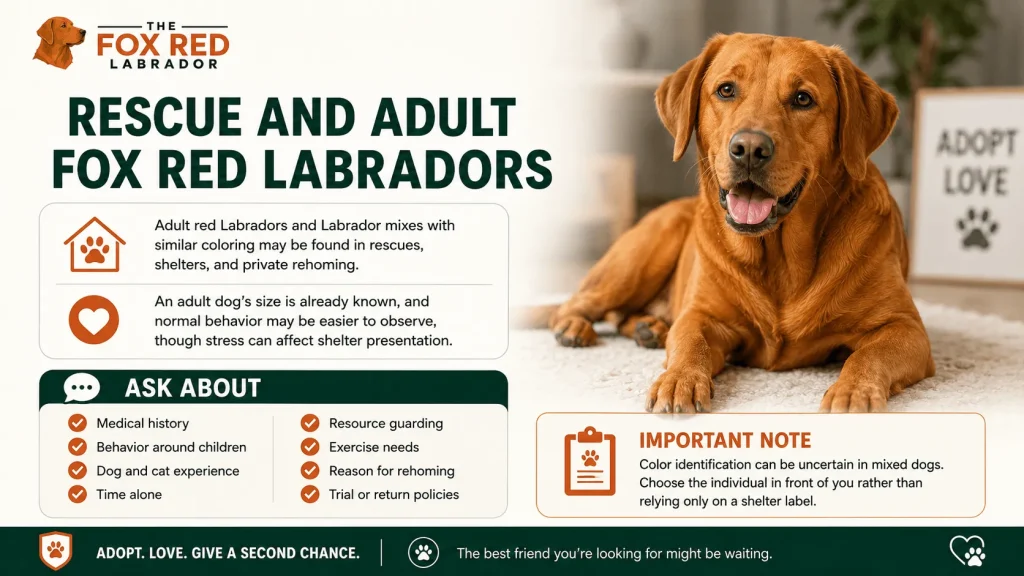
Puppies are not the only ones. Red adults or Labrador mixes with similar coloring may be found in Labrador rescues, shelters and private rehoming.
The size of the adult is known. It may also be easier to observe its normal behavior, but stress can impact shelter presentation.
Ask about:
- Medical history
- Behavior around children
- Dog and cat experience
- Time alone
- Resource guarding
- Exercise needs
- Reason for rehoming
- Trial or return policies
Color identification can be uncertain in mixed dogs. Choose the individual in front of you rather than relying on a shelter label.
Fox Red Labrador Breeder Red Flags
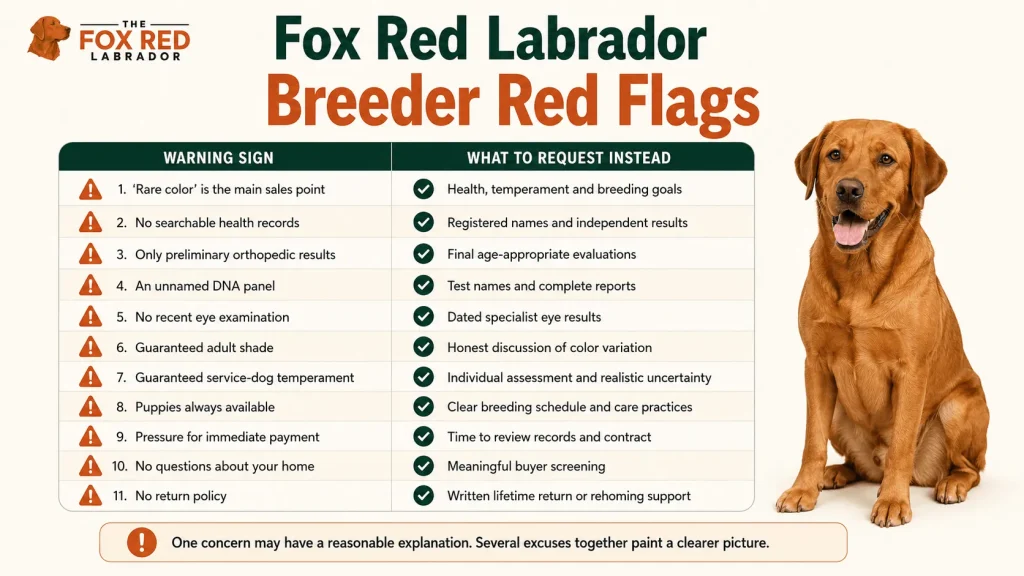
Be cautious when you find:
| Warning Sign | What To Request Instead |
|---|---|
| “Rare color” is the main sales point | Health, temperament and breeding goals |
| No searchable health records | Registered names and independent results |
| Only preliminary orthopedic results | Final age-appropriate evaluations |
| An unnamed DNA panel | Test names and complete reports |
| No recent eye examination | Dated specialist eye results |
| Guaranteed adult shade | Honest discussion of color variation |
| Guaranteed service-dog temperament | Individual assessment and realistic uncertainty |
| Puppies always available | Clear breeding schedule and care practices |
| Pressure for immediate payment | Time to review records and contract |
| No questions about your home | Meaningful buyer screening |
| No return policy | Written lifetime return or rehoming support |
One concern may have a reasonable explanation. Several excuses together paint a clearer picture.
Does Registration Prove A Puppy Is Healthy?
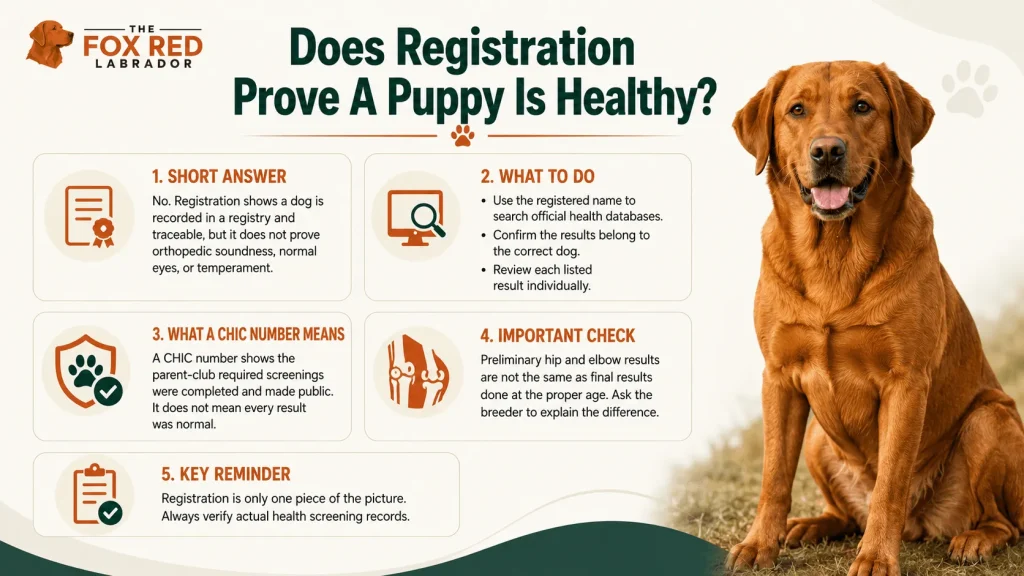
Yes, a dog is registered in a registry and can be traced back. Does not indicate orthopedic soundness, normal eyes or temperament.
Use the registered name to search official health databases. Verify that results are from the right dog, and review each result.
If a parent club has a CHIC number, it indicates that the parent club has done the required screenings and made them public. This does not imply that all the results were normal.
Preliminary hip/elbow outcomes are not equal to final outcomes done at the correct age. Have the breeder tell you about the difference.
Your First 30 Days With A Fox Red Labrador Puppy
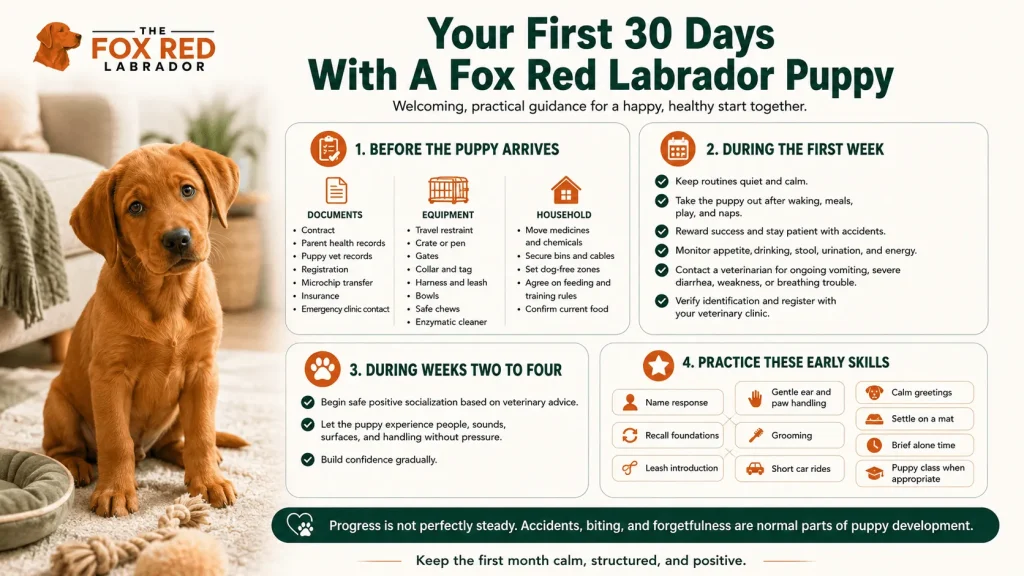
The first month should be a more settled one than full of adventures. A new puppy is settling into new people, sounds, routines and a sleep schedule.
Progress will not be a continuous rising curve. The accidents can follow a beautiful day, the biting and apparent memory loss. It’s puppy development, not a personal grudge.
Before The Puppy Arrives
Prepare documents:
- Signed contract
- Parent health records
- Puppy veterinary records
- Registration information
- Microchip-transfer details
- Insurance start date
- Emergency clinic contact
Prepare safety equipment:
- Travel restraint
- Crate or pen
- Gates
- Collar, tag, harness and leash
- Food and water bowls
- Safe chews
- Enzymatic cleaner
Prepare the household:
- Move medication and chemicals
- Secure bins
- Protect cables
- Create dog-free areas for resident animals
- Agree on feeding and training rules
- Confirm the puppy’s current food
Screening, warning signs, preventive care, and common conditions are examined in the main red Labrador health guide.
During The First Week
Maintain a normal routine and quiet atmosphere. Ensure rest and reduce traffic of visitors.
Remove the puppy from the room after waking, feeding, playing and exercising. Avoid penalizing mistakes and encourage achievement.
Watch appetite, drinking, stool, urination and energy. If vomiting does not stop and severe diarrhea, weakness or difficulty breathing occurs, contact a veterinarian immediately.
Verify identification and build rapport with the clinic. Weigh the puppy and assess its body condition when it is first brought to the clinic.
During Weeks Two To Four
Start safe, positive socialisation according to disease risk and veterinary guidance. Allow the puppy to see, hear, smell, and feel people, animals, surfaces and sounds without forcing contact.
Practise:
- Name response
- Recall foundations
- Leash introduction
- Gentle ear and paw handling
- Grooming
- Short car rides
- Calm greetings
- Settling on a mat
- Brief alone time
Once you are able to attend based on your puppy’s vaccinations and local advice, a good puppy class can help. Socialization is about gaining confidence and not having a pulse on every event.
Common Fox Red Labrador Ownership Mistakes
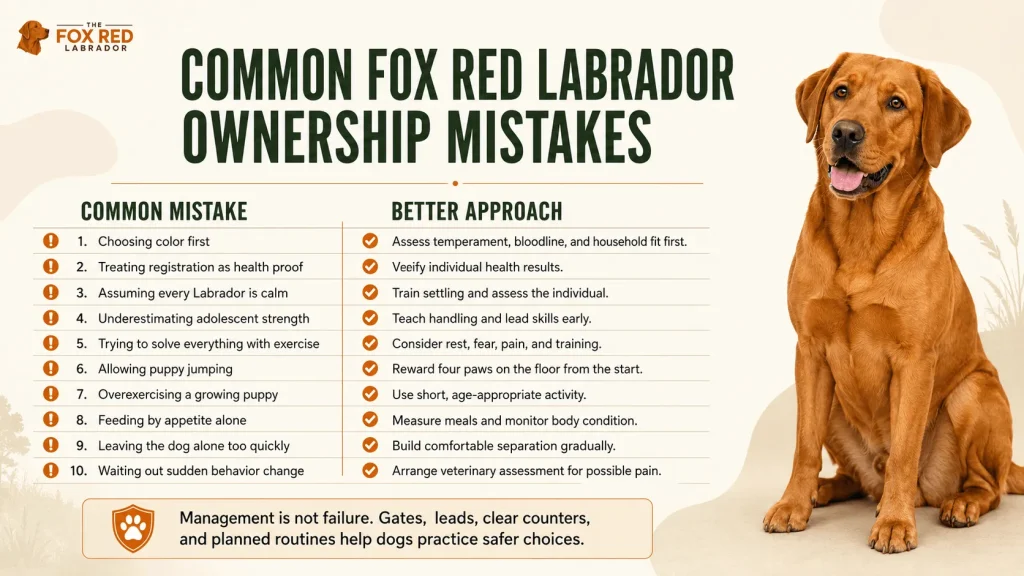
Most problems begin with understandable choices repeated too often.
| Common Mistake | Better Approach |
|---|---|
| Choosing color before temperament | Assess parents, bloodline and household fit first |
| Treating registration as health proof | Verify individual health results |
| Assuming every Labrador is naturally calm | Train settling and assess the individual |
| Underestimating adolescent strength | Begin handling and lead skills early |
| Trying to cure every problem with exercise | Consider rest, fear, pain and training |
| Allowing puppy jumping because it is cute | Reward four paws on the floor from the start |
| Overexercising a growing puppy | Use short, age-appropriate activity |
| Allowing chasing of small animals | Prevent access and build control at a safe distance |
| Feeding according to appetite | Measure meals and monitor body condition |
| Leaving the dog alone too quickly | Build comfortable separation gradually |
| Ignoring fear because Labs are “friendly” | Respect stress signals and seek help early |
| Using daycare for every active dog | Assess whether group care improves or worsens behavior |
| Expecting an exact adult shade | Accept normal coat variation |
| Forgetting holiday care | Budget and book early |
| Waiting out sudden behavior change | Arrange veterinary assessment for possible pain |
Management is not failure. Gates, leads, clear counters and planned routines help the dog practise safer choices.
Is A Fox Red Labrador Right For You?

The final decision isn’t really about loving the dog; it’s about matching the needs of the dog to normal life. Rainy weekdays are as valuable as sunny hiking photos!
Take time, activity, housing, children, other animals, travel and money all into account. It should be a good match, and not something that gets worked out when the honeymoon phase is over.
A Fox Red Labrador May Suit You If
The match may be strong when:
- You are active outside regularly.
- You’re interested in continuing your education.
- Someone may be able to offer companionship & day care.
- Shedding, mud and wet coats are accepted.
- Children are able to be supervised.
- There is a secure dog-free area for small animals.
- Your budget includes regular and emergency care.
- You have workday and holiday plans.
- Temperament is more important than depth of coat.
Meeting these conditions does not promise an effortless dog. It does suggest that the household can meet common Labrador needs without resenting them.
A Fox Red Labrador May Not Suit You If
Think carefully when:
- You’re looking for a quiet or very independent dog.
- The dog was left alone for long periods of time.
- Exercise is a chore.
- There is no way to manage a strong adolescent.
- Hair and outdoor mess would lead to continuous stress.
- Small pets should not be separated.
- The training time is short.
- Permission for housing is in doubt.
- The cost of walking or boarding support is not affordable.
- The primary consideration is that you get an exact adult shade.
Choosing another dog—or waiting—is not failure. Sometimes the kindest answer is “not yet.”
Fox Red Labrador Ownership Scorecard
Give each answer 0 to 2 points. Zero means unprepared, one means a partial plan and two means ready.
| Ownership Area | Question |
|---|---|
| Daily time | Can someone provide exercise, training and companionship? |
| Activity | Does the household genuinely enjoy an active routine? |
| Training | Will everyone use consistent reward-based methods? |
| Children | Can adults supervise and provide quiet space? |
| Other animals | Can introductions and separation be managed safely? |
| Housing | Is the dog allowed, and is outdoor access practical? |
| Monthly costs | Can routine expenses be paid comfortably? |
| Emergencies | Is insurance or a medical reserve available? |
| Work schedule | Is daytime support arranged when needed? |
| Travel | Is there a realistic boarding or pet-sitting plan? |
| Grooming | Is regular shedding acceptable? |
| Breeding line | Does the dog’s likely drive match the household? |
A high score indicates a potentially good match. A middle score indicates gaps that require planning. A low score is a good indication that it’s time to think about another option.
The scorecard offers no prediction of any specific dog. Test it out at home and then test the dog alone.
Conclusion
Fox Red Labrador ownership can be a source of affection, outdoor adventures and a dog who wants to share almost every aspect of family life. It also involves training, shedding, daily activity and a financial commitment which can span many years, and even decades.
The red coat will never be able to tell you if a puppy is healthy, calm or if he fits in your home. Parents’ temperament, breeding line, health history, and early development are better indicators.
Be honest in using the scorecard. Work out your monthly budget and check both parents’ health records before you select a puppy. Darkest is not always best when it comes to Fox Red Labrador. It’s the dog that your home can provide for a lifetime.
FAQ’s
No. A Fox Red Labrador is a Labrador Retriever with a dark yellow coat. Major registries classify fox red within the yellow Labrador color range.
They can suit prepared first-time owners who enjoy training and activity. People seeking a naturally quiet or low-effort dog may find the adolescent stage difficult.
Yes, when the family can meet its exercise and training needs. Parent temperament, drive and the dog’s ability to settle indoors deserve careful assessment.
Many are affectionate with children, but their size and excitement can cause accidental injuries. Adult supervision and a protected resting space remain necessary.
Some live very successfully with cats after gradual introductions. Individual chase behavior, safe escape routes and continued management determine compatibility.
Safety should not be assumed. Rabbits and birds need secure dog-free areas because chasing or grabbing can happen quickly, even during play.
Yes, provided exercise, toilet access, training and companionship are handled well. A yard is helpful but cannot replace shared activity.
Tolerance varies with age, health and training. Puppies need frequent care, while adults should not routinely spend full working days without suitable support.
U.S. costs vary with food, insurance, medical needs and professional services. A household providing most care may spend a few hundred dollars monthly, while regular daycare can raise the amount considerably.
Yes, a healthy dog with suitable temperament and task training may become a service dog. Coat color has no effect on legal qualification.
No separate disease pattern has been established for the shade. Genetics, breeding decisions, body condition and preventive care have much greater influence.
Yes. Their dense double coat sheds throughout the year and often more heavily during seasonal changes. Brushing manages loose hair but does not eliminate it.
The shade is less common than many lighter yellows, but it is not a separate exotic breed. Availability depends on location and bloodline.
Yes. Both terms describe the same dark yellow Labrador color variation. “Red Labrador” and “Ruby Lab” may also be used informally.
Some breeders charge more because demand exceeds local supply. A higher price does not prove better health, temperament or breeding quality.
Refrences
- American Kennel Club: Labrador Retriever
- Official AKC Labrador Retriever Standard
- American Kennel Club: Is The Labrador Right For You?
- Orthopedic Foundation for Animals
- OFA CHIC Program
- OFA Health-Testing Overview
- Labrador Retriever Club Health Information
- AKC Canine Health Foundation: Exercise-Induced Collapse