Fox Red Lab Breeder Red Flags: 18 Signs To Check Before Buying
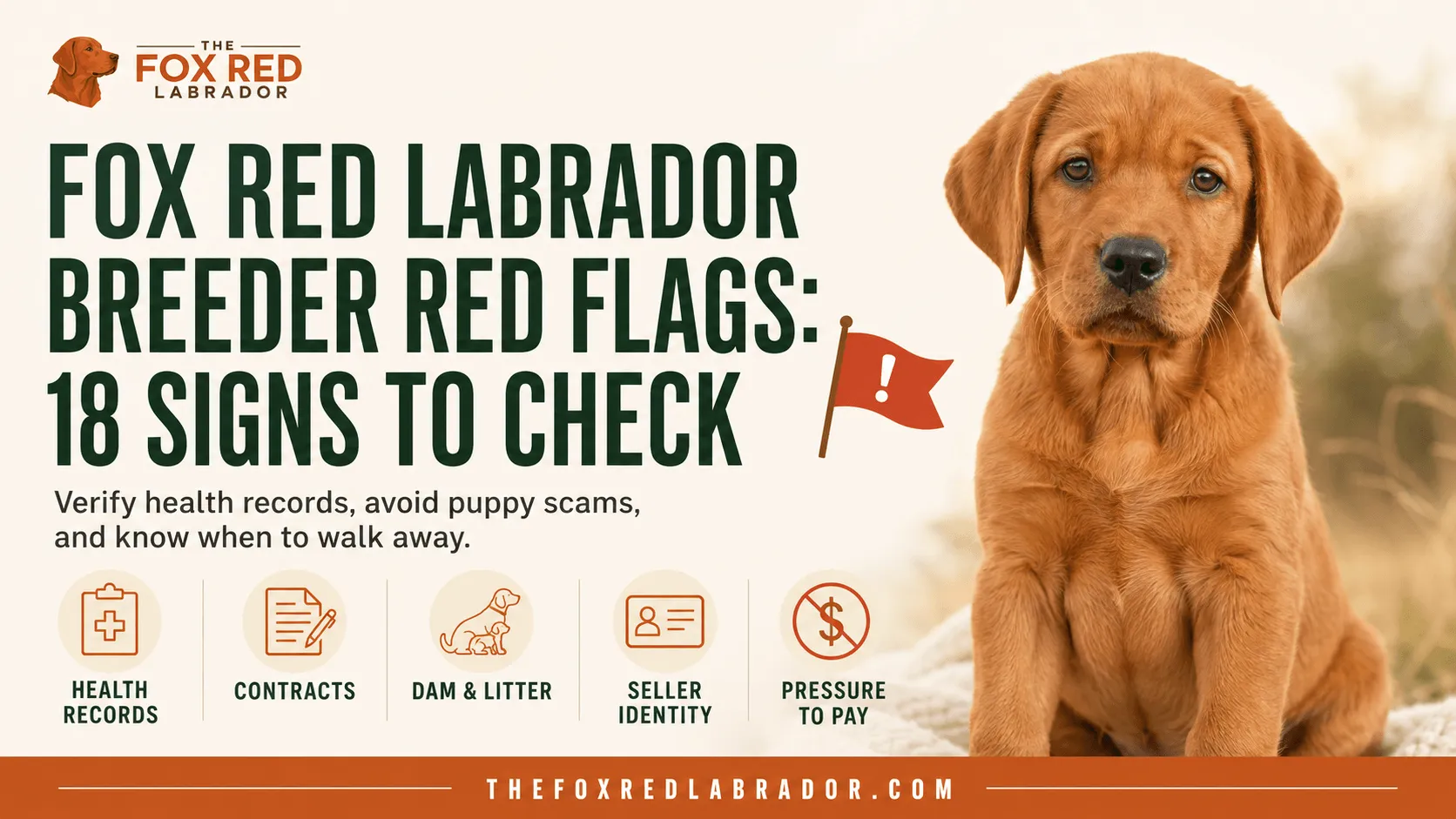
A fox red Labrador puppy can be difficult to resist, especially if he’s got a deep copper coat. One picture appears, those little brown eyes glance right at you, and sensible questions just don’t come to mind.
Fox red is a legitimate shade of yellow Labrador. That’s not to say that it’s always bad to breed for that shade. When health, temperament, genetic diversity and appropriate puppy placement take a back seat to color and sales price, trouble begins.
Make sure to verify the parents, environment, paperwork, and identity of the seller before depositing. A good breeder will appreciate thoughtful questions as their puppy’s future is theirs as well.
TLDR: What Are The Biggest Fox Red Labrador Breeder Red Flags?
The most serious red flags are when the parents’ health records are not verifiable, when they claim the dog is a “rare breed,” when the puppies are bred for color first, when the dam or puppy environment is not accessible, when the puppies are offered too young, and when the contract is ambiguous or the price is due immediately.
Photographs that have been copied, mismatched identities and unexpected shipping charges can be a sign of a scam. A serious unresolved problem is often the only reason to leave.
Is Fox Red A Legitimate Labrador Color?
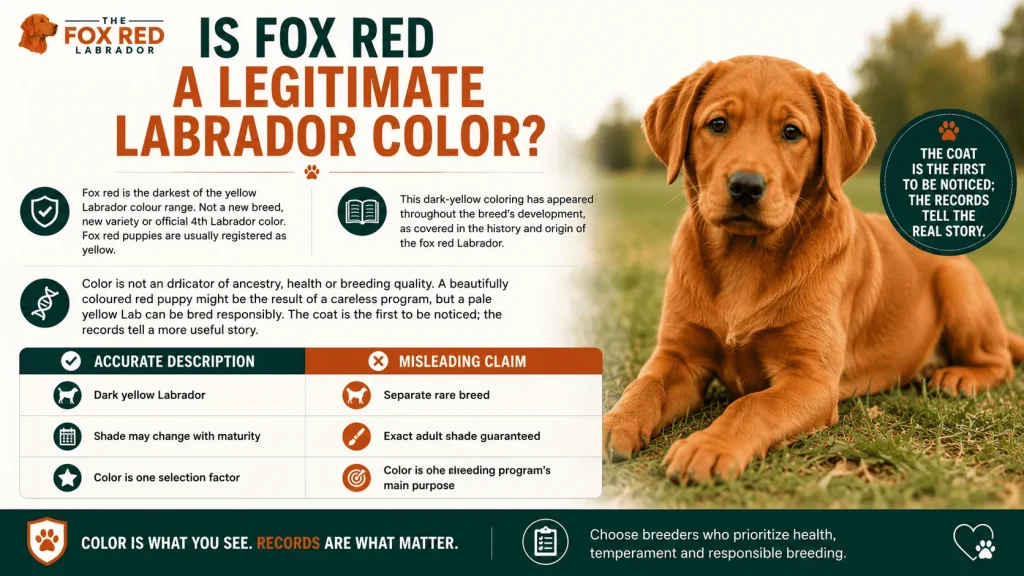
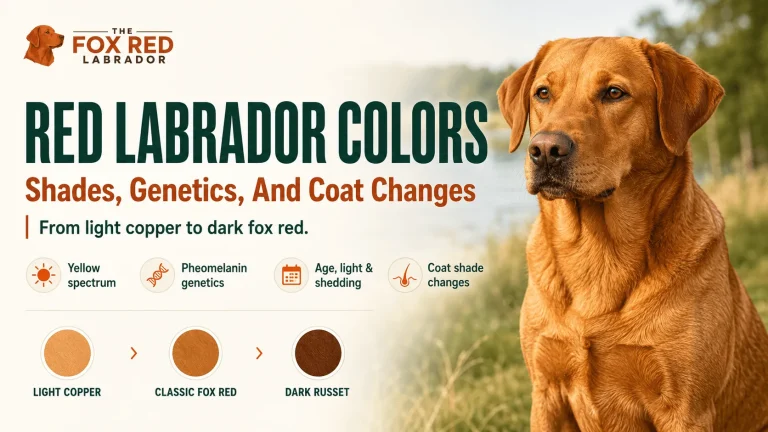
Fox red is the darkest of the yellow Labrador colour range. Not a new breed, new variety or official 4th Labrador color. Fox red puppies are usually registered as yellow. This dark-yellow coloring has appeared throughout the breed’s development, as covered in the history and origin of the fox red Labrador.
Color is not an indicator of ancestry, health or breeding quality. A beautifully coloured red puppy might be the result of a careless program, but a pale yellow Lab can be bred responsibly. The coat is the first to be noticed; the records tell a more useful story.
| Accurate description | Misleading claim |
|---|---|
| Dark yellow Labrador | Separate rare breed |
| Shade may change with maturity | Exact adult shade guaranteed |
| Color is one selection factor | Color is the breeding program’s main purpose |
18 Fox Red Lab Puppy Breeder Warning Signs
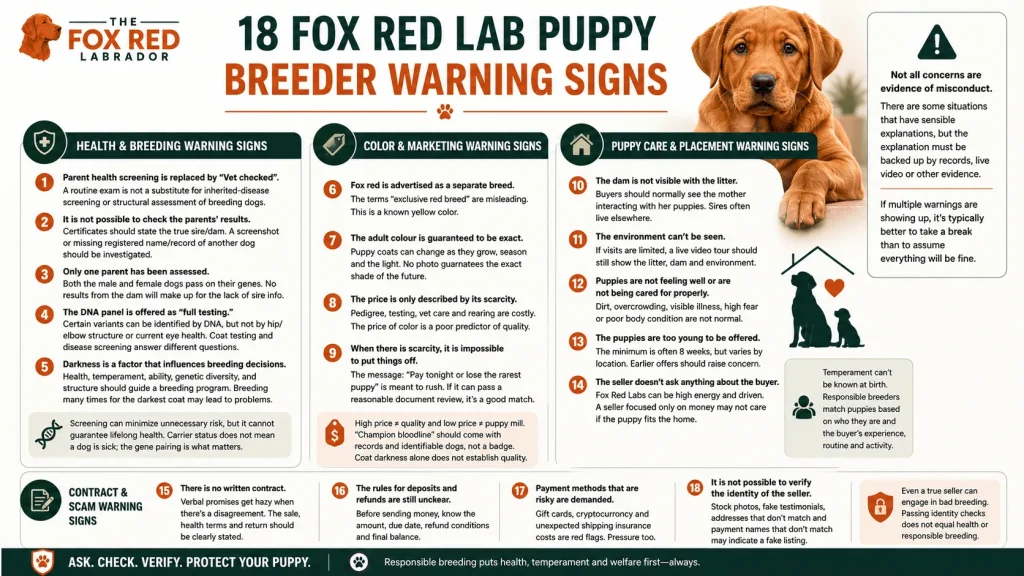
Not all concerns are evidence of misconduct. There are some situations that have sensible explanations, but the explanation must be backed up by records, live video or other evidence. If multiple warnings are showing up, it’s typically better to take a break than to assume everything will be fine.
Health And Breeding Warning Signs
1. Parent health screening is replaced by “Vet checked”.
A routine exam is an evaluation of a dog’s present health state. It is not intended to be used as a substitute for inherited-disease screening or structural assessment of breeding dogs.
2. It is not possible to check the parents’ results.
Certificates should state the true sire/dam. A cropped screenshot or a missing registered name or record of another dog should be investigated.
3. Only one parent has been assessed.
Both the male and female dogs pass on their genes. No results from the dam will make up for the lack of sire information
4. The DNA panel is offered as “full testing.
Certain variants can be identified by DNA, but not by hip or elbow structure or current eye health. Coat testing and disease screening answer different questions, as explained in the guide to fox red Labrador coat genetics.
5. Darkness is a factor that influences breeding decisions.
Health, temperament, ability and genetic diversity, and structure should all be taken into account when developing a breeding program. Breeding many times for the darkest coat may lead to the emergence of the darkest traits.
Screening can minimize unnecessary risk, but it cannot guarantee lifelong health. Likewise, a dog’s ability to breed and its sickness are not determined by the dog’s carrier status; it is the intended pairing of genes that is important.
Color And Marketing Warning Signs
6. Fox red is advertised as a separate breed.
The terms “exclusive red breed” are misleading, as this is a known yellow color.
7. The adult colour is guaranteed to be exact.
Puppies’ coats may change as they grow, season and the light. No photo is guaranteed to show the exact shade of the future.
8. The price is only described by its scarcity.
Pedigree and responsible rearing, veterinary care, and testing are all costly. The price of color is a poor predictor of a high premium.
9. When there is scarcity, it is impossible to put things off.
The message: “Pay tonight or lose the rarest puppy” is meant to be outrun. If it can pass a reasonable document review, it’s a good match.
A high price does not equal quality and a lower price does not equal a puppy mill. If you are using terms such as “champion bloodline,” you should have a record and identifiable dogs, not a decorative badge on a website.
Puppy Care And Placement Warning Signs
10. The dam is not visible with the litter.
Buyers should normally be able to see the mother interacting with her puppies. It’s common for the sire to be an outside stud and live elsewhere.
11. The environment can’t be seen.
Puppy restrictions on visits may be imposed because of disease-control regulations. The live video tour can still demonstrate the litter, dam and environment altogether.
12. Puppies are not feeling well or are not being cared for properly.
Dirt, overcrowding, visible sickness, high fear or poor body condition should never be considered as a normal kennel life.
13. The puppies are too young to be offered.
The minimum is often 8 weeks, but varies depending on the location of the laws. Careful legal and welfare checks should be made of an earlier offer.
14. The seller doesn’t ask anything about the buyer.
Fox Red Labs tend to be very energetic and motivated by working lines. A person who is only interested in the money might not consider whether a puppy is suitable for the home.
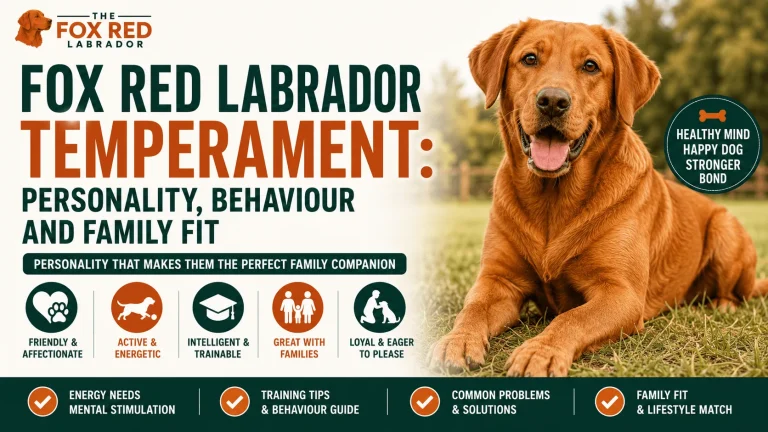
It is not possible to determine a dog’s temperament at birth. It is no help to assign puppies, based on color or markings, to a home without learning what each dog will be like in the home. A responsible breeder should assess whether the typical fox red Labrador temperament matches the buyer’s experience, routine, and activity level.
Contract And Scam Warning Signs
15. There is no written contract.
When there seems to be a disagreement, the verbal promises get hazy. The sale, health terms and return should be stated clearly in the sale.
16. The rules for deposits and refunds are still unclear.
Before exchanging money, the amount, the due date, the condition for refunding and the final balance should be known.
17. Payment methods that are risky are demanded.
Signs that should be considered include gift cards, cryptocurrency, and unexpected shipping insurance costs. They are more worried when they are under pressure.
18. It is not possible to verify the identity of the seller.
Photocopied photos, fake testimonials, addresses that don’t match and payment names that don’t match may indicate a fake listing.
Even a true seller can engage in bad breeding. Passing identity checks does not equal health or responsible breeding of the dogs.
What Health Tests Should A Fox Red Lab Breeder Perform?
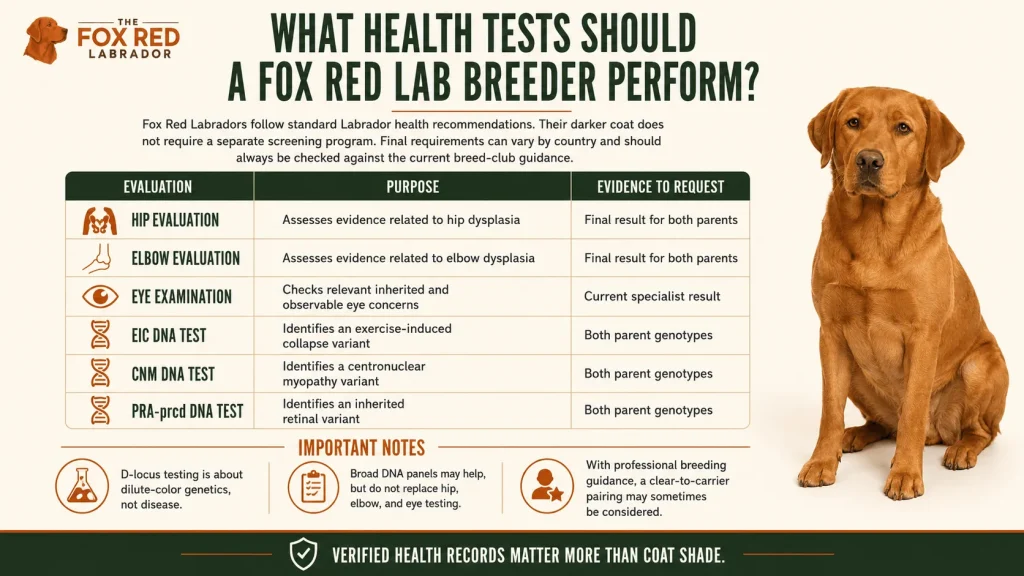
Fox Red Labradors adhere to the recommendations for Labrador health. They are darker in color than the other ones and do not require a separate screening programme. The breed-club requirements in each country may vary and may be subject to change, so the final check should be made in accordance with the requirements as advised by the breed-club in the country.
| Evaluation | Purpose | Evidence to request |
|---|---|---|
| Hip evaluation | Assesses evidence related to hip dysplasia | Final result for both parents |
| Elbow evaluation | Assesses evidence related to elbow dysplasia | Final result for both parents |
| Eye examination | Checks relevant inherited and observable eye concerns | Current specialist result |
| EIC DNA test | Identifies an exercise-induced collapse variant | Both parent genotypes |
| CNM DNA test | Identifies a centronuclear myopathy variant | Both parent genotypes |
| PRA-prcd DNA test | Identifies an inherited retinal variant | Both parent genotypes |
D-locus testing is not a disease test, but rather a test for dilute-color genetics. Wider DNA testing may be helpful, but not a substitute for hip, elbow and eye testing. When professional breeding advice is given, a responsible pairing of a clear dog with a carrier may be considered.
Are OFA Certificates And AKC Registration Enough?
OFA provides evaluations and a searchable health-record system in the United States. It is not obligatory by law and other countries may have other recognised schemes.
Ancestry or registration eligibility may be documented through AKC registration. It is not a guarantee of overall health, appropriate temperament, proper living environment or responsible puppy placement.
How Can You Verify The Parents’ Health Records?
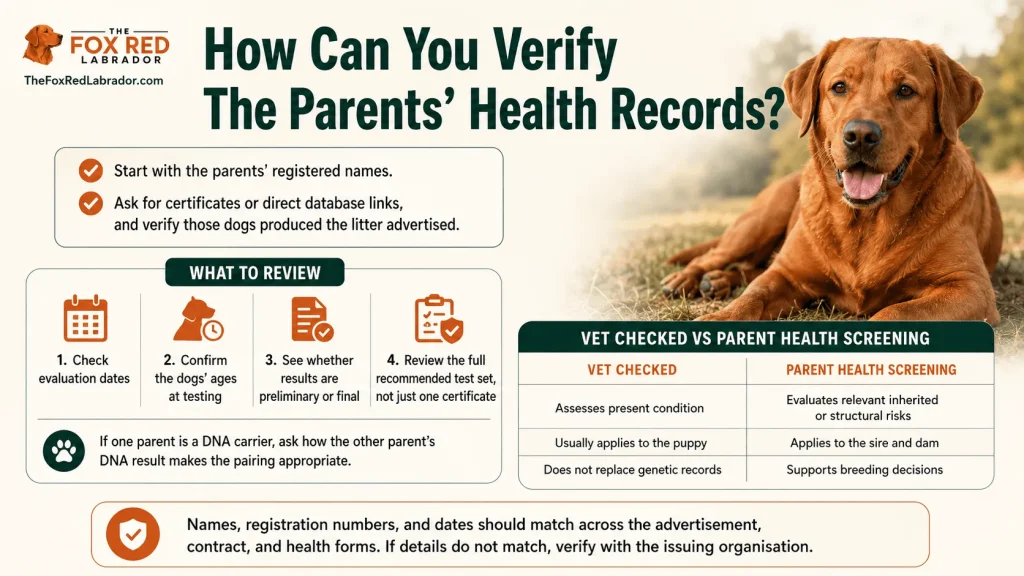
Begin by asking for the parents’ registered names. Get copies of certificates and/or direct links to the database and verify that those dogs sired the litter advertised.
Review dates of evaluation, age of the dogs and whether the results are preliminary or final. Don’t settle for one good certificate; look at the entire recommended set. When a DNA test indicates that a parent is a carrier, ask how the other parent’s DNA test makes the pairing appropriate.
| “Vet checked” | Parent health screening |
|---|---|
| Assesses present condition | Evaluates relevant inherited or structural risks |
| Usually applies to the puppy | Applies to the sire and dam |
| Does not replace genetic records | Supports breeding decisions |
Name/registration number and dates must be consistent throughout the advertisement, contract and health forms. Unresolved inconsistencies require verification from the issuing organisation.
What Paperwork Should A Fox Red Lab Breeder Provide?
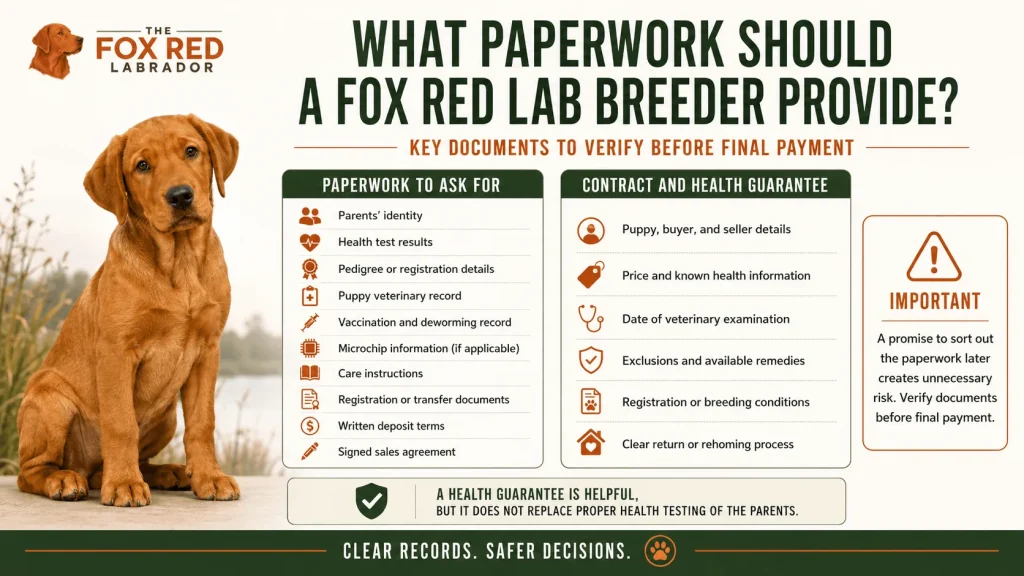
The parents’ identity, health results, pedigree or registration information and the puppy’s veterinary record should be provided before final payment. Vaccination and deworming, and/or microchip information should be added if applicable.
The breeder should also provide care instructions, registration or transfer documents, written deposit terms and a signed sales agreement. A promise to “sort out the paperwork later” means that the buyer has an unnecessary risk.
What Should The Contract And Health Guarantee Include?
A good contract will include the name of the puppy, the buyer and the seller. It includes the price, known health information, the date of veterinary examination, exclusions, remedy available and any registration and breeding conditions.
The return or rehoming process should be made clear too. A health guarantee can provide protection, but challenging deadlines or impossible evidence requirements can make it virtually worthless. No substitute for proper testing of the parents.
How Can You Avoid A Puppy Mill Or Online Puppy Scam?
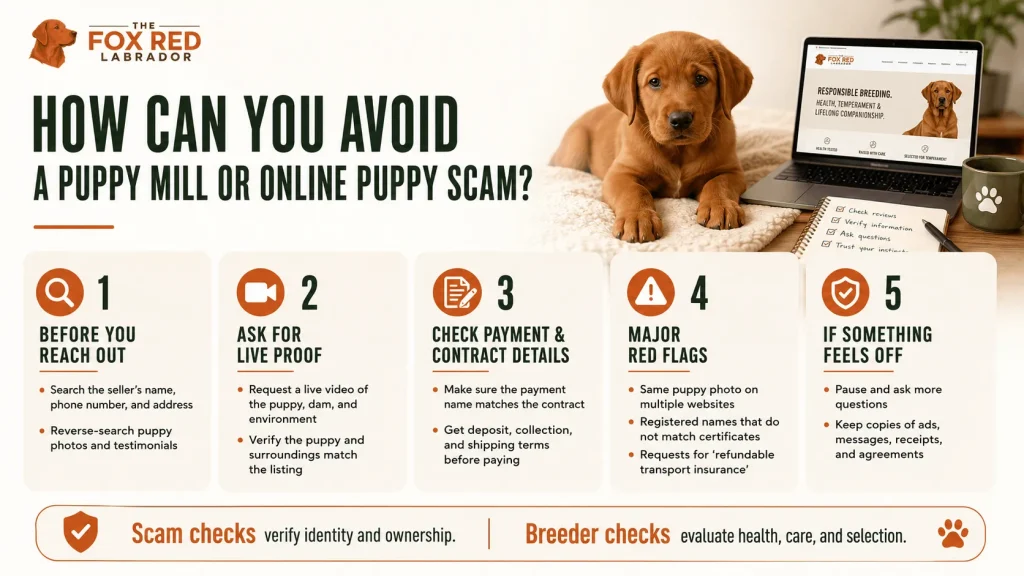
Before reaching out to the seller, do a search for their name, phone number and address. Search several pictures of puppies backwards, and search for unique testimonial sentences to determine if they are found on other websites.
Ask to see a live video of the puppy, dam and environment. Ensure the person or business to which the payment is being made is the same as the name listed in the contract. The written deposit, collection and shipping terms should be received prior to payment.
Now, imagine you come across the same puppy picture on three different websites, a sire whose registered name is different from the certificate and a surprise request for “refundable transport insurance.” Anyone deserves questions. They are a powerful motivation to halt.
Maintain copies of advertisements, messages, receipts and agreements. Scam verification is used to establish identity and ownership claims, while breeding-quality checks are used to evaluate the selection and care of the dogs.
What Are The Green Flags Of A Responsible Breeder?
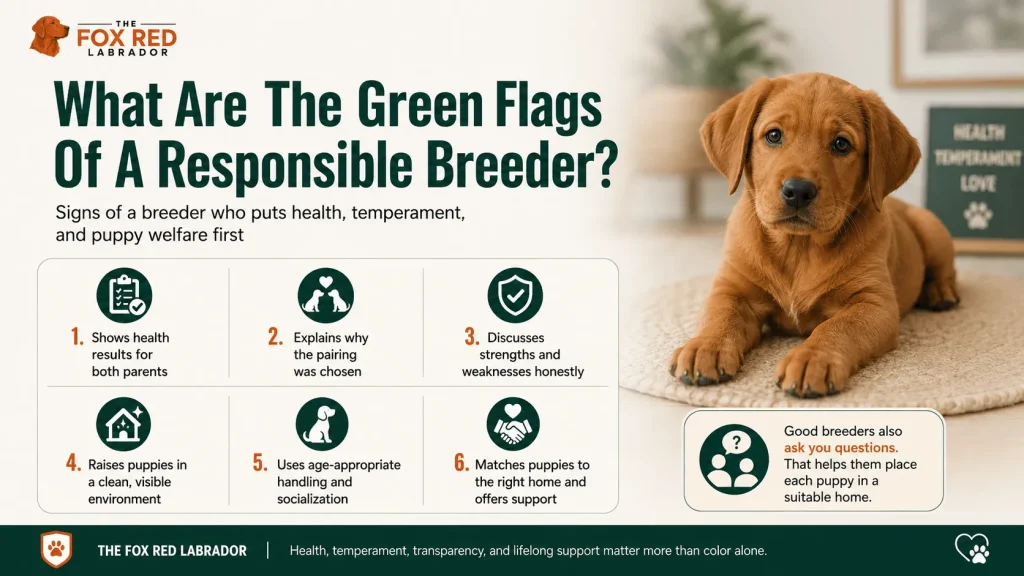
A good breeder can show results for both parents and can give reasons for mating. Vigor and weaknesses are discussed, but so are health issues, temperament, and the needs and care of the puppies that result.
The litter is kept in a clean environment that is visible and is given age-appropriate handling and socialization. Temperament and Household fit are taken into account when placing a puppy. Contracts are received before the puppy is paid, questions are answered specifically and support is given after the puppy has gone. Early handling should continue with age-appropriate fox red Labrador training once the puppy reaches its new home.
Also good breeders ask the potential owner questions. That slight awkwardness can be a bit like an interview, but it serves a good purpose; the puppy is searching for a home where he can live and grow.
What Questions Should You Ask Before Buying?
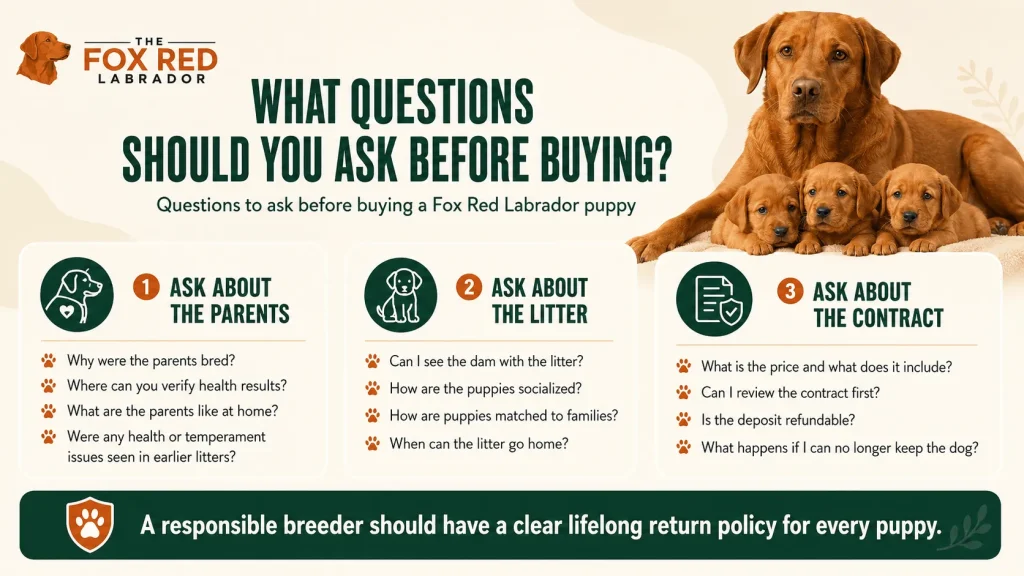
Discuss why the parents were mated and the location of the results. Talk about temperament, working qualities and health issues observed in previous litters. Ask to see the dam with the litter and find out where they go.
Learn about socialization and temperament testing, which puppy the puppy matches with, and when the litter can go. Explain the contract’s terms and conditions, including the price, the contract’s review period, and whether the deposit is refundable.
The final question that remains important years later is what happens when the dog’s owner no longer wants to keep the dog? If you are a breeder who takes on the responsibility of your puppy for life, you should be able to give a definite answer.
Fox Red Lab Puppy Checklist Before Paying
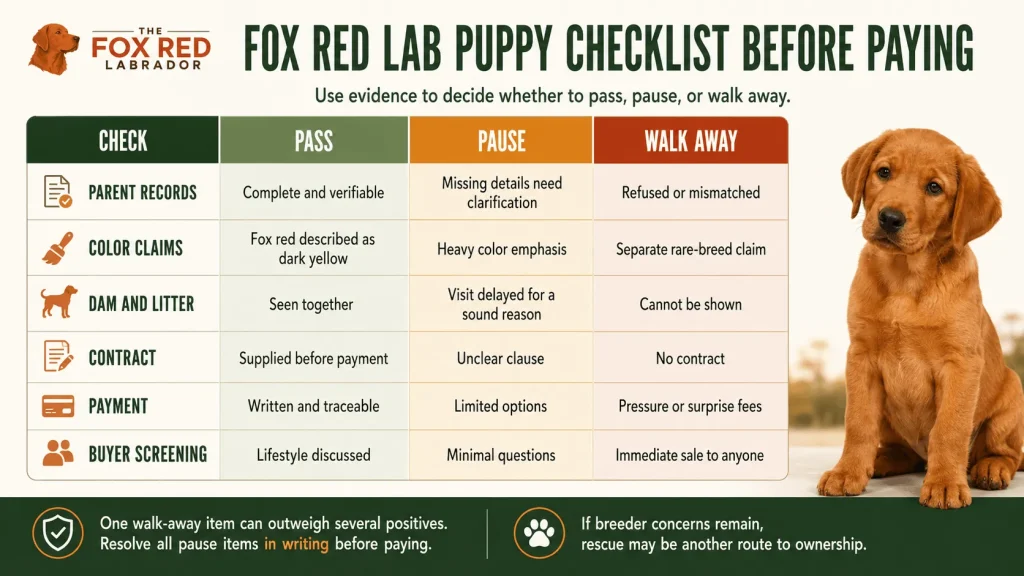
Use the evidence collected to make a pass, pause or walk-away decision. Hope is a fine thing, but it’s not a health certificate.
| Check | Pass | Pause | Walk away |
|---|---|---|---|
| Parent records | Complete and verifiable | Missing details need clarification | Refused or mismatched |
| Color claims | Fox red is described as dark yellow | Heavy color emphasis | Separate rare-breed claim |
| Dam and litter | Seen together | Visit delayed for a sound reason | Cannot be shown |
| Contract | Supplied before payment | Unclear clause | No contract |
| Payment | Written and traceable | Limited options | Pressure or surprise fees |
| Buyer screening | Lifestyle discussed | Minimal questions | Immediate sale to anyone |
One negative walk-away item can negate several positive items. Complete all Pause items in writing prior to payment. Anyone uncertain about purchasing from a breeder can also investigate fox red Labrador rescue options as an alternative route to ownership.
Conclusion: Put Health And Temperament Before Color
Fox red is a gorgeous, authentic Labrador color. However, a good copper coat is not enough to make up for the lack of health records, inadequate puppy care, and an unwilling seller to respond to reasonable inquiries.
Check both parents, review the contract and check the seller before paying. Save the checklist, take your time and walk away if a serious concern is not resolved. Another puppy will find its way in, despite the brown eyes.
FAQ’s
They can be purebred as fox red is a dark shade of the yellow Labrador. Color cannot verify ancestry, so check the pedigree, registration and parent identities.
Price may be dependent on demand, location, parent credentials, testing and puppy care. Cost should not be a substitute for verification; some sellers will charge more for a specific color.
Breed relevant DNA tests are used to control inherited variants. They complement the hip, elbow and eye evaluations, not supplant them.
The dam should normally be seen with her litter. The outside sire may reside elsewhere, but all of his identification, health and temperament data should be available.
The usual minimum is 8 weeks, but this varies by area. Just double-check the rule and ask any questions about an offer that pertains to a younger puppy.
Yes, as long as all litters have sufficient room, attention, socialization and record keeping. This is an area that needs to be investigated in more detail because of its constant presence in a number of breeds.
Planned litters may attract homes before birth. A waiting list can reflect demand, but it does not establish responsible practices by itself.
A seller can refuse, but the buyer should not proceed without verifiable evidence for the actual parents. Verbal assurances offer no independent confirmation.
The strongest warnings are unverifiable parent health records, “rare breed” claims, no access to the dam, puppies offered too young and pressure to pay quickly. Missing contracts, copied photographs and unexpected shipping charges are also reasons to stop.
A reputable breeder provides verifiable health records for both parents, allows the dam and litter to be seen, screens potential homes and supplies a written contract. Health, temperament and household suitability should matter more than coat darkness.
No. Price alone does not show whether the parents were properly tested or the puppies were responsibly raised. Evaluate health records, living conditions, temperament, socialization and contract terms instead.
OFA certificates are not a universal legal requirement. They are commonly used in the United States to record health evaluations, while breeders in other countries may use different recognized systems. Buyers should still request independently verifiable results.
Look for recognized hip, elbow and eye evaluations plus relevant DNA results for both parents. Registration and breeder-program membership may add context, but neither replaces the complete health record.
No. AKC registration can document ancestry or registration eligibility, but it does not prove complete health testing, good living conditions or stable temperament. Treat it as one document rather than a quality guarantee.
Expect parent identities, health records, pedigree or registration details, the puppy’s veterinary record and vaccination or deworming information. A sales contract, deposit terms and return policy should also be provided before final payment.
The contract should identify the puppy, buyer and seller and state the price, deposit terms and known health information. It should also cover registration conditions, veterinary deadlines, remedies and the return or rehoming process.
A written health provision should explain covered conditions, reporting deadlines, evidence requirements and available remedies. Its wording matters more than the label “health guarantee,” and it should never replace parent health testing.
A puppy mill prioritizes production volume and sales, often with limited transparency or individual care. An ethical breeder plans each mating, tests both parents, socializes the puppies, screens homes and remains responsible after placement.
Common signs include little knowledge of inherited conditions, incomplete parent testing, no clear reason for the mating and informal sales without useful contracts. Claims that two friendly dogs are “healthy enough” do not replace formal evaluations.
They provide gradual, age-appropriate exposure to handling, people, household sounds, surfaces and safe new experiences. Puppies should be observed individually without being overwhelmed or promised as completely trained.
Responsible breeders often plan limited litters, while suitable homes may apply before puppies are born. A waiting list can reflect demand, but it does not prove quality without health records and transparent practices.
Ask why the parents were paired, where their health results can be checked and how the puppies are raised and matched. Also ask about go-home age, contract terms, deposits and lifetime return support.
Look up the name of the breeder, phone number, address and dog names on independent sources. Research in health databases, search for images and compare all identities with the contract before sending money.
Reference
- https://www.akc.org/dog-breeds/labrador-retriever/
- https://www.akc.org/breeder-programs/breed-health-testing-requirements/sporting-group-health-testing-requirements/
- https://www.akc.org/expert-advice/dog-breeding/signs-of-a-responsible-breeder/
- https://www.akc.org/expert-advice/puppy-information/questions-to-ask-your-potential-breeder/
- https://www.akc.org/expert-advice/advice/spot-puppy-scam/
- https://www.thelabradorsite.com/how-to-spot-a-bad-labrador-breeder/
- https://www.thelabradorsite.com/fox-red-labrador/