Fox Red Labrador Breed: Complete Guide to Temperament, Size, Health & Care
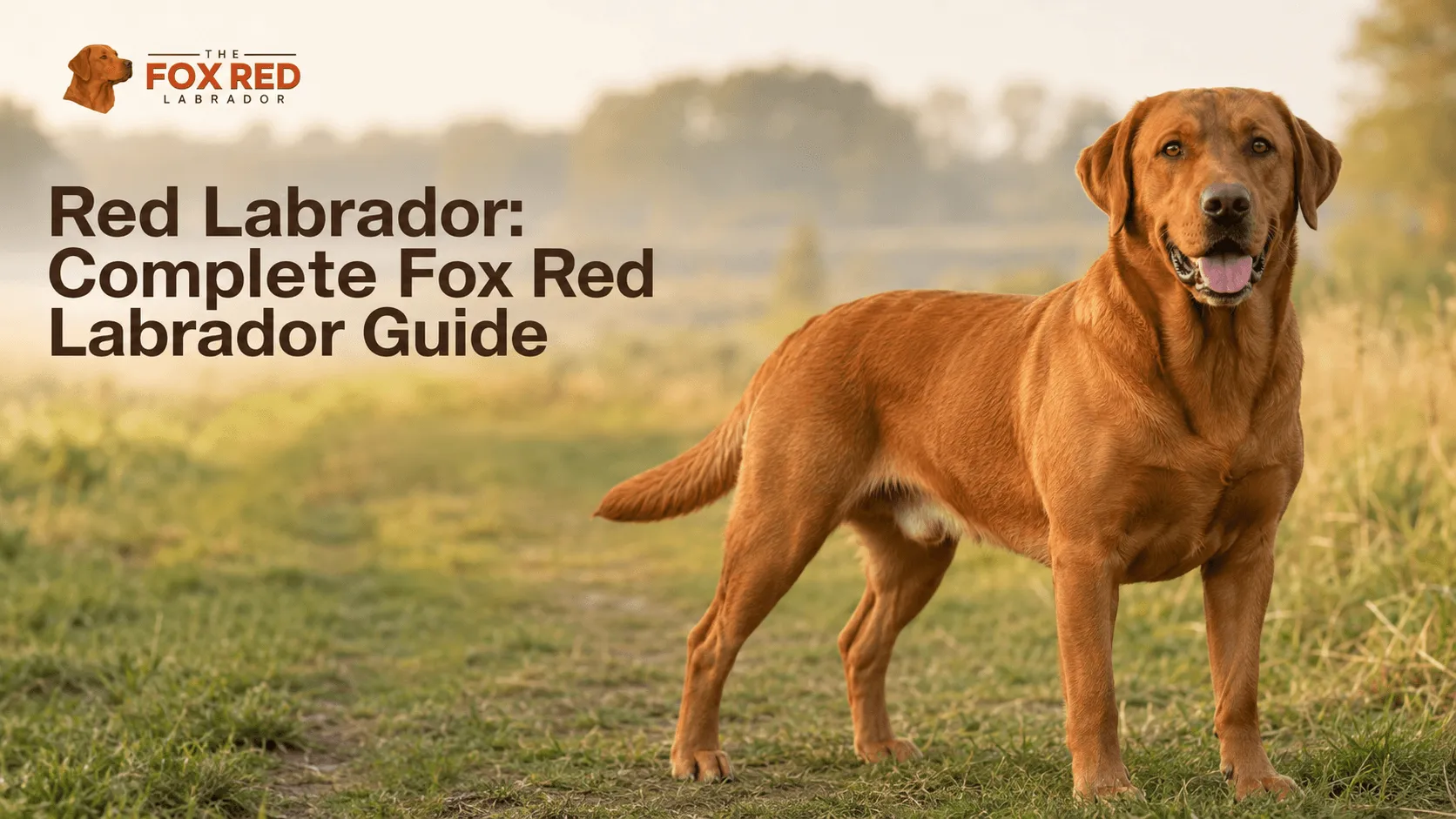
A fox red Labrador breed is a dark yellow to copper colored Labrador Retriever. It does not constitute a breed or a registration colour; qualifying dogs are registered as yellow Labradors. Not all fox red Labs are from active working lines, but energy, health and personality are not determined by color.
The Appearance, size, temperament, day-to-day care, health, puppy, and breeder selection are covered in this guide. How dark the coat is should never be the most important factor; health screening, parent temperament and household suitability should always be considered.
The Red Lab is an independent resource for anyone considering owning a Labrador, current owners, or anyone looking into this darker shade of Labrador.
Red Labrador At A Glance
These dogs have the same basic traits as the Labrador Retriever breed, in general. There can still be differences in dogs that are apparent due to sex, ancestry, health and upbringing.
| Trait | Information to show |
|---|---|
| Breed | Labrador Retriever |
| Common name | Red Labrador or Fox Red Labrador Retriever |
| Official color category | Yellow |
| General size | Medium-to-large |
| Coat | Short, dense double coat |
| Shedding | Moderate to heavy |
| Activity | Usually active |
| Trainability | Commonly responsive to consistent training |
| Hypoallergenic | No |
| General lifespan | Often around 11–13 years, with individual variation |
| Common roles | Companion, sport, gundog or working dog |
| Best suited to | Active households prepared for training |
| Common challenges | Pulling, jumping, chewing, shedding and slow maturity |
Is A Red Labrador Right For You?

A fox red Labrador Retiever tends to be a more active dog; it is suitable for owners looking for a social, trainable dog and can deal with the less dazzling aspects of owning a Labrador. Young Labs are capable of being strong, excitable and slow to mature. But they require much more than a pretty coat and a walk every so often.
Appearance should be one small part of the decision. The Red Labrador ownership hub explains the wider commitment.
A Red Lab May Suit You If
- The family exercise routine works with the daily schedule.
- Training will be ongoing until the adolescent age.
- Shedding, wet coats and muddy paws are okay.
- The dog is able to be part of the family.
- A strong young dog can be safely managed by household members.
- Food, insurance, training and veterinary care are affordable.
- Coat color is not as important as health and temperament.
A Red Lab May Not Suit You If
- A quiet, low energy dog is preferred.
- The dog would be left alone for extended periods of time on a regular basis.
- Very little shedding is needed.
- There is a time constraint on training.
- It would be hard to control if pulled or jumped.
- Exactly the same color and/or personality is required.
- The main criterion for selecting the puppy is the color of its coat.
Household Readiness Questions
Consider who will be taking care of the puppy on a day-to-day basis. Early on, it is important to agree on responsibilities so that one individual doesn’t start to take over the role of the dog’s full-time employee.
Time, space, budget and shared rules all matter.
Time
Someone needs to be in charge of meals, toilet breaks, exercises, and training each day. Puppies should be watched closely and given more rest.
Work, holidays and busy periods should be included in the plan. The dog’s schedule doesn’t change when the house schedule doesn’t fit.
Space
This dog requires a secure resting place and a quiet place to rest. Exercise, toileting, noise and shared access can be managed so that apartment living is possible.
A garden is convenient but it is not a substitute for walking or relating. Fencing should also be installed around open spaces.
Budget
Continuing costs consist of food, preventive care, equipment, training and veterinary care. Unexpected costs can be covered by insurance or an emergency fund.
Beds, collars and harnesses for puppies can be short-lived. Those lower replacement costs soon start to roll in a herd.
Agreement
Household members should adhere to the same guidelines as to feeding, furniture and greetings. Training can be much more difficult if there are mixed signals.
When adults do not take responsibility for children’s care, they are still responsible. The routine should be carried out by the child’s enthusiasm, not the child.
What Is A Red Labrador?
A fox red Labrador retriever is a yellow Labrador with more copper or red coloring. The terms Red Labrador and Fox Red Labrador usually refer to the same dog. For more details on recognition and terms, please refer to the breed guide.
Is A Fox Red Labrador A Separate Breed?
No. Lighter yellow, chocolate and black Labradors follow the same breed standard as a fox red Labrador Retrievers.
It has no official temperament standard, breed group or registry. Fox red is just a way of describing the dog’s appearance.
Are Fox Red Labs Purebred?
Yes, a fox red dog can be a purebred Labrador. Dark yellow pigmentation has been present in Labrador lines for many generations and is not dependent upon a Vizsla, Golden Retriever or other breed.
Just because something looks like a particular family doesn’t necessarily mean it is. Pedigree and registration papers can be used to make a purebred claim, but they do not mean that the parents are properly screened or the puppies raised responsibly.
Is Fox Red An Official Labrador Color?
Fox red is not registered as a separate red colour, but is accepted within the yellow range. The American Kennel Club Labrador standard specifies that yellow can be from fox red to light cream. Fox red is also included in the Royal Kennel Club standard under yellow.
The terminology used for registering a fox red dog differs from one country to another, but they are typically registered as yellow.
Red Labrador, Fox Red Lab Or Red Fox Lab?
These names typically refer to the same colour:
- Fox red Labrador
- Red Labrador
- Fox red Lab
- Red Fox Lab
- Red fox Labrador
The informal description is very clear: “Fox red Labrador”. The terms copper, mahogany and ruby can be used in advertising, but are not definitive categories.
Fox Red Labrador History And Origins

These dogs have the same heritage as other Labradors. Fox Red coats have been around within the breed for a long time, before the recent boom in demand for them.
Paler yellow later became fashionable in some show and companion families, while darker shades remained visible elsewhere. Follow the complete timeline in the Fox Red Labrador history and origin guide.
Shared Labrador Retriever Origins
The Labrador originated from British bred working water dogs of Newfoundland. The ability to retrieve was important in developing the breed’s conformation and temperament.
Red-coated dogs are part of the same stories. They have no origin story of their own.
Dark Yellow Labradors In Breed History
Dark yellow isn’t a new “designer” hue. Lighter yellow coats became popular, but the shade stayed.
The popularity of photography and modern breeders’ interest made Red Fox Labrador Retrievers more visible. They did not change their breed when they became more popular.
Fox Red Labrador Coat Color And Genetics

Fox red is a darker shade of yellow Labrador. The intensity of the yellow color depends on several inherited characteristics.
The full inheritance is more involved than one simple red gene. Read the detailed Fox Red Labrador coat and genetics guide.
Fox Red Is Part Of The Yellow Spectrum
Yellow Labrador coats can be light cream to deep Fox Red. No official boundaries exist for all the shades.
The words copper, rust and mahogany describe. They are not registered Labrador colours.
Fox Red Labrador Retrievers Genetics In Simple Terms
The puppy inherits coat colour from both parents. The other part of that inheritance gives rise to the yellow coat and other factors determine its intensity.
It is possible for littermates to have the same official color but appear different. For more detail, see the supporting genetics guide.
Yellow Coat Expression
Most of the coat has to be yellow for it to show through, as a result of inherited variants. This gives the base yellow color.
That base may be light cream to dark red-yellow. It won’t tell you exactly what color.
Pheomelanin Intensity
Pheomelanin is responsible for the yellow-to-red color in the coat. Modifiers are traits that are passed on from parents and affect the intensity of that pigment.
Multiple factors can combine. That’s why there’s always a chance of shade.
No Single Fox Red Gene
There is no gene that would ensure a precise Fox Red coat. Describing one exclusive red gene makes the inheritance sound simpler than it is.
Dark puppies may be more likely to occur through selective breeding. There may be variation within a litter.
Can Yellow Labradors Produce Red Puppies?
Yes. Fox red is in the yellow Labrador range.
Sometimes shade factors are inherited in a combination that results in darker puppies. The parents’ look may be a good indicator but not a guarantee.
Can Breeders Guarantee the Adult Shade?
No breeder can guarantee 100% shade. The coat color can lighten, darken or change patchily in puppies.
Appearance is also influenced by season, age and lighting. Beware of exact-color promises.
Red Labrador Appearance And Markings
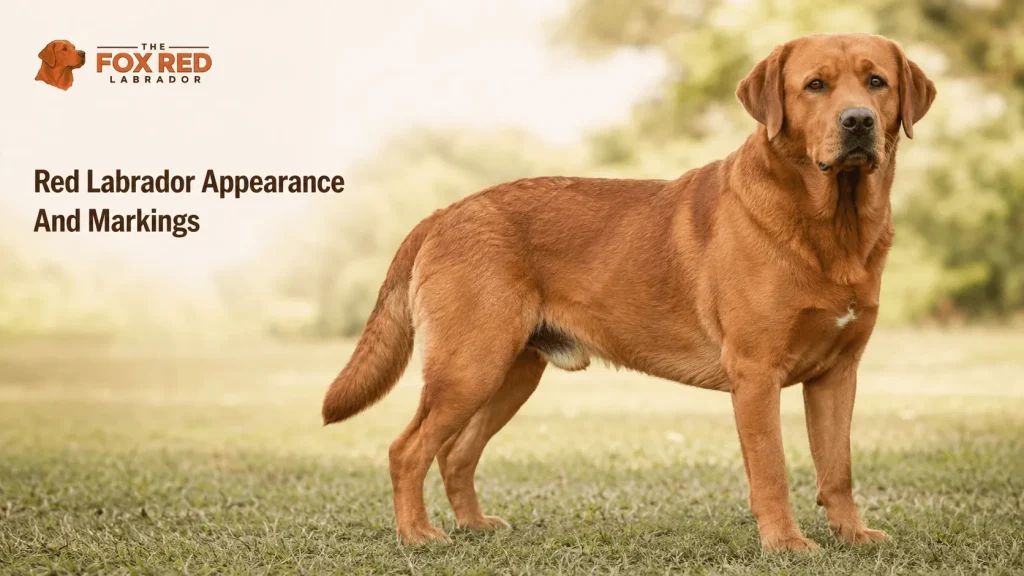
A red Fox Labrador Retriever should look like a Labrador first; red is a shade within yellow, not a separate type. Build, coat and movement matter more than small shade differences. Explore shades and markings in the Fox Red Labrador color guide.
Typical Labrador Features
Most have a strong, balanced build, drop ears, an otter-like tail and athletic movement. The short, dense coat has no Golden Retriever-style feathering, while the head may be broad or moderately broad depending on the breeding line.
Nose, Eyes, And Pigmentation
Many have dark pigmentation around the nose, lips and eye rims, with brown or hazel eyes. Lighting can change how the eyes and coat appear, and lighter pigmentation alone does not prove mixed ancestry.
White Marks And Uneven Shading
A small white marking on the chest may develop. Ears, back and upper tail might appear darker than the rest of the body.
If the coloring is extensive and white or patterned, it should be examined more carefully. Just because something looks like a specific type of person doesn’t mean that it is.
Fox Red Labrador Coat Color Spectrum
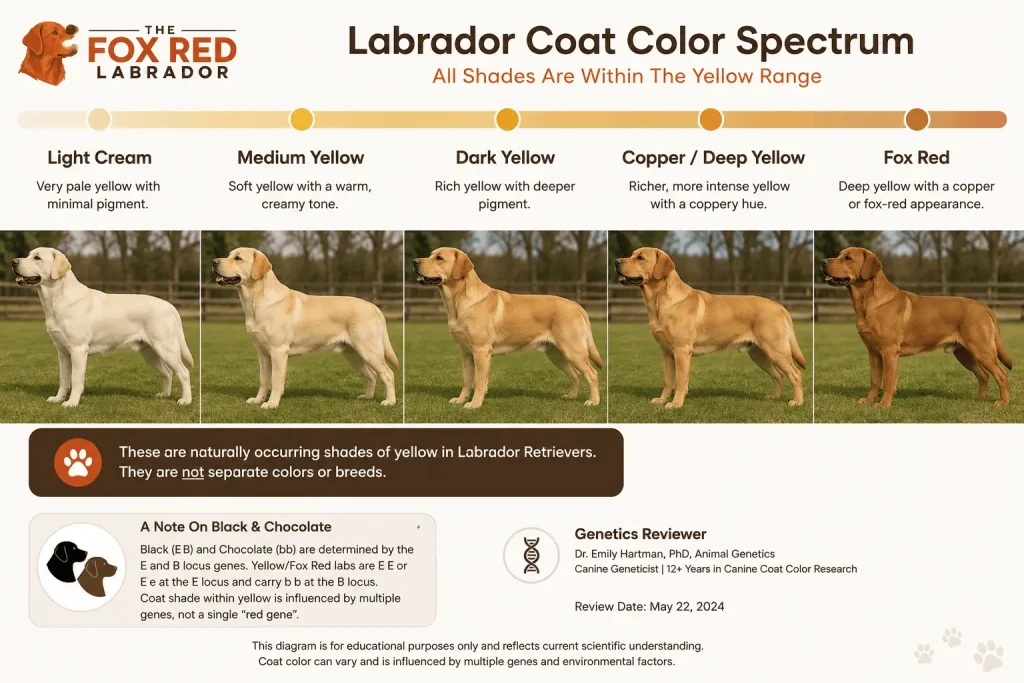
Fox Red is not a block of yellow, but rather a part of the yellow spectrum. A dog’s color can be described as dark yellow by one person and copper by another. Photographs can make the difference look larger than it is. Compare controlled examples in the Fox Red Labrador color guide.
Common Descriptive Shades
Common names are cream, yellow, dark yellow, golden-red, copper and Fox Red. These labels are used to define how things look.
None produces a separate variety of Labrador. Advertising terms that are dramatic should be considered marketing language.
What Can Change the Perceived Color?
The shade may appear different in different lighting conditions, such as indoor lights, sunlight and camera white balance. Hair that is wet can also be darker than when it is dry.
There is more variation with the seasonal coat and digital editing. A more level playing field is neutral daylight.
Fox Red Labrador Puppy Coat Changes
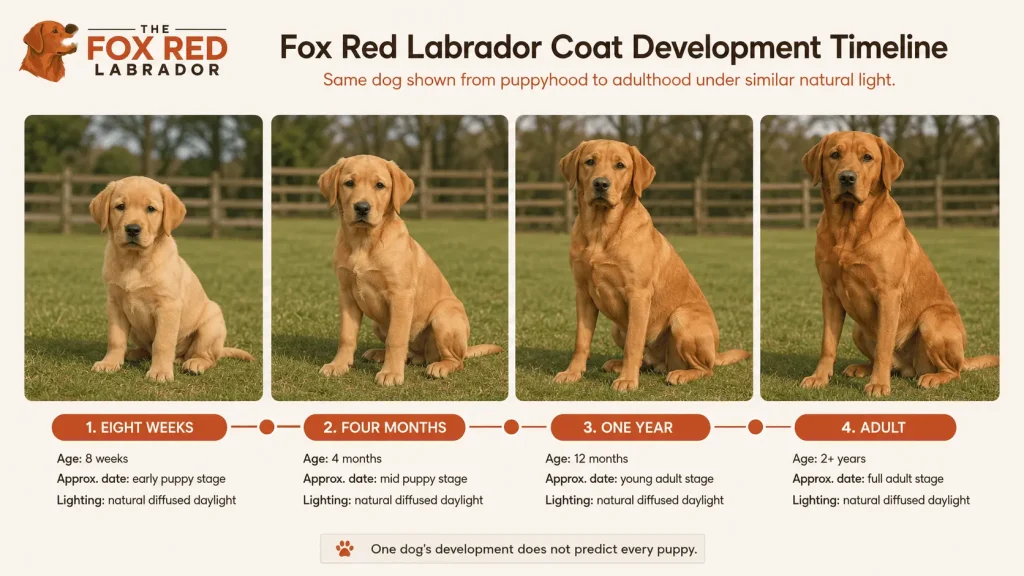
Fox Red Labrador puppies can get lighter or darker during the development of its adult coat. Change is in different directions and of different magnitudes for different people.
Early shade should never outweigh health or temperament when selecting a puppy. More examples appear in the Fox Red Labrador color guide.
Puppy To Adult Coat Development
The soft puppy coat will be replaced over time with a thicker adult coat. This can alter the depth and the distribution of color.
Littermates can grow up at various rates. An eight-week old dark puppy does not mean that it will stay dark.
Seasonal and Age-Related Changes
The coat may look different in different seasons and due to exposure to sunlight. As dogs age, they may get gray around the muzzle.
These changes are normal. They have no effect on the dog’s official colour category.
Fox Red Labrador Size, Weight, And Growth

These dogs are expected to be Labrador-sized. They do not have a colour based height or weight standard.
Sex, line type and body condition influence the final measurements. Detailed growth information belongs in the Fox Red Labrador size guide.
Adult Red Fox Labrador Weight And Height
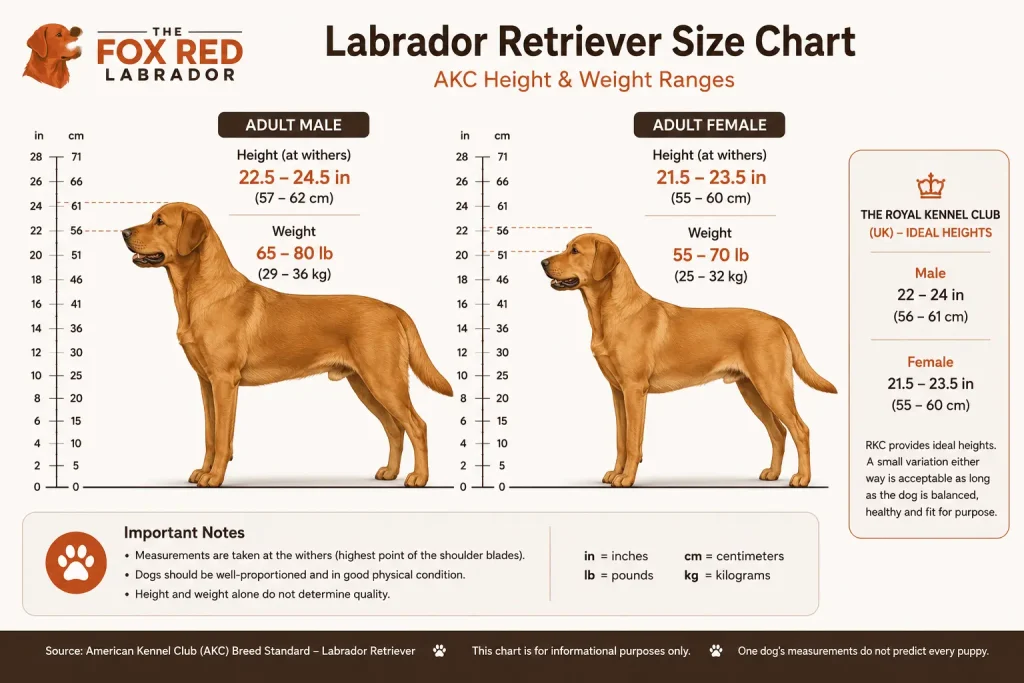
The figures vary slightly between organisations. They should be kept as separate ranges and not lumped together as one universal range.
| Measurement | Male Labrador | Female Labrador |
|---|---|---|
| AKC height | 22.5–24.5 inches | 21.5–23.5 inches |
| AKC weight | 65–80 pounds | 55–70 pounds |
| Royal Kennel Club ideal height | 22–22.5 inches | 21.5–22 inches |
These ranges may be different for individual dogs. It’s important to have a healthy body condition rather than the highest weight.
Red Labrador Growth And Maturity
Most Labradors reach adulthood at one year of age. Chest and muscle can still grow after growth in height slows.
Typically, behavior develops later. Even a large adolescent can make very puppy-like decisions.
Height Development
Growth rates are highest during early puppyhood and gradually decrease. The pace is influenced by genetics, nutrition, sex and health.
Monthly data are general guides. They shouldn’t be used as weight goals.
Body Development
The chest and muscles can still grow until the dog reaches full size. Different outlines can be created by working and showing ancestry.
More weight does not equate to more health. The better objective is a sound condition.
Behavioral Maturity
Emotional development may lag behind physical development. It is possible for adolescent dogs to get stronger than their self-control.
This should be used as an opportunity to continue training. A wait-and-see attitude regarding behavior is not a good strategy.
Healthy Body Condition
At a healthy body condition, the ribs should be easy to feel, with a visible waist from above and abdominal tuck from the side. Photographs cannot provide a complete health assessment; ask a veterinarian about growth or weight concerns.
Working-Line Vs Show-Line Red Labradors
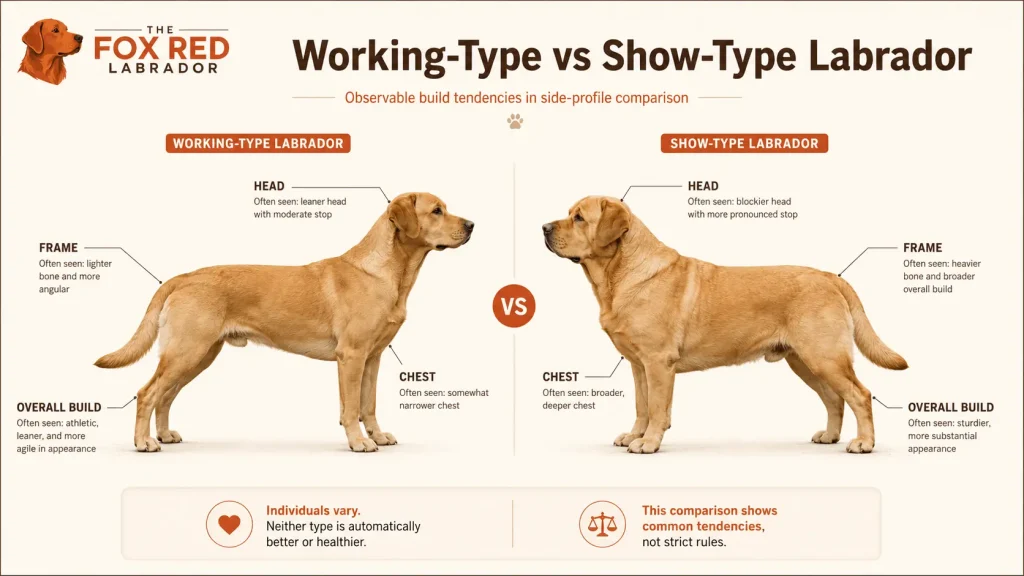
The working and show lines differ in breeding priorities. They are not distinct breeds of Labrador.
Fox red appears frequently in some working families, but color cannot confirm line type.
Working Or Field-Line Tendencies
Working Labradors tend to be slimmer and bred for field trials. Many have a good interest and stamina in retrieving.
These are tendencies in general. The energy and behaviour of individuals remain variable.
Show Or Bench-Line Tendencies
Labradors that are influenced by the show are likely to have thicker bones, wider heads, and wider chests. They prefer to breed in a conformation.
They do not necessarily have low energy or be calm. Young show-bred Labs are still capable of being active and vigorous.
Why Line Matters More Than Color
Shade is not as important as line background in terms of build and working interest. Better clues are provided by parent behavior and breeding objectives.
A dark coat does not prove field ability.
Male vs Female Red Labrador Retrievers
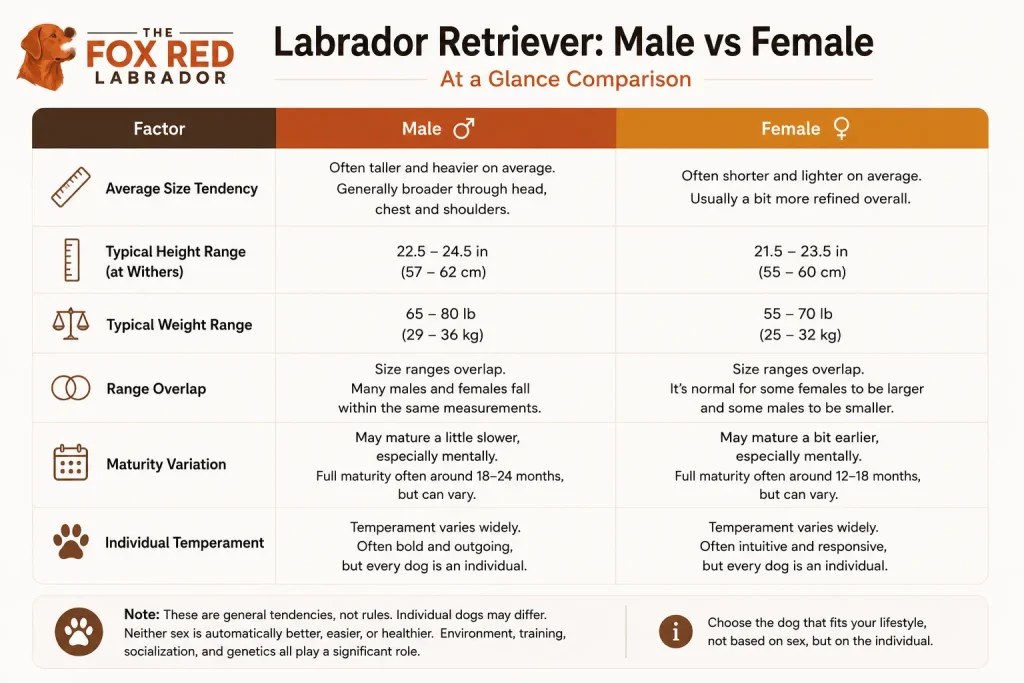
The male Red Labs tend to be bigger, on average, than the females, but there is a lot of overlap between the sizes of males and females. The difference may be more noticeable depending on the line type.
Sex is a poor shortcut for predicting personality. The male vs female Red Labrador guide covers the practical considerations.
Average Physical Differences
Males are often taller and heavier on average, following the same Labrador standards used for every coat shade. However, male and female size ranges overlap, so an individual female may be larger than an individual male.
Does Sex Determine Temperament?
No, sex does not guarantee affection, independence, calmness or trainability. Parent temperament, early experiences, health, training and individual personality are more useful considerations. Neutering is not a guaranteed behavior correction; discuss medical choices with your veterinarian and assess each dog individually.
Fox Red Labrador Temperament And Family Life

These dogs may exhibit some Labrador characteristics, including sociability, playfulness and food drive. Young dogs can also jump, pull, chew and have trouble calming down.
Coat shade does not control personality. Read the full Fox Red Labrador temperament guide for family and behavior considerations.
Typical Labrador Personality
Labradors like to hunt and bring in games, and are fond of people. They are willing to work and it can be rewarding to train them.
Adolescence can be distracting and exciting. It is important to continue practicing as the dog becomes stronger.
Does Red Coat Color Affect Temperament?
There is no evidence that temperament is related to shade. Working ancestry, parent behavior and breeder selection are better indicators.
Early handling and daily experience are also important. Color should not be used to predict calmness or aggression.
Are Red Labs Good Family Dogs?
They can be ideal for families who are active and ready to train and supervise. They are large and can be quite energetic; this can be overwhelming to a household that is expecting a quiet and relaxed dog.
It’s still about the dog. A breed label does not ensure safe behaviour.
Homes With Young Children
Young Labradors may accidentally knock over small children. Management of mouthing and toy stealing is also required.
A resting or eating dog should not be disturbed by children. Adult supervision is required.
Homes With Older Children
Supervised training and care is available for older children. Final responsibility needs to be retained by adults.
Having rules that are consistent helps the dog understand what is expected. Unwanted jumping or grabbing may be stimulated by rough play.
Red Labradors With Cats And Other Dogs
The majority of these dogs are compatible with other animals. Slowly introduce and keep them separate.
Not all dogs are interested in chasing. Cats must have safe places to escape and smaller animals must have protected housing.
Barking, Aggression, And Alone Time
Barking can be a response to excitement, boredom, fear or distress. It’s better to find out what’s causing the issue than to point to the breed.
Fox red is not known to be aggressive. If the behavior is serious, or sudden, it needs a professional evaluation.
Red Labrador Care and Daily Needs
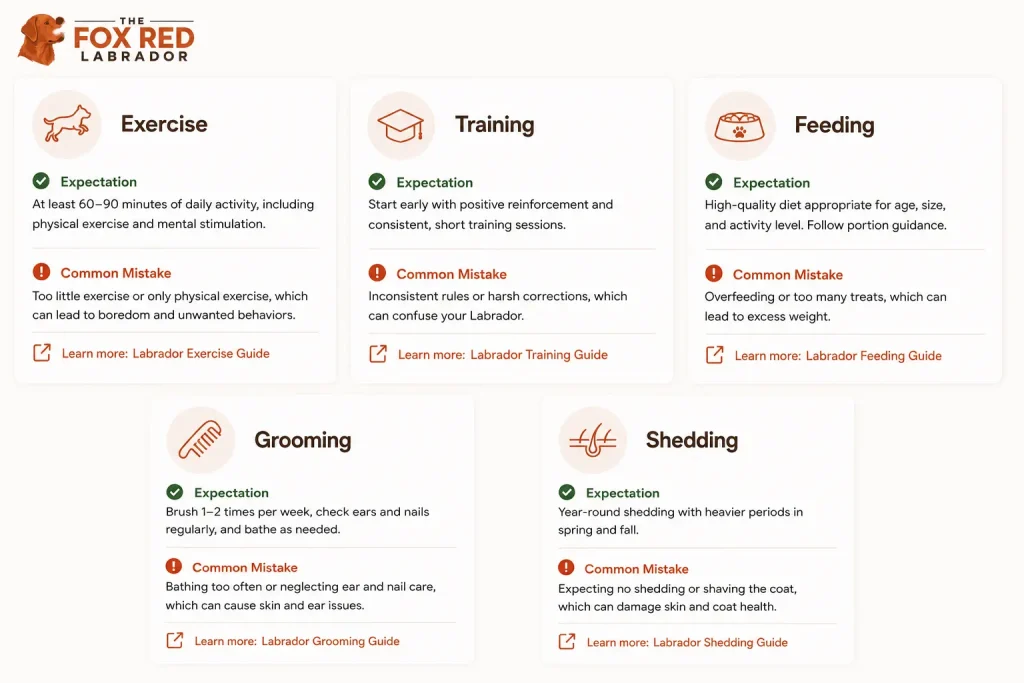
Caring for a Red Labrador is less about following one universal schedule and more about responding to the individual dog. Age, health, fitness, weather, activity level and household lifestyle can all change what a suitable routine looks like. The complete Red Labrador care hub brings the detailed care guides together.
Exercise And Mental Enrichment
Most healthy adults benefit from a varied routine combining walks, controlled retrieving, safe swimming, scent work and short training sessions. Puppies, older dogs and dogs returning to activity may need a different balance, with rest and recovery treated as part of the plan. A common mistake is forcing every Labrador into one fixed exercise duration instead of watching energy, movement and recovery.
Training
Daily skills such as name response, recall, loose-lead walking, cooperative handling and settling make home life and outings easier. Expect progress to become less consistent during adolescence, when familiar behaviors often need practice in new places and around distractions. A common mistake is relying on punishment or assuming one successful lesson is permanent.
Feeding And Healthy Weight
Choose a complete, age-appropriate food, measure portions, count training treats and follow body-condition and weight trends over time. Appetite alone is a poor portion guide, especially for a food-motivated Labrador. A common mistake is waiting for obvious weight gain before reviewing the routine.
Grooming
A short coat still requires regular care, including brushing, bathing when needed, ear checks, nail trimming, dental care and skin checks. Expect brief, calm handling sessions to be easier than occasional long sessions. Waiting until nails are overgrown, ears are sore or the dog resists handling is a common mistake.
Shedding And Allergies
Red Labradors have a dense double coat, shed throughout the year and are not hypoallergenic. Owners should expect heavier shedding periods and some hair on clothing, furniture and floors. Shaving the coat or expecting one product to stop shedding is a common mistake.
Red Labrador Health And Lifespan

They are the same as the general Labrador profile in terms of health. They do not form a distinct disease group.
Health screening can reduce uncertainty without guaranteeing a problem-free life.
Common Labrador Health Concerns
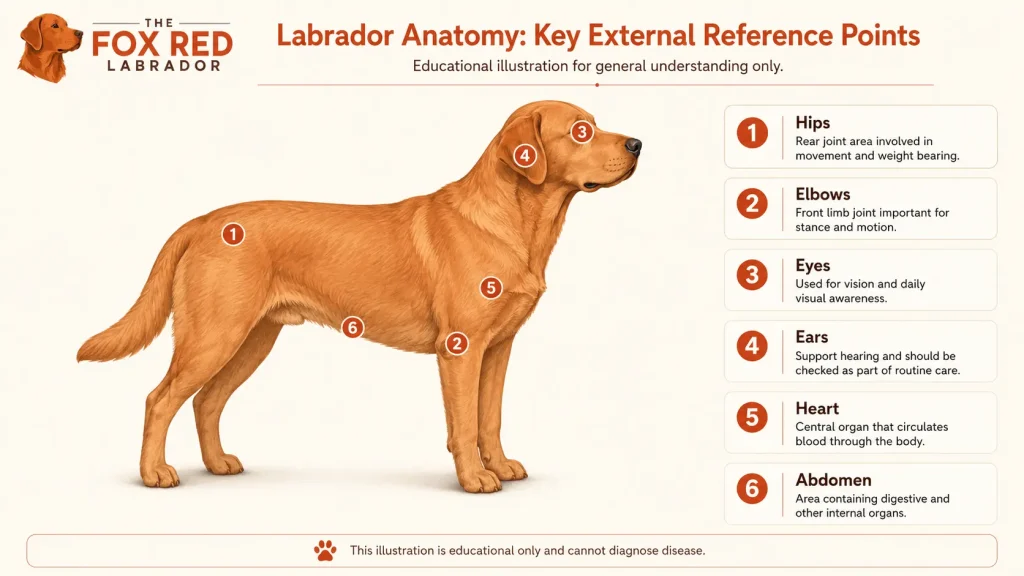
Labradors may suffer from joint, eye, inherited, ear, skin and weight-related problems. Individual risk varies.
No list can foretell the future of one dog. Personal health choices should be based on veterinary recommendations.
Is The Red Coat Linked To Poor Health?
The Fox Red shade is not a shade that is known to create its own health profile. The marketing name is less important than breeding decisions.
Issues can occur if colour is more important than health and genetic diversity. Evaluate the whole breeding program.
How Long Do Red Labs Live?
Generally, they live as long as other Labradors, about 11-13 years. Individual outcomes vary.
Genetics, body condition and lifetime care all matter.
What Health Records Should Buyers Check?
There are different recommendations for screening in different countries. Common areas are hips, elbows, eyes and related inherited conditions.
Request proof of results associated with both parents. A breeder badge will not tell you much. The information provided here is only educational and should not be used as a substitute for veterinary treatment.
Red Labrador Puppies, Price, And Adoption

Finding a Red Labrador puppy should begin with household fit, welfare and verifiable health information rather than coat color or sales urgency. Prospective owners should compare responsible breeders, rescue and rehoming routes before committing. Begin with the complete Red Labrador puppy hub and review the breeder warning signs.
What Red Labrador Puppies Look Like
Fox red Labrador puppies can range from dark yellow to copper, and puppies within one litter may not share exactly the same shade. The ears or back can appear darker, while indoor lighting and camera settings may distort the recorded color. Coat tone may also change as the puppy coat gives way to the adult coat, so photographs should not be treated as a color guarantee.
Puppy Development and Preparation
Before moving home, a puppy should receive appropriate time with its mother and litter, suitable handling, veterinary care and safe early socialization. New owners should prepare for frequent rest, patient toilet training, protected social experiences and household management that limits access to hazards. The Red Labrador puppy hub contains the full development timeline and preparation steps. A seller should also be willing to explain how the puppy has been raised.
Fox Red Labrador Price For Puppy
No single worldwide price accurately represents fox red Labrador puppies because country, currency and local demand affect advertised costs. Documented health testing, veterinary care, nutrition, facilities and early raising practices may influence the cost of producing a responsibly raised litter. A higher price, rare-color label or expensive deposit does not prove health, temperament or breeder quality.
Rescue And Adoption
Rescue is a valid path, although a fox red dog may not be available on a preferred schedule or in every region. Check Labrador rescues, general shelters and breeder rehoming programs, while approaching private rehoming offers carefully. Ask for any available medical and behavioral history, meet the dog where possible and consider household fit before agreeing to adopt.
Finding Responsible Red Labrador Breeders
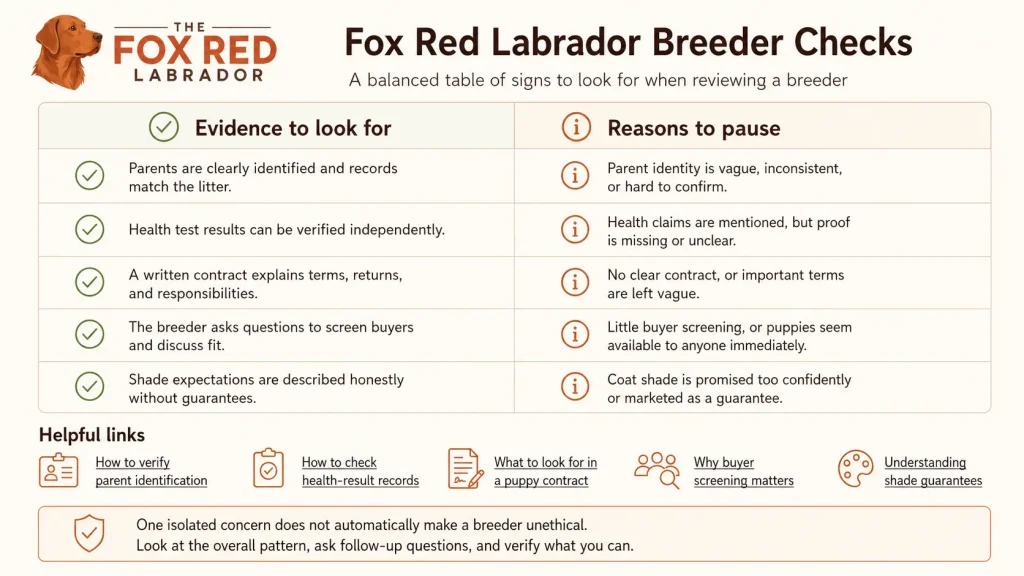
Finding a responsible Red Labrador breeder means checking records and practices rather than relying on polished photographs, registration claims or coat color. We do not recommend individual breeders without a published assessment method, and buyers should verify each program independently.
What A Responsible Breeder Should Provide
A breeder should identify both parents, provide independently verifiable health results, describe their temperaments and explain the reason for the pairing. They should also outline the puppy-raising process, supply a written contract and return policy, screen prospective buyers and remain available for ongoing support.
Fox Red Labrador Breeder Red Flags
Representative warnings include heavy emphasis on “rare color,” missing health records, no dependable information about the mother, exact adult-shade guarantees and copied or inconsistent photographs. Pressure for immediate payment, untraceable payment methods, no contract, no questions for the buyer or puppies leaving unusually early also deserve attention. One concern may require more questions, but a pattern of missing evidence is a reason to pause. Review the Fox Red Labrador breeder red-flags checklist before paying a deposit. Review the full breeder red-flags checklist.
Registration Is Not the Same as Responsible Breeding
Registration may help document a dog’s identity or ancestry, but it does not automatically confirm health testing, parent temperament, puppy-raising quality or ethical placement. Treat registration as one record rather than a complete breeder assessment, and compare its details with independent evidence.
Other Labradors And Labrador Mixes
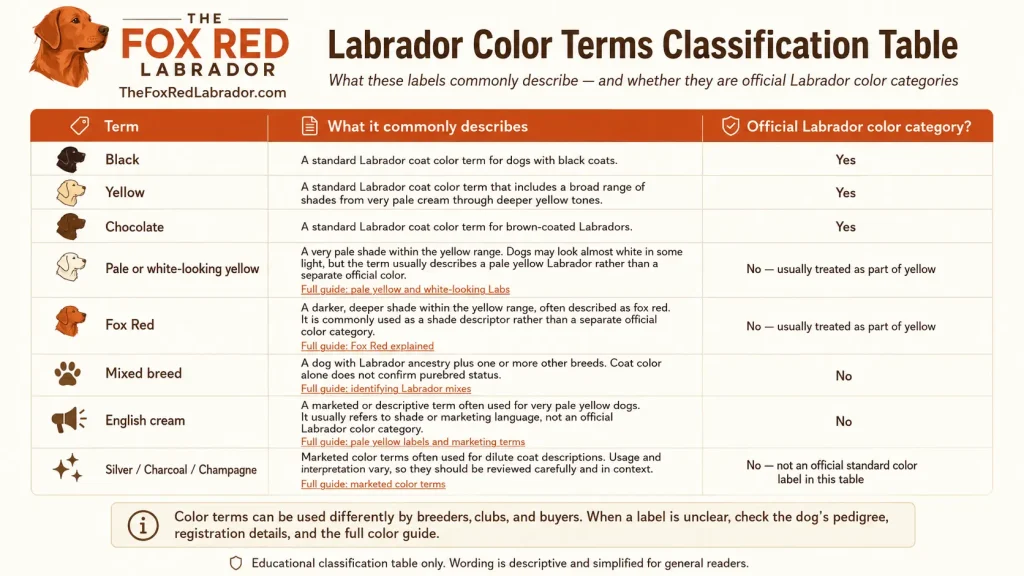
Official colours and informal shade names and sales terms are frequently combined. This can make normal colour variation sound like a new Labrador type.
Mixed ancestry is a subject of its own. It can’t be determined from just the coat color.
Other Labrador Colors And Types
The common color categories are black, yellow and chocolate/liver. The color terms “white” and “Fox Red” are used to indicate pale yellow and dark yellow, respectively.
Other marketed colors need separate explanation.
Labrador Mixed Breeds
Mixed dogs can receive a variety of characteristics from both parents. There can also be differences in puppies within the same litter.
Appearance cannot confirm ancestry.
Red Labrador Dogs Comparisons
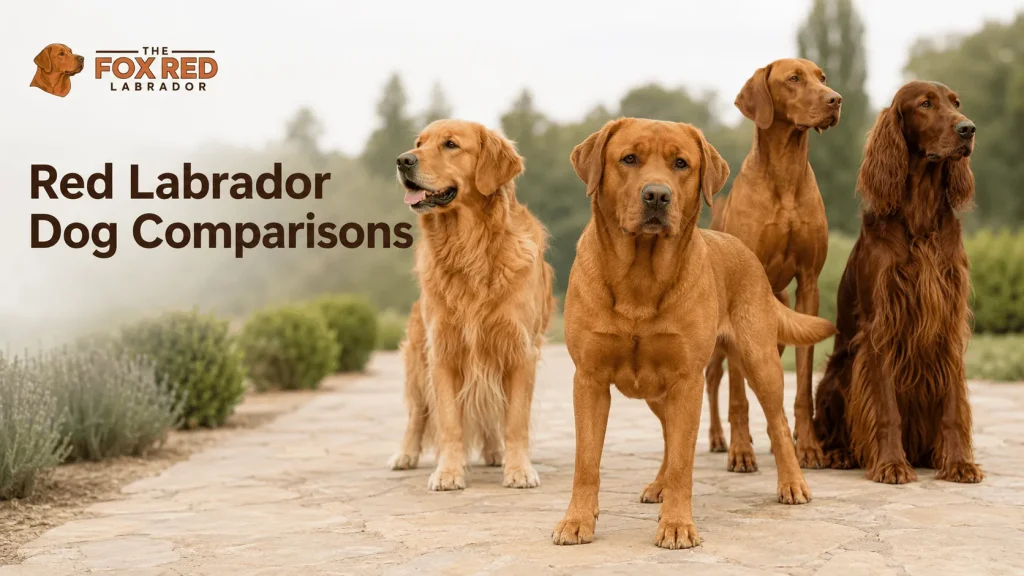
Fox red Labradors are sometimes confused with other red-coated gundogs or described using informal Labrador labels. These summaries establish whether each comparison involves the same breed or two separate breeds before explaining the most relevant appearance and ownership differences.
Fox Red Vs Yellow Fox Red Labrador
A fox red Labrador and a yellow Labrador are not separate breeds or official varieties. Fox red describes the darker end of the recognized yellow Labrador color range, so shade is the clearest visible difference. Size, coat type, general structure and expected Labrador characteristics come from the same breed standard.
Fox Red Labs Vs Golden Retrievers
These are separate retriever breeds. A fox red Labrador has a short, dense coat without the longer feathering associated with a Golden Retriever. Goldens typically carry more coat around the neck, legs, underside and tail. Their structure and grooming requirements also differ, even though both breeds were developed for retrieving work.
Fox Red Labrador Vs Vizsla
These are separate gundog breeds with different original roles. The Labrador was developed primarily as a retriever, while the Vizsla is a Hungarian pointing breed with a leaner outline, narrower head and close, smooth coat. Similar warm coloring can cause confusion in photographs, but color does not indicate shared breed identity.
English Vs American Red Labrador
“English Labrador” and “American Labrador” are informal labels, not separate breeds or officially recognized varieties. They are commonly associated with show or bench breeding and field or working breeding, respectively, although individual dogs may not fit either extreme. Build and activity tendencies can differ by breeding emphasis, but breeder goals, parent temperament and the individual dog remain more informative.
Fox Red Labrador vs Irish Setter
These are separate gundog breeds. A fox red Labrador has a short, dense retriever coat and a broad, balanced Labrador outline. An Irish Setter has a longer, feathered red coat and a taller, more refined setter build. Their traditional field roles also differ: Labradors retrieve game, while setters were developed to locate and indicate it.
Fox Red Labrador vs Chesapeake Bay Retriever
These are separate retriever breeds with different histories and coat characteristics. The fox red Labrador carries the Labrador’s short, dense coat, while the Chesapeake Bay Retriever is an American waterfowl retriever known for its wavy, water-resistant double coat and rugged build. General working style and temperament may also differ, although breeding line, training and individual personality matter.
Fox Red Labrador vs Nova Scotia Duck Tolling Retriever
These are separate retriever breeds. The Nova Scotia Duck Tolling Retriever is generally smaller, has a longer feathered coat and was developed to attract waterfowl within range before retrieving them. A fox red Labrador is larger, short-coated and follows Labrador structure and breed history. Similar red coloring should not be used to identify either breed.
Working Lab vs Family Lab
Working Lab and family Lab are not official Labrador varieties. The terms usually describe breeding emphasis, daily role or marketing. One program may select strongly for field performance, while another may place greater emphasis on companion homes. Neither label guarantees energy level, temperament or suitability, so prospective owners should assess the parents, breeding goals, raising practices and individual dog.
Fox Red Labrador vs German Shorthaired Pointer
These are separate gundog breeds. The fox red Labrador is a retriever with Labrador structure and a dense double coat. The German Shorthaired Pointer is a versatile pointing breed with a leaner outline and short coat, often carrying liver-and-white coloring rather than a solid fox-red shade. Ownership expectations should be compared beyond color and athletic appearance.
Explore Red Labrador Guides
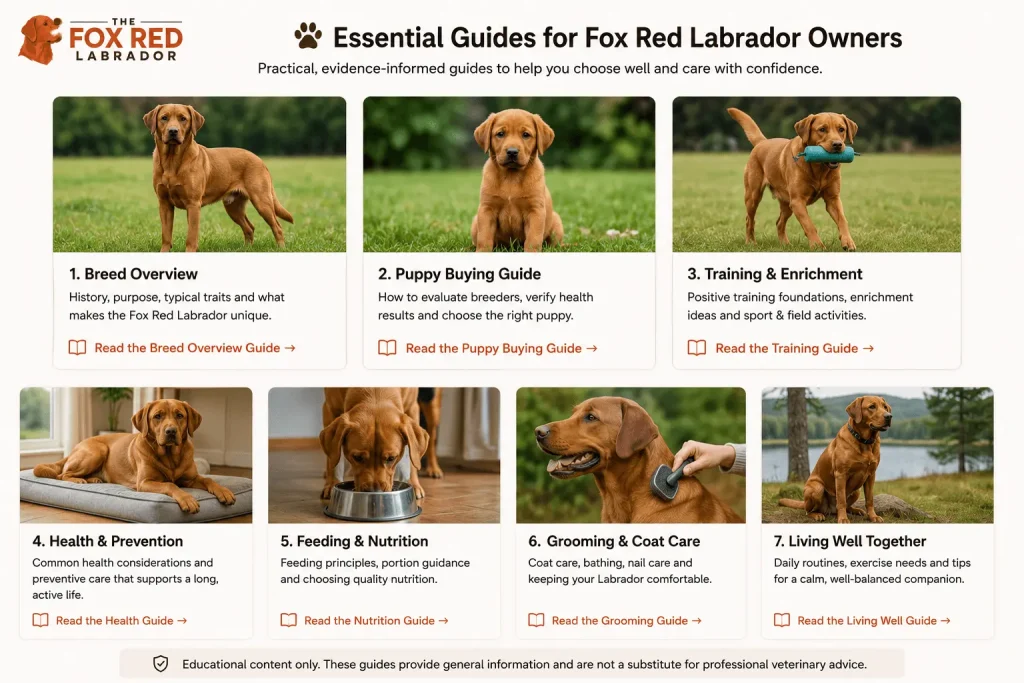
This page introduces the main questions without replacing the supporting pages. Choose the guide that matches the information needed next.
Each hub groups closely related subjects. This keeps detailed material organized and easier to update.
Breed And Appearance
Learn about history, color, genetics, size and temperament.
The hub also covers male and female differences. Individual pages handle each subject fully.
Puppies And Adoption
Find information about puppy preparation, price and rescue.
These pages help connect puppy interest with practical planning. They do not list puppies for sale.
Breeders
Learn how to compare breeders and verify records.
The focus remains on evidence and buyer protection. Coat darkness does not determine breeder quality.
Health And Lifespan
Read about health concerns, screening and healthy aging.
These guides are educational. Personal health concerns require veterinary advice.
Care
Build routines for exercise, training, feeding and grooming. Visit the Red Labrador care guides.
Care changes as the dog moves through different life stages. Separate pages provide the needed room.
Ownership
Consider suitability, commitment and household expectations. Explore the Red Labrador ownership guides.
This hub helps turn general interest into a realistic decision. Not every household needs to reach the same answer.
Original Red Labrador Research And Resources
Original surveys and records can improve the site when their methods are disclosed. They should appear only after real data has been collected.
Owner reports can describe experiences but cannot establish medical conclusions. Sample size and limitations must remain visible.
Red Labrador Owner Survey
A survey may collect age, sex, country, line type and daily-care experiences. Health information must be labeled as owner-reported.
Results need a stated collection period. Small samples should not be treated as universal.
Puppy Growth Records
Growth records should include age, sex, weight and measurement method. Line type may also provide useful context.
Charts should show variation rather than one ideal path. Healthy puppies develop at different rates.
Coat Development Gallery
Use same-dog photographs with age and date information. Similar lighting improves comparison.
Owner permission and honest labeling are required. Color filters should not be used.
Regional Ownership-Cost Report
Cost reports should state country, currency and collection date. Food, care, equipment and training can be shown separately.
Local findings must remain local. One market should not be presented as a worldwide average.
FAQ’s
No, fox red is a colour of the coat of a Labrador Retriever. There is no registry or breed standard for these dogs.
Yes, they can be purebred. There are naturally dark yellow coats in Labrador families. Appearance is not a good indicator of ancestry; pedigree records are more useful.
Yes, dogs that have the correct temperament can be registered as Labrador Retrievers. They are reported as being yellow in colour. Registration is not a guarantee of health testing or responsible breeding.
Named for its warm reddish-yellow color. It doesn’t imply that it is of fox origin. Fox red is still a part of the yellow Labrador range.
In some places, they may be less prevalent than lighter yellow Labradors. They are not considered rare anywhere in the world. Do not use scarcity as a measure of quality.
There is no correlation between personality and coat shade. Parents’ temperament and traits, ancestry, upbringing and training are more important. Dogs are all unique and can act differently.
They are not aggressive due to their colour. Any dog can be affected by fear, pain, inherited temperament and experience. Individual assessment of serious concerns is needed.
They can be appropriate for families that are active and ready for training and supervision. They can be difficult to manage because of their size and kid-like enthusiasm. The temperament of parents and early rearing should be taken into consideration.
One can be successful if the first time owner is well-prepared. There is still work to be done on training, exercise and adolescent behavior. Owning may be easier if professional assistance is provided early on.
Yes, if exercise, toilet, noise and companionship are managed. The suitability of a floor space is not determined by the floor space. Access to buildings and time spent alone should also be taken into account.
A few breeds have a good working history to produce good retrievers. Ability is based on breeding, health and training, not shade. Working ability cannot be determined by the colour of a coat.
Regular exercise and mental stimulation are needed for most healthy adults. The quantity is dependent on age, fitness and health. The routines of puppies and seniors are different.
They have the broader Labrador health profile. There can be joint, eye, inherited, ear, skin and weight-related issues. They do not have their own disease list because of their coat shade.
They are based on Labrador Retriever size standards. Males may be larger than females and line type will vary in build. There is no separate Fox Red size range.
The price is subject to the region, testing, pedigree and breeder program. Quality breeding does not necessarily mean a high price. Use local information that is dated before comparing costs.
A fox red Labrador is a yellow Lab. The first noticeable difference is the shade. There is a greater association between health and temperament differences and the dog’s ancestry and temperament than with color.
Sources
- AKC Labrador Retriever Breed Standard
- Royal Kennel Club Labrador Breed Standard
- AKC Labrador Retriever Profile
- The Labrador Retriever Club Breed Standard