
Is a Fox Red Labrador a Perfect Choice For Buying?
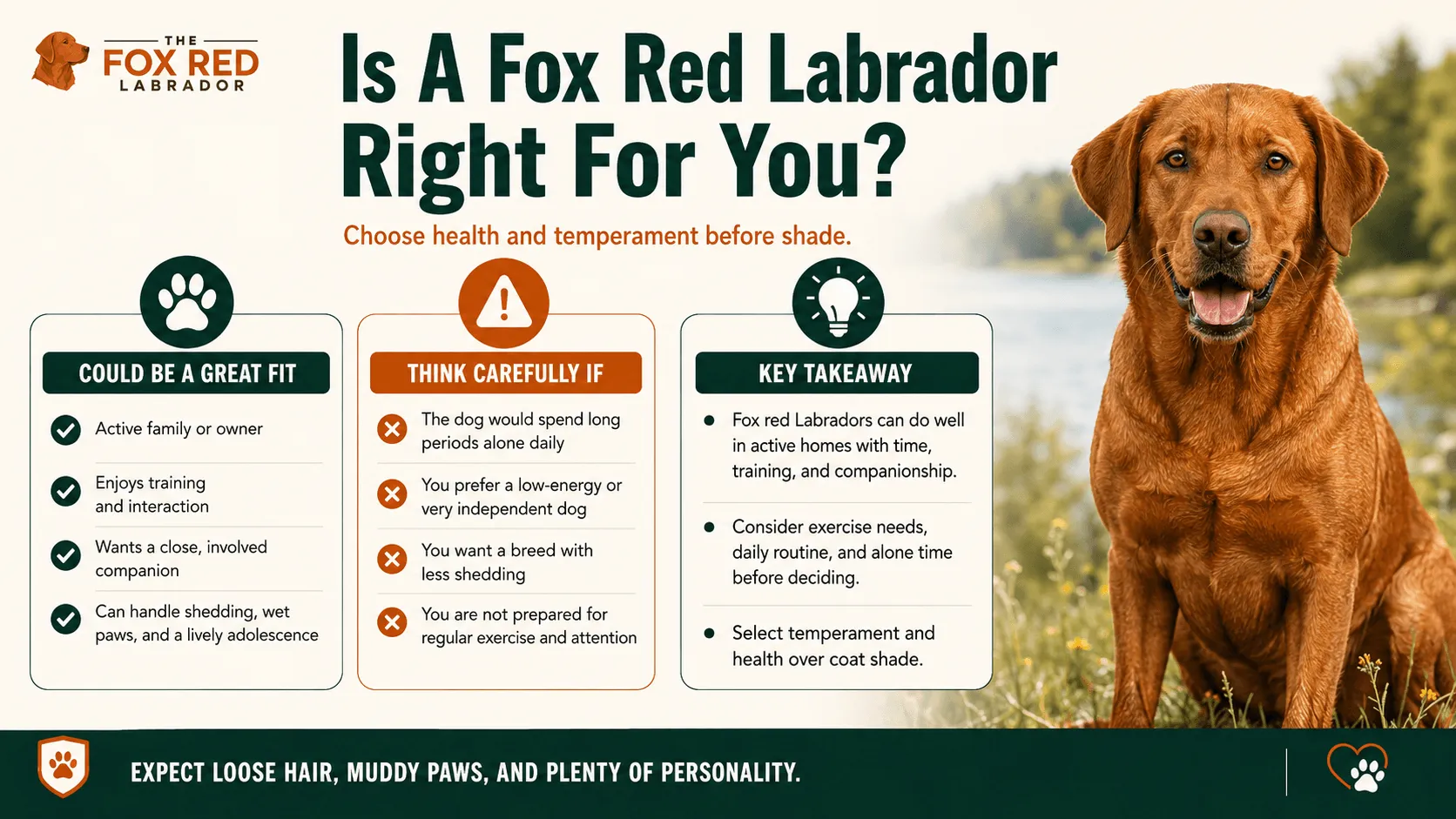
A fox red Labrador could be the perfect choice for an active family who are looking for a social, trainable dog to join in with the day to day activities. The fit is less comfortable when the family desires minimal shedding, workday absences or a good-natured, well-behaved dog that requires little training.
Although the fox red Labrador is a unique color, it is just a yellow Labrador that is darker. It is not one of its own breeds. There is no sure test of intelligence, temper, energy or health by colour.
Every day is more important than any photos that first come to mind. These dogs will require plenty of exercise, attention, boundaries, feeding control, and patient handling during their lively adolescent years. The arrangement is often accompanied by hair on clothing and muddy pawprints.
Coat color is not as good an indicator of compatibility as line, parental temperament, early development, health or the individual dog. The first step in making a responsible decision is to examine the household routine, not the darkest puppy.
Quick Answer: Is This Dog A Good Match?
The following comparison provides a quick reference. It’s not a ‘right or wrong’ examination, as one bad match for safety, time or money can be more important than several good ones.
| Likely Good Match | Likely Poor Match |
|---|---|
| Enjoys regular outdoor activity | Wants a naturally low-energy dog |
| Has time for daily interaction | Leaves the dog alone for long workdays |
| Will train through adolescence | Expects good behavior without training |
| Accepts shedding and muddy paws | Has a low tolerance for hair or mess |
| Can manage a strong young dog | Has limited safe handling ability |
| Has a realistic care budget | Has no plan for unexpected costs |
| Values health and temperament | Is choosing mainly for coat color |
It doesn’t have to be a perfect home. It does require a viable exercise, company, training, cleaning, veterinary, and emergency plan.
What Is A Fox Red Labrador?

Dark yellow is a fox red Labrador breed. It is also known by other names such as red Lab, red fox Lab and dark yellow Labrador.
According to the Royal Kennel Club breed standard, yellow Labradors can be light cream to fox red. That makes fox red a color within a range of yellow, not a separate color or breed. This is confirmed by the Royal Kennel Club Labrador breed standard.
Shade can vary greatly. Some dogs will be coppery, others will be a deeper reddish yellow. A dog may appear different in one photo than another based on lighting, seasonal changes in their coat, and photography techniques.
All of these visual differences are not reliable personality predictors. Don’t assume that a dark puppy is automatically calmer, harder working, healthier or more affectionate than a pale yellow puppy. Check all fox lab colors.
Why Are Some Yellow Labradors Fox Red?
The genes passed on by the parents determine the coat pigmentation. Breeders can breed for a darker yellow color by choosing dogs that are carriers and express the pigmentation.
There can be a difference in color between puppies in the same litter. They may also have a slightly different appearance from the fluffy puppy coats they had when they were born.
It is not a bad thing to select for colour. The problem is when a breeding program focuses more on darkness than on health, temperament, genetic diversity, structure and the quality of life of the parents. An attractive coat is no substitute for poor breeding.
Does Lineage Matter More Than Coat Color?
Yes. The red color is not as important as lineage and breeding purpose.
The broad tendencies of breeding in Labrador are indicated by the terms “field-line” and “show-line”. They are not distinct breeds and not consistent types of personality. Labradors bred for various uses can have fox red coats.
Field-bred dogs may be chosen for drive, responsiveness, stamina, speed or performance. Some show bred Labradors are heavier and may be chosen more for their conformation. But real dogs don’t fit into marketing boxes. A show-line puppy may be very active, and a field-line adult may be very calm after appropriate activity.
Inquire about parents’ behaviors and activities at home. They can be observed and are more useful in terms of a single line label.
Field-Line Vs Show-Line Tendencies
The following descriptions are illustrative, not guarantees. There are different breeding programs and different dogs in the same program can be very different.
| Factor | Field-Line Tendency | Show-Line Tendency |
|---|---|---|
| Breeding focus | Work and performance | Conformation and breed type |
| Build | Often lighter and athletic | Often heavier and broader |
| Drive | May show stronger working intensity | May be less work-focused |
| Household fit | Training, sport, or outdoor homes | Some companion homes |
| Limitation | Does not guarantee high energy | Does not guarantee calm behavior |
Don’t rely on labels; inquire from both parents about their level of activity, how well they recover from excitement, how they behave around people, how they react to frustration, and how well they can relax indoors.
What Is Daily Life With A Fox Red Labrador Like?
A normal working day starts with a toilet break, breakfast, movement and some people. There may be a short training period to be done before the house gets very busy for a young dog.
It’s not always as easy as opening the back door. The toilet and sniffing that can occur in the yard is not the same as changing sights, smells, learning opportunities and shared activity that can be provided during a planned outing.
There’s a workload to indoor life. During greetings, young Labradors can jump, pick up shoes, poke through bins, grab food, pull on the lead or turn a forgotten sock into the prize of the day. Good management avoids the practice of these habits and training provides safer alternatives.
Rest should also be a part of the routine. If a dog is exposed to constant entertainment, he can become an expectation dog. Predictable quiet times, comfortable downtime and settle training help to create a household companion, not a furry events manager.
Another walk, play, feeding, grooming checks, short training, and family time can be provided in the evening. Toilets must be scheduled during workdays and dogs or puppies must be accompanied, particularly if they are not coping well when left alone.
How Does Daily Life Change by Age?
A puppy requires lots of short lessons, plenty of sleep, safe socialization, chewing outlets and lots of frequent toilet trips. Sometimes things go better, sometimes worse. One day, the puppy is very sensible; the next day a chair leg is fascinating.
There is a lot of strength, confidence, excitement, and selective hearing during adolescence. Pulling, jumping, scavenging and distracted recall may increase. Routines are important at this age as the dog is strong before being emotionally ready.
Older Labradors tend to establish a more consistent routine. They require activity, interaction and continued training, but daily care may be more predictable.
Senior pets typically require adjustments to their exercise, weight management, resting spots and care for any changes in mobility, senses, appetite or stamina from their veterinarian.
Fox Red Lab Pros And Cons, And Challenges
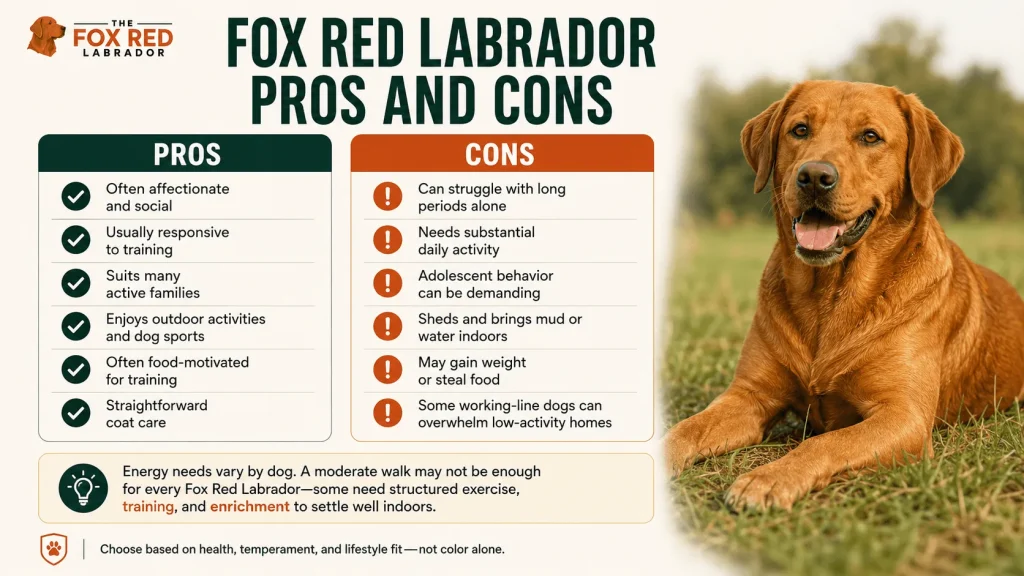
The pros and cons of Fox red Lab should be considered as connected pairs. What makes the dog a pleasure at one home can make him a chore at another.
| Potential Benefit | Related Ownership Challenge |
|---|---|
| Often social and affectionate | May struggle with isolation or boredom |
| Usually motivated to learn | Motivation does not equal automatic good behavior |
| Suitable for outdoor activities | Requires consistent daily activity |
| Can live with children and pets | Young dogs can be excitable and physically overwhelming |
| Straightforward coat care | Heavy shedding remains normal |
| Adaptable when needs are met | Adaptability does not make care optional |
| Attractive dark-yellow coat | Color-focused breeding may obscure health priorities |
| Often food-motivated | Scavenging and weight gain require management |
A home that is active and has a training mindset is better equipped to deal with these compromises. The routine may be challenging for low-activity households or individuals who are away for extended periods of time.
Can’t tell from the looks or the cost if a Fox Red Lab is a good investment. The question that is useful is whether or not the household desires the reality that comes with the dog every day.
Is A Fox Red Labrador A Good Family Dog?
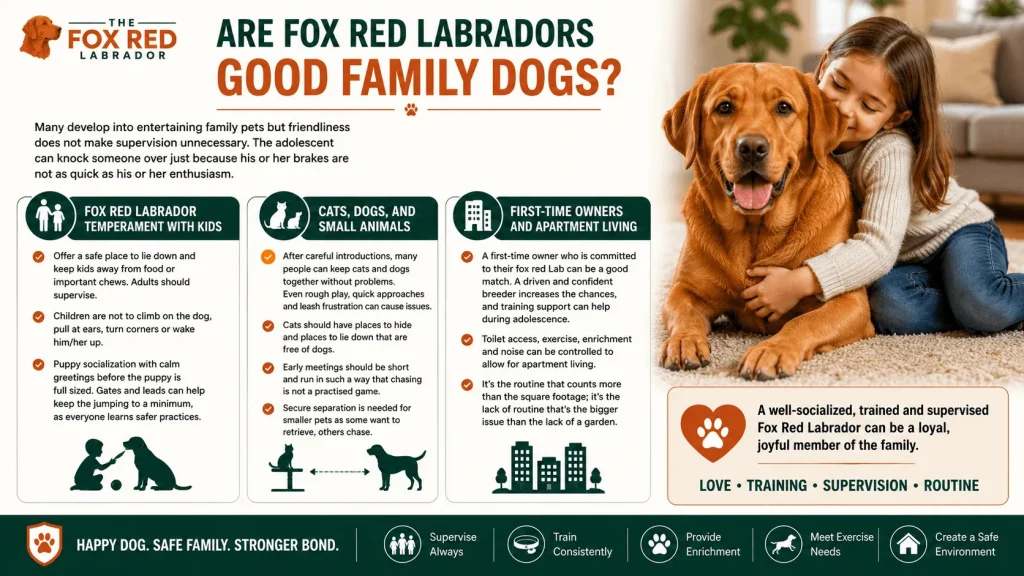
They can make good family dogs when the adults take care of the relationship rather than relying on the dog to make things safe.
Several Labradors like to be near home activities. Young dogs may also bite, jump, chase, grab a toy and knock over a little child without meaning to do so. They are enthusiastic in a fairly robust manner.
Children should not disturb a dog sleeping, eating, hiding or chewing something of value. Even if the dog is tolerant, hugs, climbing, cornering and face-to-face contact can make him uncomfortable.
Young children and dogs should never be left alone. Even if dogs seem well behaved, the AVMA recommends supervising children around dogs of all types.
Some families may prefer a puppy with a calm, well-behaved adult Labrador rather than a puppy. When looking at a litter, take into account the temperament of the parents, the puppies’ early environment, and how the breeder matches them to homes.
Is A Fox Red Labrador Good With Cats And Other Dogs?
But just because a fox red Labrador is a Labrador does not mean that it will get along with another dog or cat. The outcome is influenced by previous experience, chase behaviour, play style, age, health and confidence.
Introductions should be gradual and cautious. Start slowly, with distance, with barriers and with rewards for calm. Avoid allowing a bouncing young Labrador to chase a cat “just to see what happens.” The cat will probably not be very enthusiastic about the experiment.
If necessary, separate feeding areas and resting areas. Cats should be given places to go where they can go offstage or have a room that is dog free.
Observe for rigidity, difficulty with eye contact, frequent chasing, guarding, hiding, and/or escalation. If introductions don’t take place or if one animal seems frightened, a qualified behavior professional can assist.
Can A Fox Red Labrador Live In An Apartment?
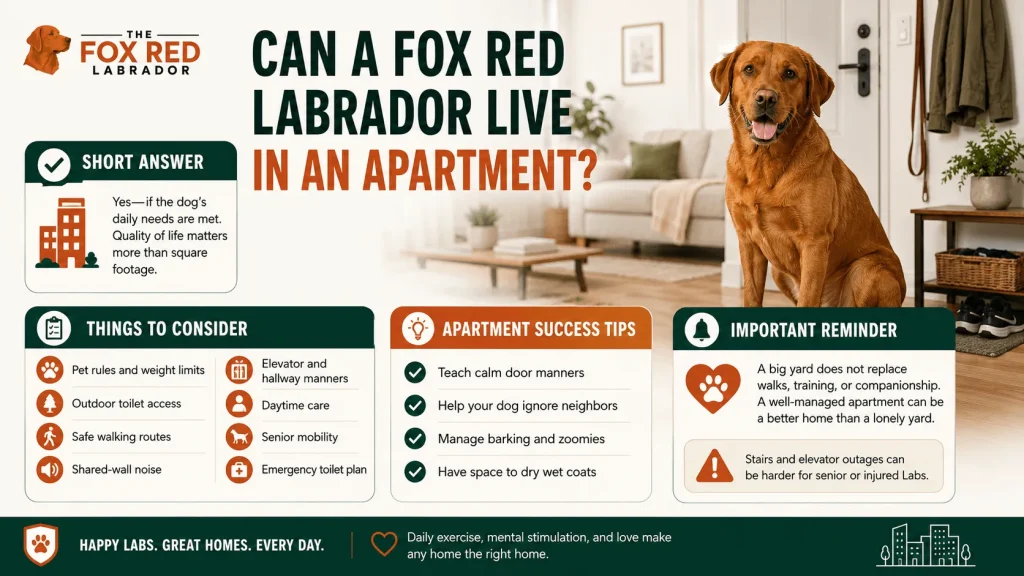
Yes, as long as the dog’s needs can be met by the owner outside of the apartment and the dog can be taught to behave calmly in the apartment.
The arrangement is just one part of the floor space. A good, active owner who offers safe outings, training, companionship and enrichment can better meet the needs of a Labrador than an inactive owner with a big yard.
Puppies should be taken out often, even if it’s not a convenient time. Factors to consider include stairs, elevators, shared entrances, slippery floors, noise and neighbor or other dog interactions.
Greeting etiquette can make living in an apartment a lot easier. So can training the dog to be relaxed when footsteps pass the door or people come into the lift. If a dog doesn’t get enough activity or attention, it can bark, pace, chew, and be restless, which can be a nuisance to the dog and to others.
Before booking, please review rental policies, breed restrictions, size limits, walk access and appropriate walking areas. A yard isn’t enough; it’s companionship, training, and purposeful outings.
How Much Exercise Does A Red Labrador Need?
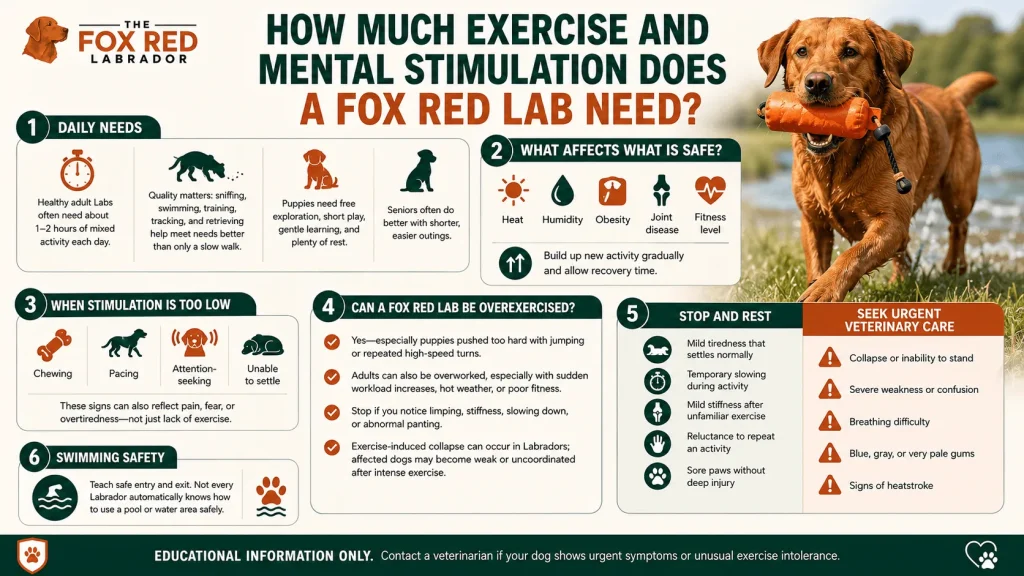
The exercise requirements are different for each age, health, fitness, body condition, lineage, weather and previous conditioning. All those differences can’t be captured in a universal daily number.
Walking, sniffing, retrieving, controlled play, swimming, hiking, scent work, and short training games are all activities enjoyed by healthy adults. Others excel in dog sports or work. Some enjoy moderate excursions and then a nice nap in the home.
Alternate physical activity, mental activity, social activity and rest:
- Physical activity can be walking, retrieval, swimming and/or structured play.
- Mental activity can be scent games, food puzzles, problem solving and training.
- Calm household interactions and appropriate outings can address social needs.
- Rest is needed to help the body and nervous system recover.
Forced endurance or repetitive high impact exercise should be avoided in puppies. Young bodies require age-appropriate movement and exploration, sleep and gradual conditioning.
Activity should gradually build up from illness, inactivity or season. No amount of exercise can compensate for over-feeding, nor for lack of training in pulling, jumping or impulse control.
If the dog becomes painful, lamens, breathless, weak, collapsing or becoming hot, stop and seek veterinary advice.
Learn more in our complete Fox Red Labrador Care Guide.
Is A Fox Red Labrador Easy To Train?

A lot of Labradors are responsive, interested in food, and willing to work with people. Those attributes can be fun to train. They are not the source of good behavior.
Begin early on with reward techniques. Sessions need to be short enough to keep the dog focused, and then practice the skills in new locations, with more distractions added over time.
Useful priorities include:
- Recall
- Loose-leash walking
- Settle
- Polite greetings
- Leave it
- Drop
- Handling tolerance
- Calm behavior around food
- Impulse control
Management supports learning. Gates can be used to prevent entrance to enticing rooms. Scavenging is minimized with covered bins. A puppy can be taught to greet visitors in a calmer manner and the lead can be used to help them do so.
As an adolescent, familiar cues can suddenly seem unfamiliar. This doesn’t imply the dog has forgotten anything. Reduce the level of challenge, reinforce positive responses and restore consistency.
The amount of treats given to the dog during training should be included in the total daily amount of food. A Lab will not complain about an unlimited snack budget, except for the waistline.
Are Fox Red Labs Good For First-Time Owners?
They can be appropriate for the first-time owner who is prepared for the work and not just the friendly reputation of the Labrador.
Time for training, daily activity, companionship and workday care are essential for a suitable first-time owner. Handling is important because an excited adolescent Labrador can be strong. Learning can be easier for the dog and owner in group classes or with professional assistance.
Budget also counts. When your puppy comes home, there’s more care, more prevention, more food, more equipment, more classes, and more unexpected illness.
Ownership of dogs is not the key factor. The qualities of patience, consistency, time, safe handling and willingness to learn provide a clearer picture of readiness. A fox red Lab puppy may be a lot to handle for a person who is looking for a first dog that is going to be automatically calm.
What Temperament Should An Owner Expect?
Labradors demonstrate social interest, enthusiasm, food motivation and interact with people. These are tendencies and not promises that every puppy will make.
Temperament is developed by a number of influences. It is influenced by genetics, parental behavior, early development, social experiences, health, learning and household management.
Well-socialized does not mean just seeing lots of people and animals. Useful socialization means safe, positive exposure, not putting the puppy in situations that are frightening.
Behavior can be altered by pain, fear, frustration, sickness and chronic stress. If a dog that is usually tolerant suddenly becomes irritable, shy, avoids contact, or growls, it could have a medical issue and should be evaluated by a veterinarian.
Statements about coat color or gender predicting affection, calmness, courage or trainability must be taken with a pinch of salt. Each dog should be evaluated on a case by case basis.
Are Fox Red Labradors Aggressive Or Protective?
There is no evidence to support the claim that the fox red Labrador is more aggressive than any other colour due to its colour. Coat color and temperament do not correlate.
Labradors are not typically considered to be a breed for a specific guarding purpose. Others bark when they hear strangers or when something is different at home. Alerting does not necessarily mean the dog will protect a person or property.
Fear, pain, resource guarding, frustration, conflict or learned behaviors can all be linked to aggressive behaviors. Growling is not a nuisance and should not be punished for it, but rather it is a sign of discomfort and can indicate that a bite is imminent if it is used correctly.
Aggression, snapping or biting that continues requires qualified assistance. A veterinarian can rule out medical contributors and a qualified behavior professional can evaluate triggers and develop a safe plan.
Can A Fox Red Labrador Be Left Alone?

A fox red Labrador will be able to learn to be left alone for a period of time, but tolerance varies with age, temperament, training, and experience. No dog is responsible enough to have a maximum.
Puppies require regular access to the toilet, regular feeding, supervision, sleep and separation training. They cannot simply be fitted around a full adult workday.
Start with short (calm) absences. Go back until the puppy is upset, then slowly increase the amount of time. Helping can be done by providing safe enrichment, exercise, rest and a predictable routine.
Adult dogs need a strategy too. Support may be offered from a dog walker, dog sitter, family member or appropriate daycare. Not all dogs are suited for daycare, especially those that do not thrive on social interaction.
Boredom can result in seeking amusement; unmet physical needs or toilet needs can cause restlessness. Separation-related distress may manifest as more intense crying, frantic destruction of exits, drooling, attempts to escape, pacing, toileting, or panic.
If the dog is left alone for an entire working day on a regular basis, it may not be a good family pet. Access to the garden is not a substitute for social interaction or supervision.
How Much Shedding And Household Maintenance Should You Expect?
Expect regular shedding. Fox red Labradors are just as short and dense as other Labradors and loose hair is seen all year round. Seasonal coat changes can result in heavier periods.
Brushing helps to loosen the coat and assists with skin checks. It does not make a Labrador a low shedding breed. Hair will still end up on clothes, furniture, car seats, and of course, the plate that wasn’t anywhere near the dog.
Bathing should be done based on need and not a schedule. Use dog products and dry coat properly. After a swim, examine the ears, especially if the dog has a tendency to get them wet or irritated.
Routine maintenance also includes:
- Nail care
- Dental care
- Skin and coat checks
- Ear checks
- Parasite prevention based on veterinary advice
- Cleaning food, water, mud, and outdoor debris
If itching is a persistent problem, skin is inflamed, there are bald spots, ears smell bad, there is discharge, repeated head shaking or pain, it’s time to consult a vet. They’re not normal grooming issues that should be ignored.
What Should They Eat, And How Is Weight Managed?
A fox red Labrador should be fed a balanced, complete diet that is suitable for their age and stage of life. The right amount is determined by the energy content of the food, the dog’s activity level, body condition, age and health.
Use measuring instruments to determine portion sizes, rather than just the package size. The treats, chews, scraps and training treats are all added to the daily intake. The little things can add up to a pretty big nutrition side business.
Puppies require food for growth. A homemade diet should not be “made-up,” particularly during growth. All individuals thinking about a homemade diet should consult a properly qualified veterinary nutrition professional.
Monitor body condition more often than just once a year. Ribs should feel easily under a light covering and the dog should have a visible waist when viewed from above, although the veterinarian can show you what is suitable for the dog.
Secure storage is also required for the Labrador’s food motivation. Don’t store food, trash, drugs, hazardous materials, or unsafe household products where they can be easily reached.
What Health Risks Should Be Considered?
The health issues affecting the Labrador breed in general are also present in fox red Labradors. These may include hip dysplasia, elbow dysplasia, inherited eye disorders, exercise induced collapse, weight-related disease, ear disease, skin disease, joint disease, and mobility disorders.
Does not imply that all predisposed dogs will develop a listed disorder. Individuals vary due to genetics, breeding, body condition, exercise, preventative care, environment and chance.
Diagnosing a dog is not the same as screening breeding dogs. While a parent’s screen result may give an idea of inherited risk, it does not ensure a puppy will be disease free.
Medical note: This information about general breeds does not diagnose or predict an individual dog’s health. Symptoms, exercise tolerance, growth, weight and preventive-care needs should be evaluated by a veterinarian.
Explore our complete Fox Red Labrador Health resource.
Do Fox Red Labradors Have More Health Problems Than Other Labs?
There is no scientific proof that the darker yellow pigment is the sole cause of more health issues in Labs. There are still some yellow Labrador dogs that have the fox gene.
More realistically, the question is how a litter was produced. Risk can be mismanaged if a breeder chooses to breed only for darkest color, without taking into consideration health results, temperament, structure or genetic diversity.
Evaluate the entire breeding program. A lighter dog from stable, screened parents will be much better than a darker puppy who was sold with lots of color marketing.
How Long Do Fox Red Labradors Live?
The coat color does not form a distinct sub-population with a specific life expectancy; thus, fox red Labs conform to the overall Labrador longevity.
The AKC now reports that a Labrador’s life expectancy is 11–13 years. This is a breed level planning range, not a guarantee for any particular dog.
Genetics, body condition, disease, preventive health care, injuries, reproductive history, living conditions and access to treatment are all factors that influence longevity. There are also differences in population estimates based on location, how the study was done, and which dogs were included.
Which Health Results Should Buyers Verify?
The Labrador Retriever Club’s current guidelines state that hip evaluation, elbow evaluation, an eye examination by a boarded veterinary ophthalmologist, exercise-induced collapse testing and D-locus testing are minimum clearances required for CHIC. The tests that are optional or recommended are centronuclear myopathy, cardiac evaluation, and prcd-PRA testing. Requirements may vary; please check the most up-to-date list before considering a litter.
Request the registered name or identification of both parents. Look for them on their own, not on a screenshot, informal certificate, or because someone “vet checked” it.
A CHIC number indicates that the dog has passed the parent club’s tests and the results have been published. Does not imply that all the results were normal. The OFA CHIC program clarifies this difference and enables buyers to inspect public records.
Health screening does not eliminate uncertainty; it just lessens it. That is a legitimate restriction, and not the same as no testing whatsoever.
How Much Does Fox Red Lab Ownership Cost?
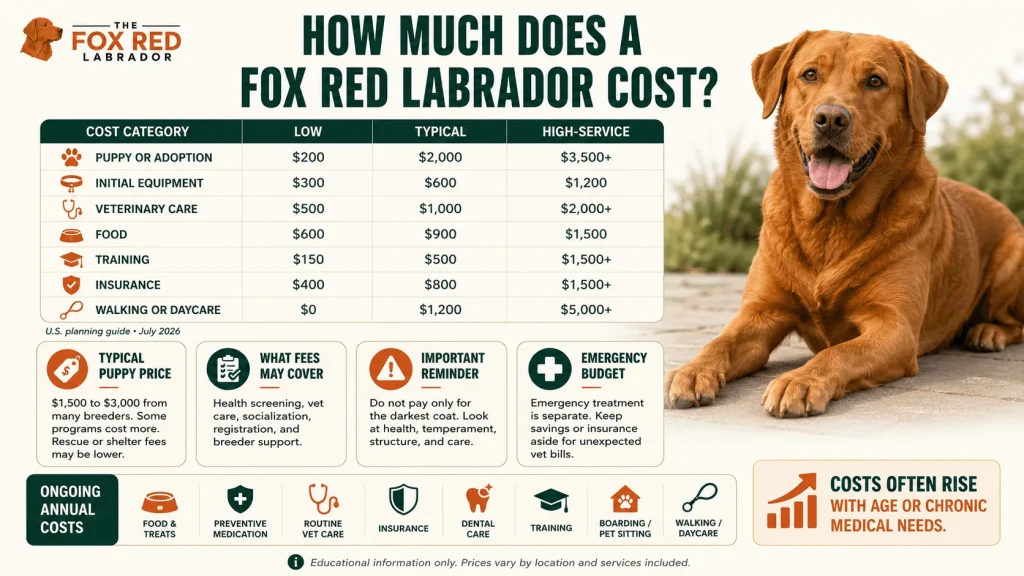
The puppy or adoption fee is just the initial cost. Food, support during the workday, preventive care, training, travel arrangements and the household’s ability to cope in case of emergency are all factors that impact long-term affordability.
| Cost Stage | Expenses |
|---|---|
| Acquisition | Purchase price or adoption fee |
| Setup | Crate, bed, gates, bowls, lead, harness, identification |
| Routine | Food, preventive care, grooming supplies, training rewards |
| Development | Classes, socialization, behavior support |
| Workday care | Walker, sitter, or daycare |
| Travel | Restraint, boarding, transport |
| Protection | Insurance or emergency savings |
| Unexpected | Illness, injury, property damage, behavior care |
There is too much variation in costs across countries and households to have a general total that is useful. Create a local budget based on the current cost of veterinary services, insurance, food, classes, boarding and walks.
The darker the coat, the worse the quality. A higher price for colour does not guarantee a better temperament and health protection.
Cost should not be an embarrassment. When the emergency-care or workday plan is not stable, waiting or choosing an adult dog or changing the timing can be a responsible decision. Check the complete guide on red lab price.
How Should You Choose An Individual Dog?
Begin by discussing what kind of information they can get from each route.
A breeder puppy gives the family the opportunity to see the animal grow up, but there is no guarantee of size, energy or temperament. An adolescent rehome can be a more complex situation, and may expose more about how to manage needs, but will still likely require a lot of training.
An adult Labrador will provide a better indication of size, activity, sociability and house training. Breed-specific rescues might know of the typical Labrador requirements. Shelters in general and foster homes can also be good matches, particularly if the dog has been in a home.
Observations at foster homes can help determine if the dog settles in the house, is tolerant of people, food or territory, pulls on the lead or lives comfortably with other animals. There is no superior route. The selection should be based on verification, transparency, welfare and fit of the house.
What Should You Ask A Breeder?
Useful questions generate a discussion, not a checklist:
- Why did they choose this combination?
- What did the parents have to do?
- Are there ways to independently verify both parents’ health results?
- How do the parents behave in the house?
- What is the puppy’s socialization and rearing like?
- How do puppies get matched up with homes?
- Which help is offered to the buyer?
- Do you have a return policy?
- Is there a greater emphasis on colour than health or temperament?
Listen for specific answers with records and personal experience of dogs. Lovely is a very weak word. A more detailed response could explain a parent’s reaction to visitors, how he/she calms down after activity, how he/she deals with frustration, how he/she avoids distractions, or how he/she acts in the home.
If the buyer is no longer able to keep the dog, what will happen? A good breeder should be concerned about the disposition of his dogs from the program and should make it clear what is to be done with them when they are returned.
Which Breeder Warning Signs Matter?
No one marketing statement can be used to conclude that an entire breeding program is immoral. If you see a combination of these warning signs, you should look into it much more closely:
- “Rare color” was used as a way to create an urgency.
- Coat colour and gender personality guarantees.Personality guarantees based on coat colour or sex.
- Parent health information missing or not verified
- Breeding was primarily for dark coat.
- Several litters continually available.
- Living conditions that are poor or crowded
- Little thought given to early socialization
- No written contract or return policy.
- A need to pay before asking questions
- The puppies are said to be healthier, smarter, or calmer due to the color.
Observe the breeder’s attitude to reasonable questions. Defensive responses, shifting information and refusal to name the parents are important.
These are good signs: clear records, honest discussion of each parent’s shortcomings, careful matching of the household, age-appropriate puppy training and ongoing support after placement.
Fox Red Labrador Household Fit Checklist
Don’t answer based on the household routine you want to have 6 months in the future. Do not answer according to the household routine you wish to have 6 months later.
- Is there a meaningful activity every day?
- Are there individuals willing to learn until they are a teen?
- Are there any regular shedding requirements?
- Do you have a workday/alone time plan?
- Is the household able to manage a powerful, excitable dog?
- Are responsibilities and rules agreed upon by all adults?
- Do you have a safe plan for your children and animals?
- Are there any normal and abnormal expenses to be met?
- Has the person who owns the dog been evaluated other than by looking at them?
- Would this Labrador be desired if it were a normal yellow lab?
A hard no could be more valuable than multiple easy nos. If you don’t like the dog’s appearance, there is no way to even it out with a disagreement about budget, handling, kids or daily care.
How To Interpret The Checklist
Mostly yes: Research individual dogs and responsible breeders/rescues. Check the health and temperament, and the household details, but do not use the checklist as an authorization to go ahead.
Several no answers: Determine what would have to change. Some gaps may be filled by a dog walker, training plan, secure savings fund or delayed timeline.
No on time, safety, finances, or household agreement: Adult dog, other type of dog, or wait. It is not a kind thing to force a bad match either on the household or the animal.
This checklist is designed to be used as a planning instrument. It cannot guarantee temperament, health, behavior, or future circumstances.
Veterinary Verdict: Is Fox Red Labrador Right Fit For You?
A fox red Labrador is an ideal choice for an active family who wants a social, trainable dog who will be a part of their family. The house needs to be prepared for exercise, training, food preparation and control, shedding, adolescent behavior, companionship, and costs associated with long-term care.
It might not be a good fit for someone who is looking for a quiet, low-maintenance dog that can be left alone a lot. A yard or occasional weekend outing will not compensate for an inappropriate day to day schedule.
The focus of the shade criteria should be at the bottom of the selection criteria. The health results are more significant, as are parental temperament, breeding objectives, early development, and home compatibility. If possible, meet and evaluate the individual dog as no breed description can guarantee what kind of dog you’ll get.
Conclusion
A fox red Labrador is not a distinct personality type; it’s an attractive dark yellow Labrador. The right household can offer daily activity, training, companionship, cleaning, food management and veterinary care, together with a safe long-term budget.
Often, the poor matches start when the focus is more on the appearance than on the adolescent behavior, shedding, workday care, or expense. The importance of health testing, parental temperament, lineage, early development, and individual compatibility should be given priority.
There may be cases where an adult Labrador is a better fit for some families than a puppy. Others might choose to wait rather than push an unwelcome dog into an inappropriate routine.
Check the checklist above, talk to all adults in the house and meet the individual dog before committing.
Learn more in our complete Fox Red Labrador Care Guide.
FAQ’s
No. The darker shade does not make a fox red Labrador calmer than another yellow Labrador. Age, lineage, parental temperament, health, training, daily routine, and the individual dog provide much better clues. A calm-looking puppy can also become a lively adolescent, so selection should not rely on one brief meeting.
Many Labradors enjoy staying close to their household and participating in family activities. Some express affection through physical contact, while others prefer play or quiet companionship. Individual personality still matters. Fox red pigmentation does not make a dog more loving or emotionally attached than another Labrador.
They are not automatically excessive barkers. Some are relatively quiet, while others vocalize during excitement, alerting, frustration, fear, or play. Repeated barking can also signal boredom, unmet needs, pain, or separation distress. The cause should be identified before the behavior is treated as a normal breed habit.
Neither sex is reliably easier for every household. Differences between individual dogs are often more useful than broad male-versus-female assumptions. Temperament, lineage, age, training, health, reproductive status, and household compatibility should guide the choice. A breeder or rescue should match the individual dog rather than sell a guaranteed personality based on sex.
Yes. They have a short, dense Labrador double coat and normally shed throughout the year. Loose hair may become heavier during seasonal coat changes. Brushing helps collect it, but no ordinary grooming routine will turn the dog into a low-shedding pet.
The darker shade is less commonly seen than some yellow shades, but “rare” is often used as sales language. Scarcity does not prove quality. A higher price should not persuade a buyer to overlook health records, temperament, living conditions, or breeding practices. The individual dog matters more than how unusual the advertisement makes the coat sound.
Not because of their color. A fox red Labrador’s training needs come from age, lineage, motivation, previous learning, environment, and individual temperament. Some highly driven dogs learn rapidly but also require careful impulse-control work. A less intense dog may progress differently without being less intelligent.
Potentially, because fox red is only a yellow coat shade. Color does not prevent a suitable Labrador from learning a working role. Success depends on health, emotional stability, task suitability, environmental confidence, training, and the individual dog. Not every Labrador, regardless of color, has the traits required for specialist work.
References
- https://www.akc.org/expert-advice/dog-breeds/labrador-retriever-right-for-you/
- https://www.thekennelclub.org.uk/breed-standards/gundog/retriever-labrador/
- https://thelabradorclub.com/health-issues/
- https://thelabradorclub.com/breeders-code-of-conduct/
- https://ofa.org/chic-programs/
- https://www.avma.org/resources-tools/pet-owners/dog-bite-prevention
- https://wsava.org/global-guidelines/global-nutrition-guidelines/
- https://petcresta.com/is-a-fox-red-labrador-right-for-you/