Red Fox Lab Temperament: Personality, Behavior & Family Guide
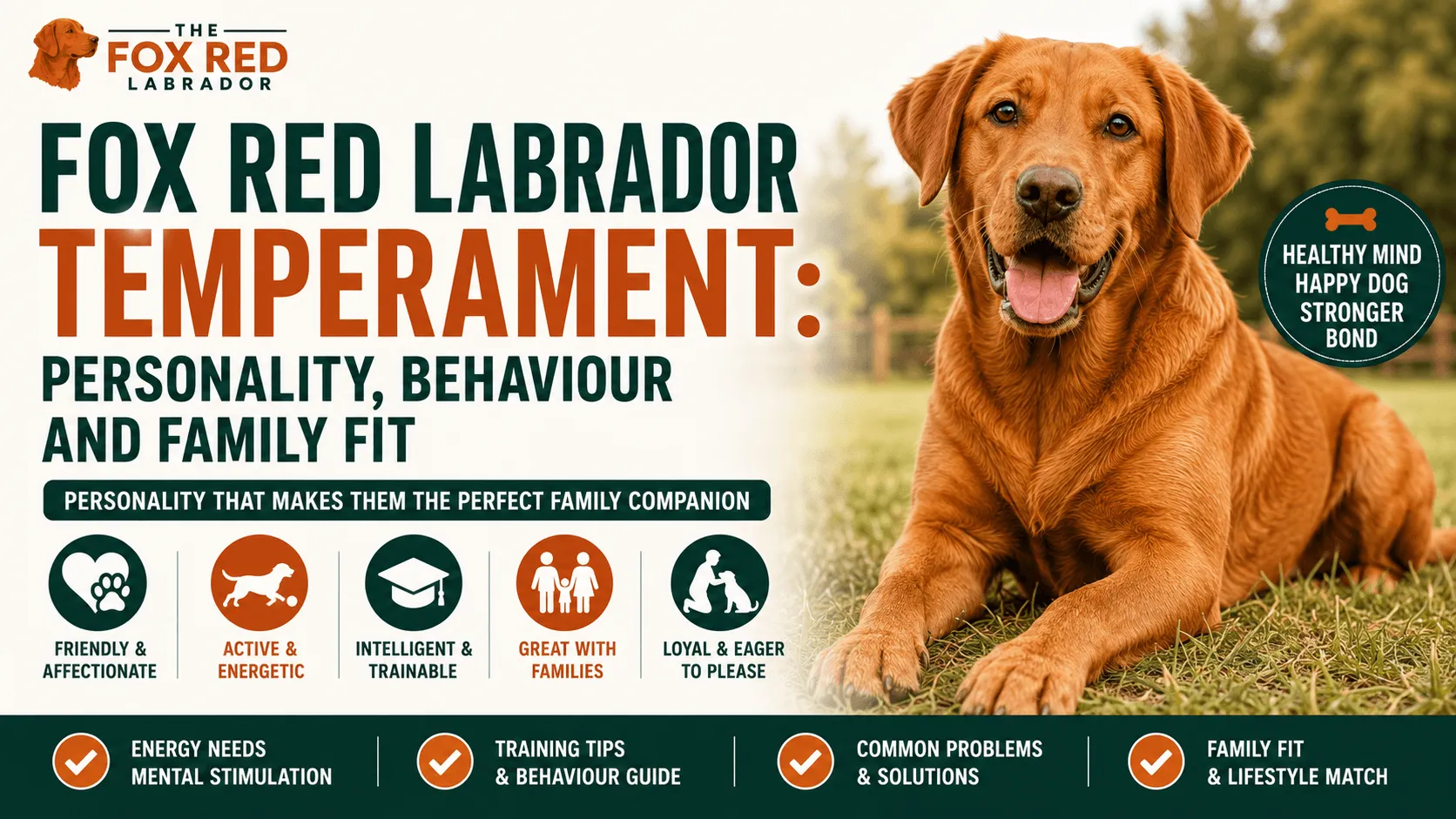
Generally, a fox red Labrador has a friendly, affectionate and trainable nature. The red color of the coat is a dark shade and is called fox red. It does not make these dogs a different breed; it does not make them a special personality.
Many are from working lines that can provide additional stamina and concentration. But parent temperament and early experiences and training tell more than colour. The red coat is not an instruction book; it’s a wrap.
Fox Red Retriever Temperament At A Glance
Most would like to join in whatever their family is doing. They are generally friendly and playful, but can also be wonderfully chaotic if they are young. Consider this profile as a guide and not a guarantee.
| Trait | Common Tendency | Everyday Meaning |
|---|---|---|
| Affection | High | Often enjoys closeness and family involvement |
| Sociability | High | Commonly friendly after suitable introductions |
| Energy | Moderate to high | Field-influenced dogs may be more demanding |
| Trainability | High | Usually responsive to reward-based teaching |
| Intelligence | High | Learns wanted and unwanted habits quickly |
| Barking | Low to moderate | May alert, vocalize from excitement or bark when distressed |
| Independence | Low to moderate | Often prefers company |
| Sensitivity | Moderate | Harsh handling may create worry |
| Ability to settle | Variable | Depends on age, line, routine and training |
Does Coat Colour Affect Labrador Temperament?
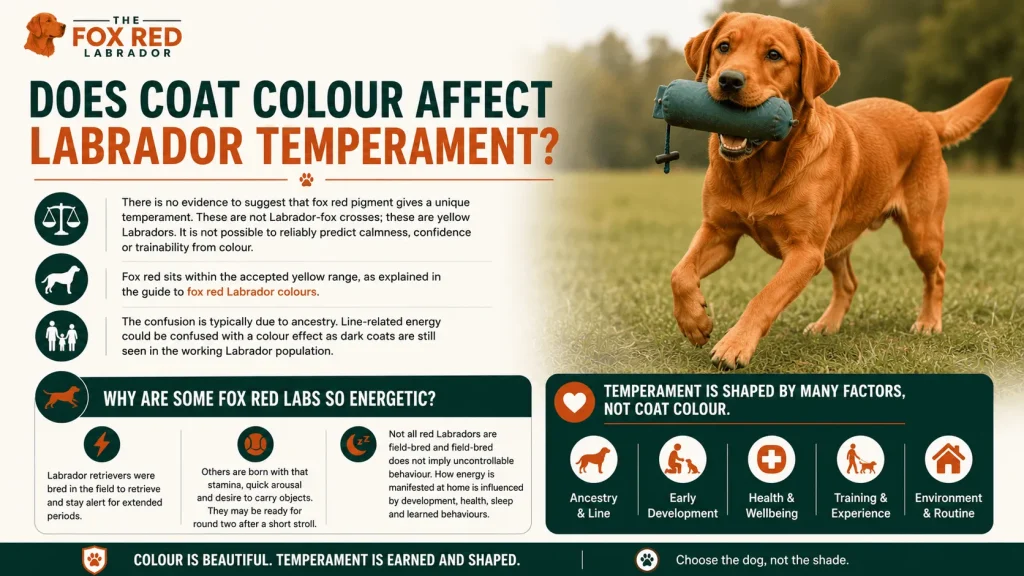
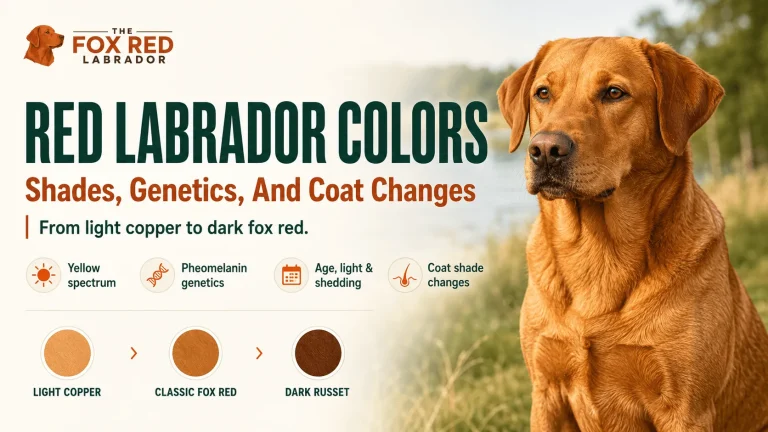
There is no evidence to suggest that fox red pigment gives a unique temperament. These are not Labrador-fox crosses; these are yellow Labradors. It is not possible to reliably predict calmness, confidence or trainability from colour. Fox red sits within the accepted yellow range, as explained in the guide to fox red Labrador colours.
The confusion is typically due to ancestry. Line-related energy could be confused with a colour effect as dark coats are still seen in the working Labrador population.
Why Are Some Fox Red Labs So Energetic?
Labrador retrievers were bred in the field to be able to retrieve and stay alert for extended periods of time. Others are born with that stamina, quick arousal and desire to carry objects. They may be in the mood for round two after a short stroll.
Not all red Labradors are field-bred and field-bred does not imply uncontrollable behaviour. How energy is manifested at home is influenced by development, health, sleep and learned behaviours.
What Shapes A Fox Red Labrador’s Personality?
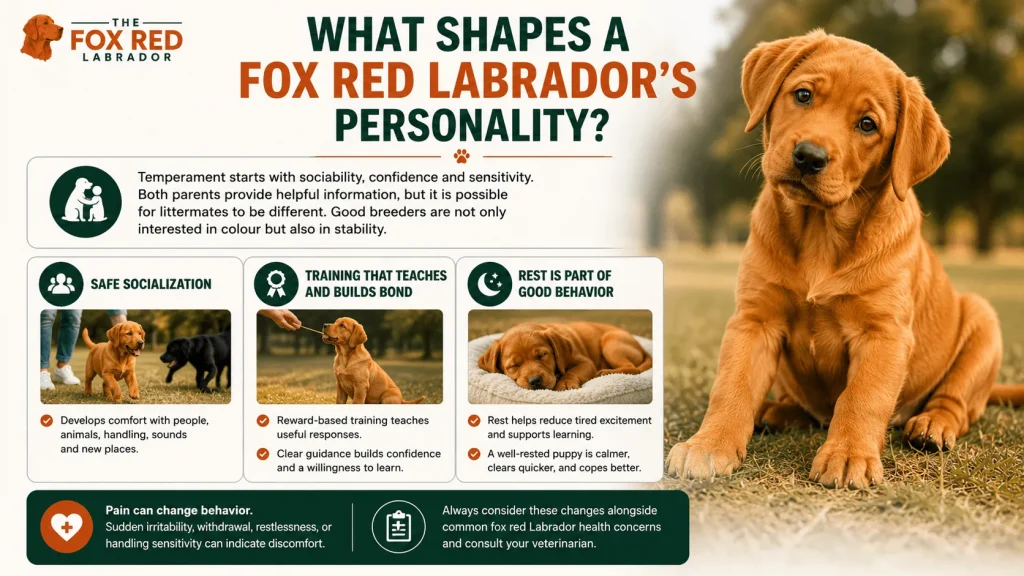
Temperament starts with sociability, confidence and sensitivity. Both parents provide helpful information, but it is possible for littermates to be different. Good breeders are not only interested in colour but also in stability.
Safe socialization develops comfort with people, animals, handling, sounds and new places. Reward-based training teaches useful responses and rest helps to reduce tired excitement. The other thing that can alter behaviour is pain, especially if a dog is normally easygoing and becomes irritated. Sudden irritability, withdrawal, restlessness, or handling sensitivity can indicate discomfort, so changes should be considered alongside common fox red Labrador health concerns.
Common Fox Red Labrador Personality Traits
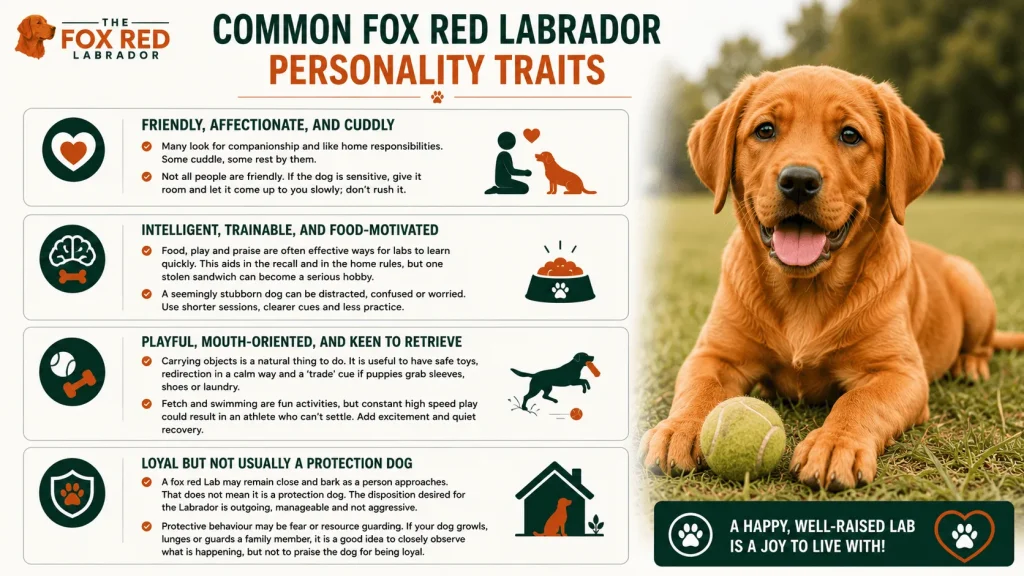
The same fox red labrador characteristic can be lovely one day and cumbersome the next. Passion can make training enjoyable, and can also get a muddy Labrador to a clean shirt.
Friendly, Affectionate, And Cuddly
Many look for companionship and like home responsibilities. Some cuddle, some rest by them.
Not all people are friendly. If the dog is sensitive, give it room and let it come up to you slowly; don’t rush it.
Intelligent, Trainable, And Food-Motivated
Food, play and praise are often effective ways for labs to learn quickly. This aids in the recall and in the home rules, but one stolen sandwich can become a serious hobby.
A seemingly stubborn dog can be distracted, confused or worried. Use shorter sessions, clearer cues and less practice.
Playful, Mouth-Oriented, And Keen To Retrieve
Carrying objects is a natural thing to do. It is useful to have safe toys, redirection in a calm way and a ‘trade’ cue if puppies grab sleeves, shoes or laundry.
Fetch and swimming are fun activities, but constant high speed play could result in an athlete who can’t settle. Add excitement and quiet recovery.
Loyal But Not Usually A Protection Dog
A fox red Lab may remain close and bark as a person approaches. That does not mean it is a protection dog. The disposition desired for the Labrador is outgoing, manageable and not aggressive.
Protective behaviour may be fear or resource guarding. If your dog growls, lunges or guards a family member, it is a good idea to closely observe what is happening, but not to praise the dog for being loyal.
Working Vs Show Fox Red Labrador Temperament
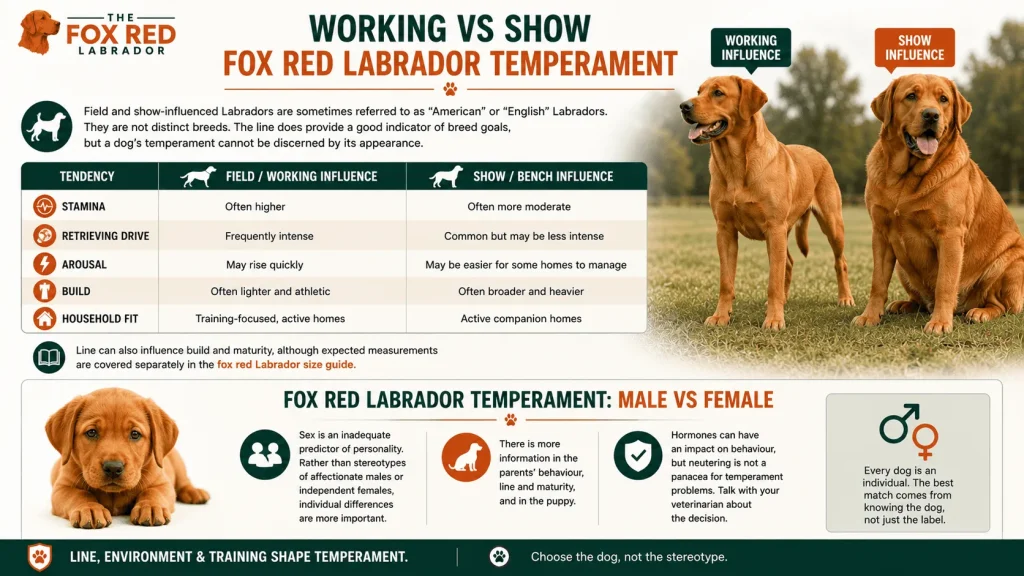
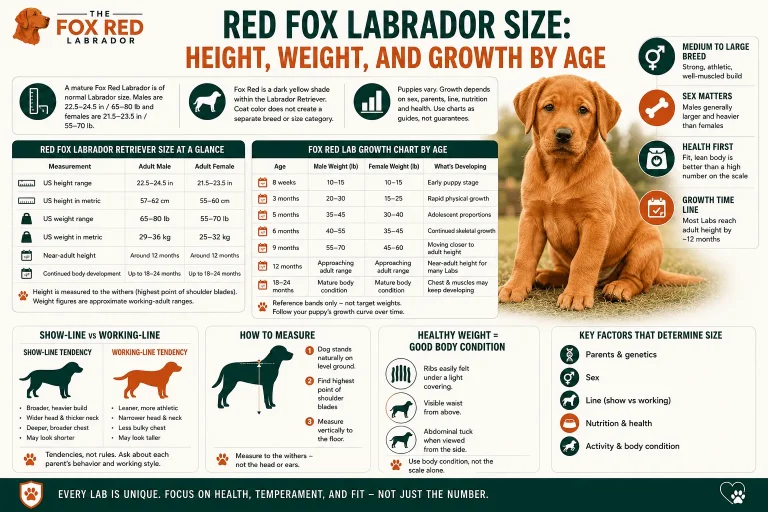
Field and show-influenced Labradors are sometimes referred to as “American” or “English” Labradors. They are not distinct breeds. The line does provide a good indicator of breed goals, but a dog’s temperament cannot be discerned by its appearance.
| Tendency | Field/Working Influence | Show/Bench Influence |
|---|---|---|
| Stamina | Often higher | Often more moderate |
| Retrieving drive | Frequently intense | Common but may be less intense |
| Arousal | May rise quickly | May be easier for some homes to manage |
| Build | Often lighter and athletic | Often broader and heavier |
| Household fit | Training-focused, active homes | Active companion homes |
Line can also influence build and maturity, although expected measurements are covered separately in the fox red Labrador size guide.
Fox Red Labrador Temperament Male Vs Female
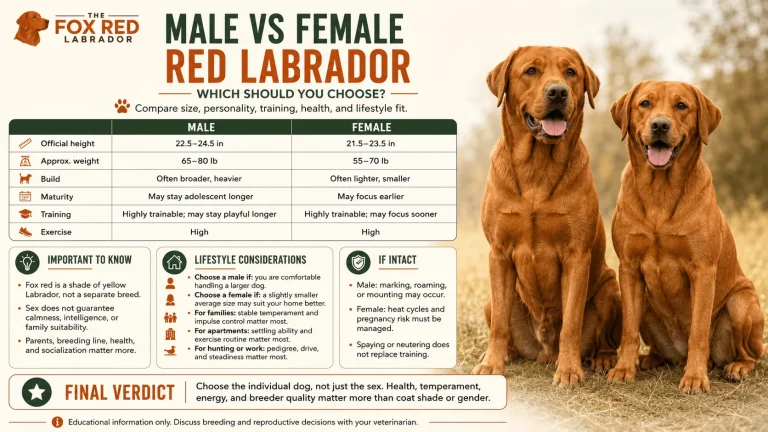
Sex is an inadequate predictor of personality. Rather than stereotypes of affectionate males or independent females, individual differences are more important. There is more information in the parents’ behaviour, line and maturity, and in the puppy.
Hormones can have an impact on behaviour, but neutering is not a panacea for temperament problems. Talk with your veterinarian about the decision.
Are Fox Red Labradors Good Family Dogs?
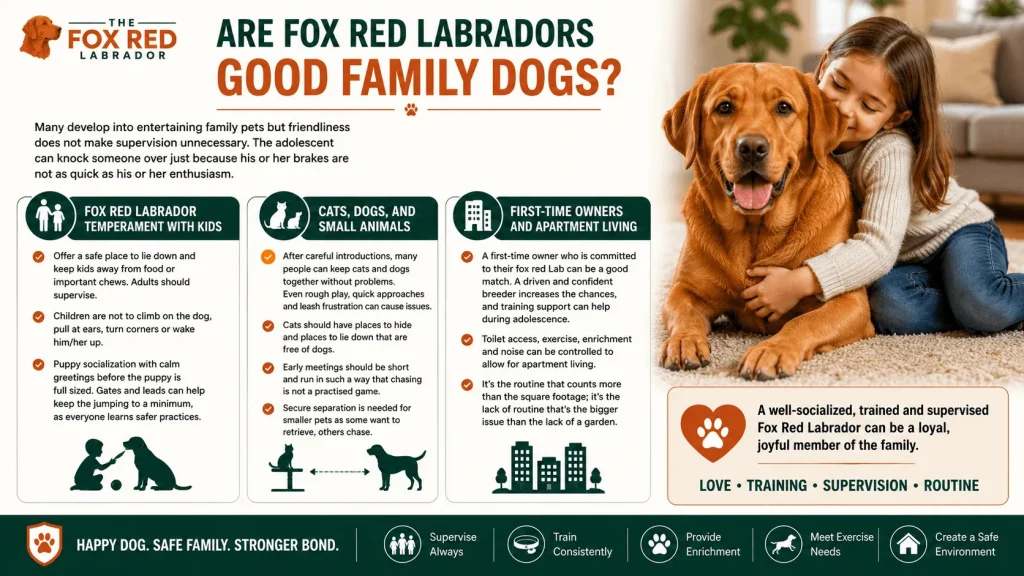
Many develop into entertaining family pets but friendliness does not make supervision unnecessary. The adolescent can knock someone over just because his or her brakes are not as quick as his or her enthusiasm.
Fox Red Labrador Temperament With Kids
Offer a safe place to lie down and keep kids away from food or important chews. Adults should supervise. Children are not to climb on the dog, pull at ears, turn corners or wake him/her up.
Puppy socialization with calm greetings before the puppy is full sized. Gates and leads can help keep the jumping to a minimum, as everyone learns safer practices.
Cats, Dogs, And Small Animals
After careful introductions, many people can keep cats and dogs together without problems. Even rough play, quick approaches and leash frustration can cause issues.
Cats should have places to hide and places to lie down that are free of dogs. Early meetings should be short and run in such a way that chasing is not a practised game. Secure separation is needed for smaller pets as some want to retrieve, others chase.
First-Time Owners and Apartment Living
A first-time owner who is committed to their fox red Lab can be a good match. A driven and confident breeder increases the chances, and training support can help during adolescence.
Toilet access, exercise, enrichment and noise can be controlled to allow for apartment living. It’s the routine that counts more than the square footage; it’s the lack of routine that’s the bigger issue than the lack of a garden.
Fox Red Labrador Behavior Problems To Expect
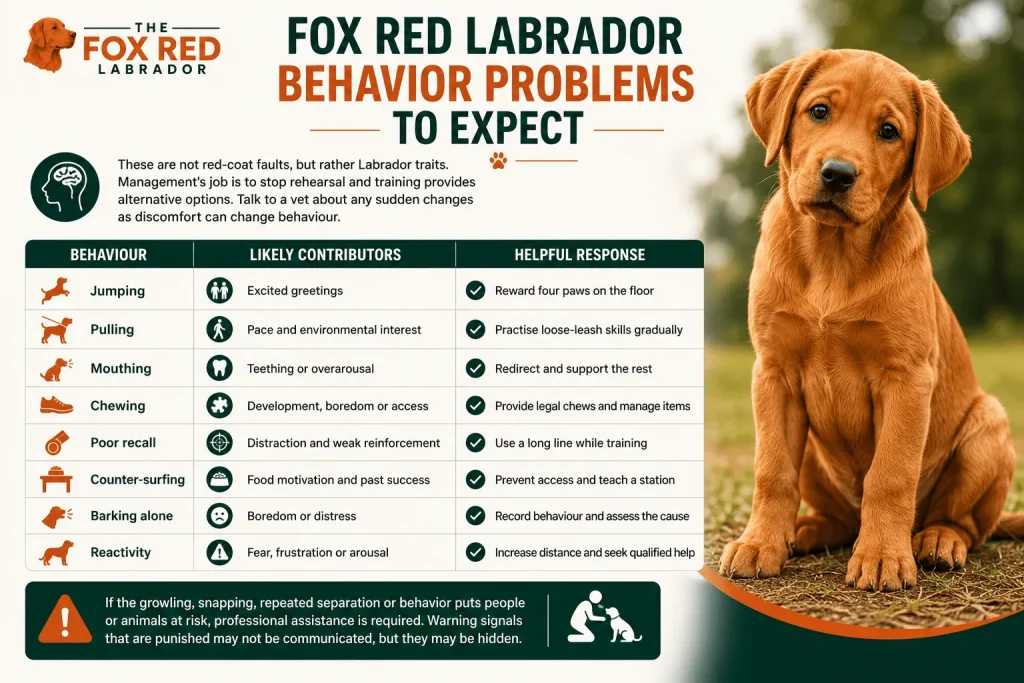
These are not red-coat faults, but rather Labrador traits. Management’s job is to stop rehearsal and training provides alternative options. Talk to a vet about any sudden changes as discomfort can change behaviour.
| Behaviour | Likely Contributors | Helpful Response |
|---|---|---|
| Jumping | Excited greetings | Reward four paws on the floor |
| Pulling | Pace and environmental interest | Practise loose-leash skills gradually |
| Mouthing | Teething or overarousal | Redirect and support the rest |
| Chewing | Development, boredom or access | Provide legal chews and manage items |
| Poor recall | Distraction and weak reinforcement | Use a long line while training |
| Counter-surfing | Food motivation and past success | Prevent access and teach a station |
| Barking alone | Boredom or distress | Record behaviour and assess the cause |
| Reactivity | Fear, frustration or arousal | Increase distance and seek qualified help |
If the growling, snapping, repeated separation or behavior puts people or animals at risk, professional assistance is required. Warning signals that are punished may not be communicated, but they may be hidden.
Training, Exercise, And Mental Stimulation
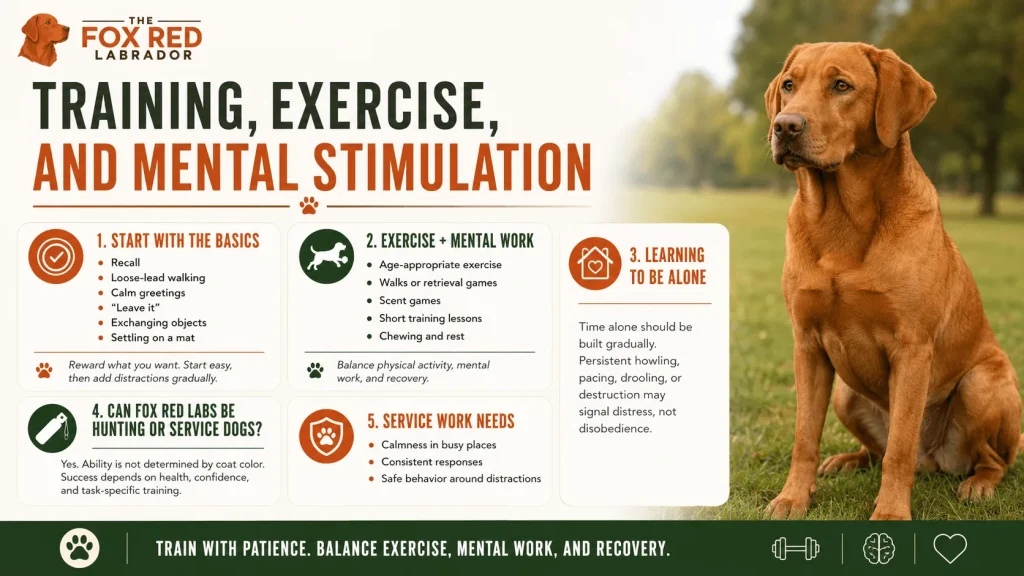
Start with recall, loose-lead walking, calm greetings, “leave it”, exchanging objects and settling on a mat. Reward the dog with something that it really wants. Practice where it is easy, then introduce distractions gradually so that they can still succeed.
Exercise should be appropriate for age, health and line. Combine walks or retrieval games with scent games, short lessons, chewing and sleep. Fitness can be developed without being taught to be calm. The Fox Red Labrador exercise guide provides age-conscious ways to balance physical activity, mental work, and recovery.
Time alone must be learned over time. If howling, pacing, exit destruction or drooling persists, it is likely that it is a sign of distress and not disobedience.
Can Fox Red Labs Be Hunting or Service Dogs?
Cooperation and human focus can fit in hunting, assistance and service. Cooperation and human focus can fit in hunting, assistance and service. Ability has nothing to do with colour. Reliability depends upon health, confidence and task-specific training.
Service work requires calmness in busy environments, consistency in responding to people and safety in dealing with distractions.
How Temperament Changes With Age
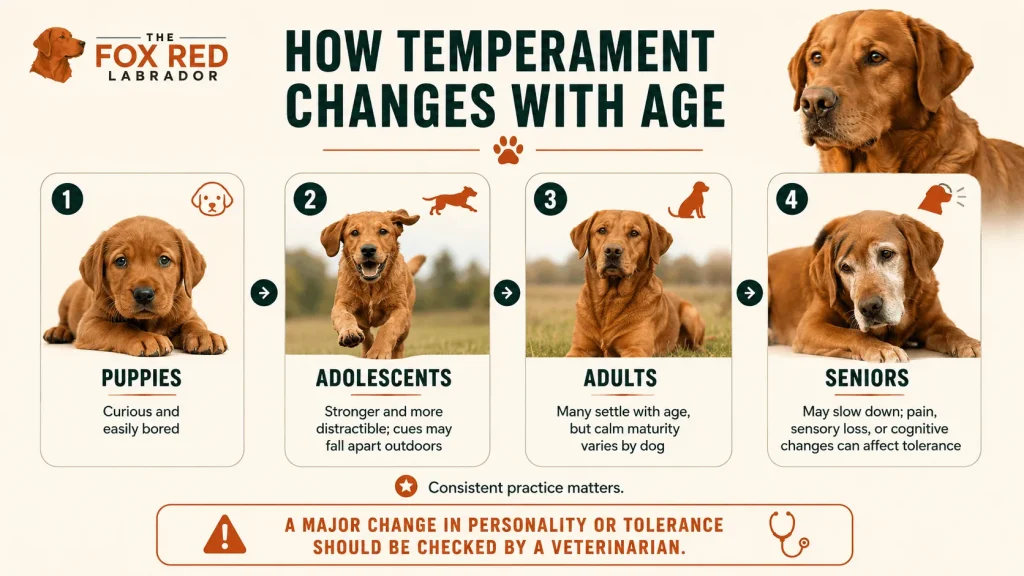
Puppies are inquisitive and easily bored. Adolescents are stronger and distractible, and the familiar cues are lost outdoors. Consistent practice matters.
For many adults, the transition from puppy to adult is the happiest time in their lives, but the age at which all fox red Labs become calm is different. Senior dogs may become less active, and pain, loss of senses or changes in cognition may affect their tolerance. If you notice a significant change in your pet’s personality, it’s time to take him to the vet.
How To Choose A Puppy With A Stable Temperament
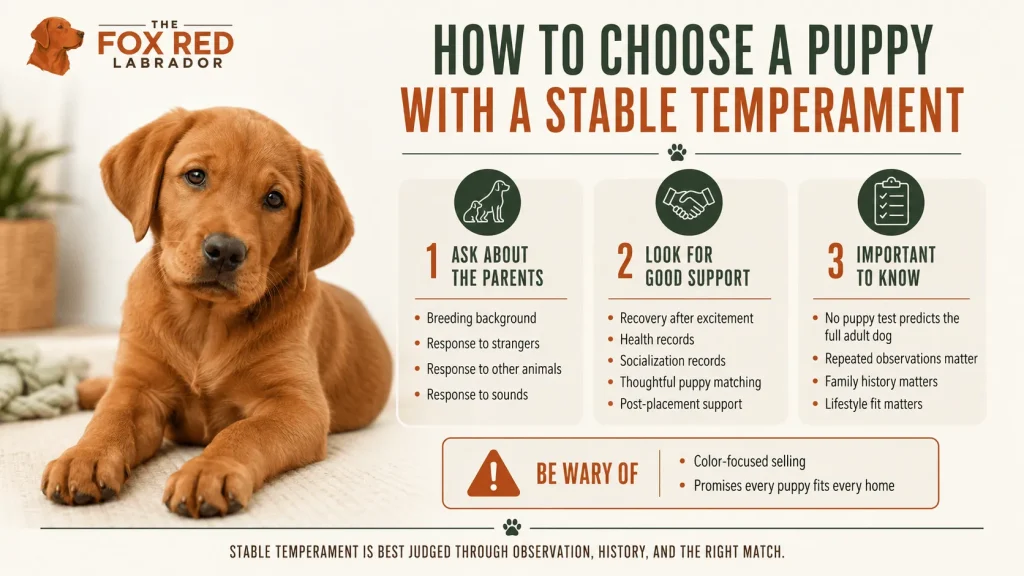
Inquire about both parents’ breeding and their response to strangers, animals and sounds. Seek recovery following excitement; ask for health and socialization records.
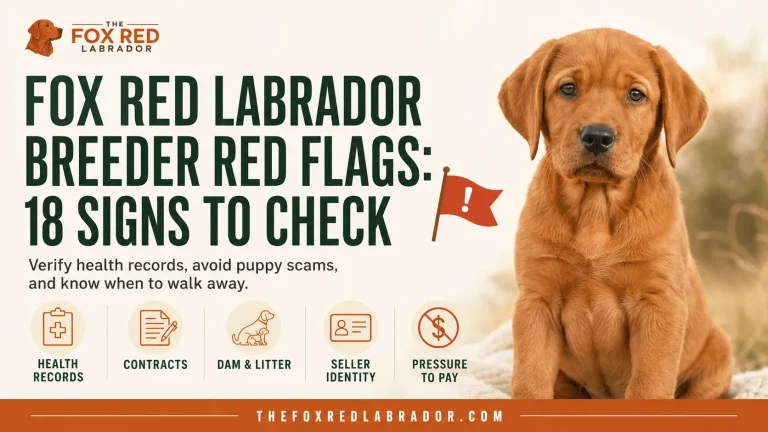
A thoughtful Breeder discusses puppy matching and post placement support. Be wary of having a lot of colour on the pitch or all puppies being guaranteed to fit every home.
No puppy test can tell you what an adult will be like. Repeated observations, fit of family history and lifestyle give a complete picture.
Is A Fox Red Labrador Right For You?
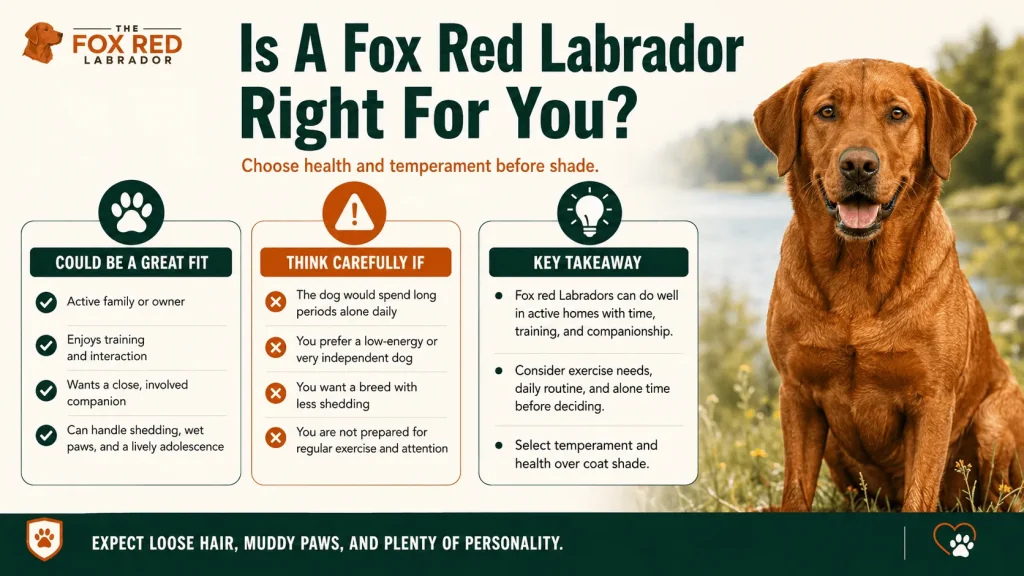
This dog might do well in an active family that likes to train and be close to their family. Shedding, wet paws and a spirited adolescence are to be expected. When a sock with a tail walks past, humour comes into play.
Consider carefully how much alone time the dog would need to spend on a daily basis, how active it would be, or whether a dog that is independent would be the preferred choice. Select temperament and health over shade.
FAQ’s
Fox red colouring has not been shown to cause aggression. More useful clues are provided by the parents’ temperament, health, social experience, learning and individual dog. Aggression is a serious matter that should be professionally evaluated.
Many are outgoing and have the Labrador temperament. Others may be more reserved or sensitive and a gentle introduction and positive experience remain important.
There are some dogs that are field-influenced and have a lot of energy and drive, particularly when young. Restlessness can also be a sign of poor sleep, overarousal, boredom or training requirements, not necessarily a “hyper” personality.
They are not typically referred to as “barkers. Barking can be used as a form of communication to alert, to gain attention, to express excitement, fear, boredom or distress when not in a group.
Training can be fun if the food motivation is high, intelligence is high, and cooperation is high. Consistent behaviour still needs consistent cues, appropriate reinforcement and practice in the presence of real world distractions.
They can warn of someone approaching them and will be close to family. This is not to be confused with the controlled skills and temperament necessary for protection work.
With careful and slow introductions, many can share a home with cats. Supervision and barriers/safe cat-only spaces are still helpful, as chasing interest is different for dogs.
Needs are age, health, breeding line and individual stamina. It involves physical activity, sniffing, training, enrichment, companionship and adequate quiet rest.
Fox Red Labs can be very relaxed family dog, but young and working line dogs can be very energetic. The calmness of an individual is influenced by his age, training, daily routine, rest and ability to settle all.
They are not generally considered stubborn, but distraction, excitement, confusion or weak rewards can look like refusal. Clear cues and short reward-based sessions usually suit their responsive nature.
Many are sociable with other dogs, though compatibility depends on introductions, play style and previous experiences. Friendly dogs may still need help controlling rough play or excited greetings.
Most benefit from some purposeful mental activity every day. Short training sessions, scent games, retrieving tasks and food puzzles can provide useful stimulation without keeping the dog constantly excited.
Conclusion: Choose Temperament Before Colour
Fox red Labs are known for their warmth, enthusiasm and eagerness to join in. Their appearance is spectacular, but the latter is preferable because of stable breeding, responsible breeding, and a realistic match with everyday life. Choose the dog that best matches the needs and personality of the household, rather than the red one with the deepest red puppy photo.
References
- Labrador Retriever Breed Standard
- Labrador Coat Colour and Behaviour Study
- AVSAB Puppy Socialization Statement
- AVSAB Humane Dog Training Statement
- AKC Labrador Retriever Profile