Red Labrador History: Origins, Evolution & Fox Red Bloodlines

Fox red Labradors are a popular choice and certainly not new or modern crosses. They are copper coloured, which is the darkest shade of yellow that Labs can be. Although “yellow” is a rather mild word, official documents still refer to them as yellow.
They started in Newfoundland with working water dogs, moved on to British sporting kennels and ended up in the American programs that expanded the modern bloodline. It is a story that takes us through early colors, influential dogs, changing fashions and the revival of fox red Labs, and that is the story below. Read everything about red Labrador history below.
Red Labrador History At A Glance
The Labrador’s forebears lived in Newfoundland with the fishing communities and were brought there by British sportsmen in the nineteenth century. Early records are dominated by black dogs, but there were yellow puppies in those lines.
The first widely recorded yellow Labrador was Ben of Hyde, born in 1899. Later, darker yellows were replaced by blacks and light colours, but British breeders maintained selected lines. Balrion King Frost, Wynfaul Tabasco, and Balrion Red Alert then carried that legacy into the modern era and across the Atlantic.
What Is A Fox Red Labrador?

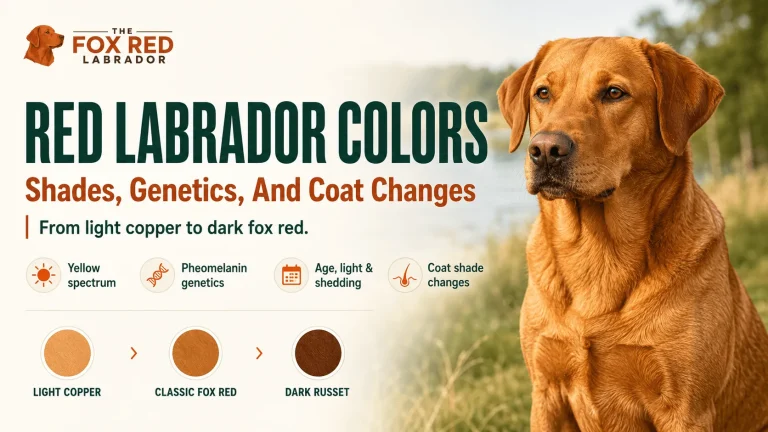
A fox red Labrador is a yellow Labrador that has strong, warm pigmentation. The coat can be copper, russet, or reddish gold. The terms “Red Lab,” “fox red Labrador,” and “dark-yellow Labrador” typically refer to the same color.
Fox red isn’t chocolate, liver, silver or champagne. A chocolate coloured dog will have a chocolate nose and chocolate eye rims; a fox red will have a black nose and black eye rims as would a yellow Labrador. There is also no separate temperament or working type based on colour intensity.
Why Are Fox Red Labs Registered As Yellow?
Broad registration categories are used by kennel clubs; not all shade names are used by breeders. Black, yellow and chocolate are recognized by the American Kennel Club and fox red is at the dark end of yellow for the Royal Kennel Club.
The wording on the form and on the coat may therefore vary and not contradict.
| Organization | Official Labrador colors | Fox red classification |
|---|---|---|
| AKC | Black, yellow, chocolate | Yellow |
| Royal Kennel Club | Black, yellow, liver/chocolate | Yellow |
This classification becomes easier to understand once the genetics behind the fox red Labrador coat are considered.
Where Did Labrador Retrievers Originate?
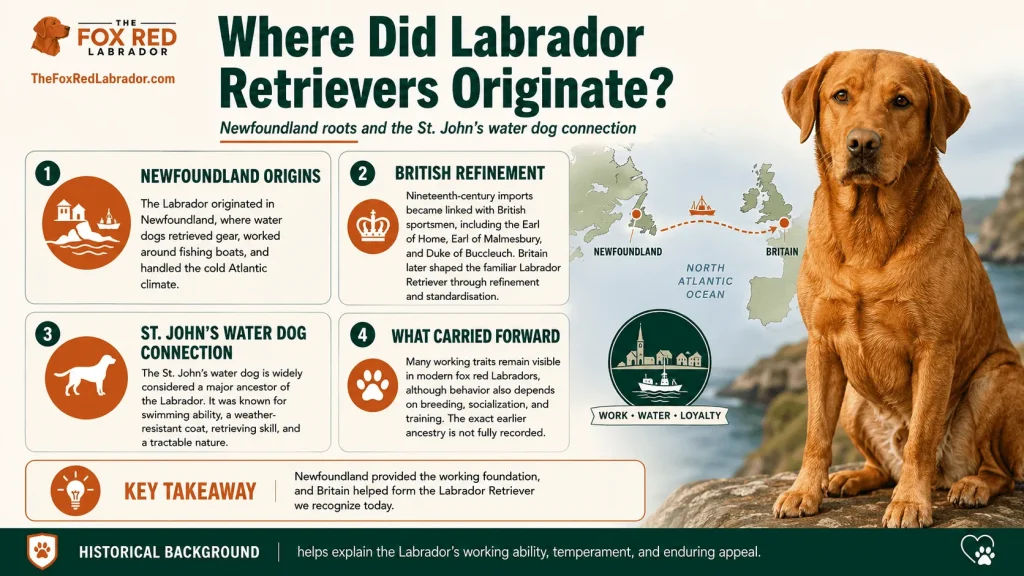
The Labrador originated in Newfoundland, where water dogs retrieved things, worked around fishing boats, and were accustomed to the cold Atlantic weather. Their utility was so great that British sportsmen, such as the Earl of Home, Earl of Malmesbury, and Duke of Buccleuch, were connected with nineteenth-century imports.
Later, Britain was the primary focus for refinement and standardisation. The Newfoundland provided the workhorse and the British estates gave the familiar Labrador Retriever.
What Was The St. John’s Water Dog Connection To Labradors
It is generally believed that the St. John’s water dog is a major ancestor of the Labrador. It was a very good swimmer, had a waterproof coat, was a good retriever, and was very tractable, making it ideal for fishing and British shooting estates. Many of those inherited working traits remain visible in the modern fox red Labrador temperament, though individual behavior also depends on breeding, socialization, and training.
There is no record of the original breeds. The safest guess in red fox Labrador history is that all of the imported St. John’s dogs were used as the central stock, and some of the finer details of their earlier ancestry are still unknown. There is no such thing as a perfect family album of a breed’s history.
What Color Were The First Labradors?

The earliest recorded population of Labradors was dominated by black dogs. That record was influenced by breeder preference, as black puppies were more likely to be retained for future breeding, and less likely to be bred from yellow and liver puppies.
Other color inheritance could slip through the black lines. With the acceptance of yellow dogs, cream to deep reddish gold coats became more noticeable. Fox red did not need to be crossed outside as a separate type, but arose as a variant of yellow Labrador inheritance.
Why Is Ben Of Hyde Important?
The first recorded yellow Labrador Retriever is believed to have been Ben of Hyde, born in 1899. Surviving information is scarce about his mother, Duchess, who is mentioned in pedigree histories as the daughter of the black dogs of Neptune and Tapper, while his father, Neptune, is a well-known figure.
“First recorded” matters. Yellow puppies might have been present earlier if there were no reliable records. Old photographs depict Ben wearing a fairly dark coat, but old photos can’t be used to confirm that he had a modern fox red coat.
Were Early Yellow Labradors Fox Red?
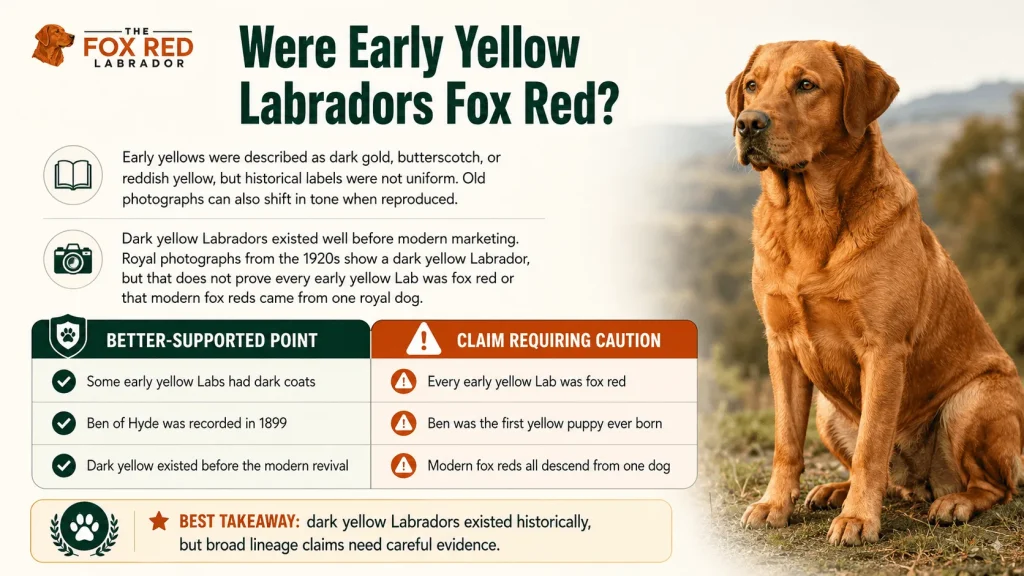
Early yellows were reported as dark gold, butterscotch or reddish yellow. Old photographs can change in tone when reproduced, and the historical labels were not uniform.
Rich shades were used well before recent marketing as King George VI and Queen Elizabeth were photographed with a dark yellow Labrador in the 1920s. It does not establish that all early yellows were fox red or that a modern line was established by one royal dog.
| Better-supported point | Claim requiring caution |
|---|---|
| Some early yellow Labs had dark coats | Every early yellow Lab was fox red |
| Ben of Hyde was recorded in 1899 | Ben was the first yellow puppy ever born |
| Dark yellow existed before the modern revival | Modern fox reds all descend from one dog |
Why Did Fox Red Labradors Become Rare?
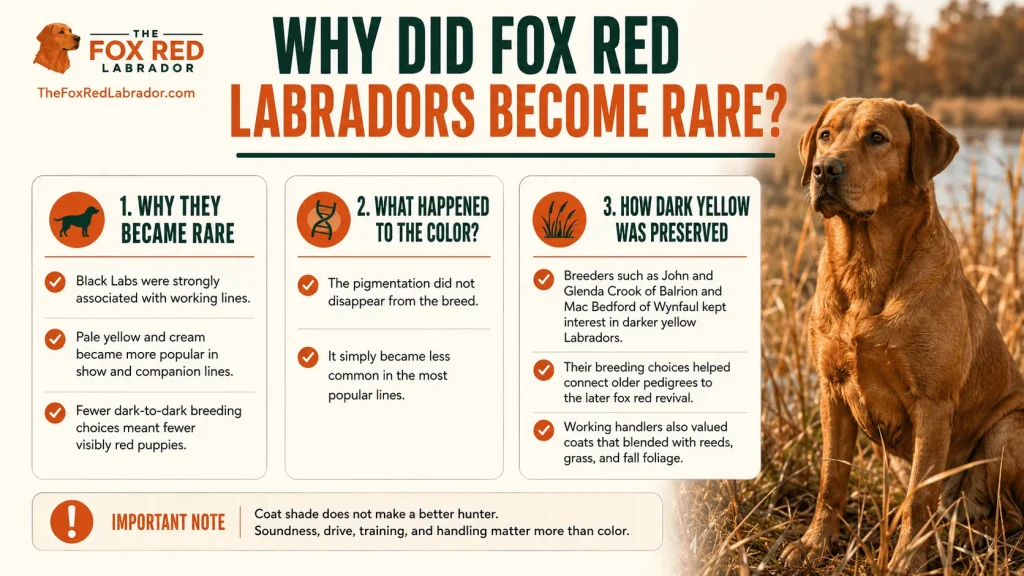
Dark yellow was pushed out of the spotlight by a number of preferences. Black was very much linked to the working Labradors, whereas pale yellow and cream came into vogue in the show and companion ring.
There were fewer dark-to-dark breeding options, so there were fewer visibly red puppies. The pigmentation did not disappear from the breed but it was less frequent in the lines that were most popular.
Why Were Dark-Yellow Labradors Preserved?
John and Glenda Crook of Balrion and Mac Bedford of Wynfaul were interested in darker yellow Labradors. They were used in their breeding choices to link up older pedigrees with the later fox red revival.
Working handlers also appreciated coats that matched in color to reeds, grass and fall foliage. Some places may benefit from camouflage, but shade does not make for a good hunter. These are the qualities of soundness, drive, training and handling that do that.
How Was The Modern Fox Red Labrador Revived?
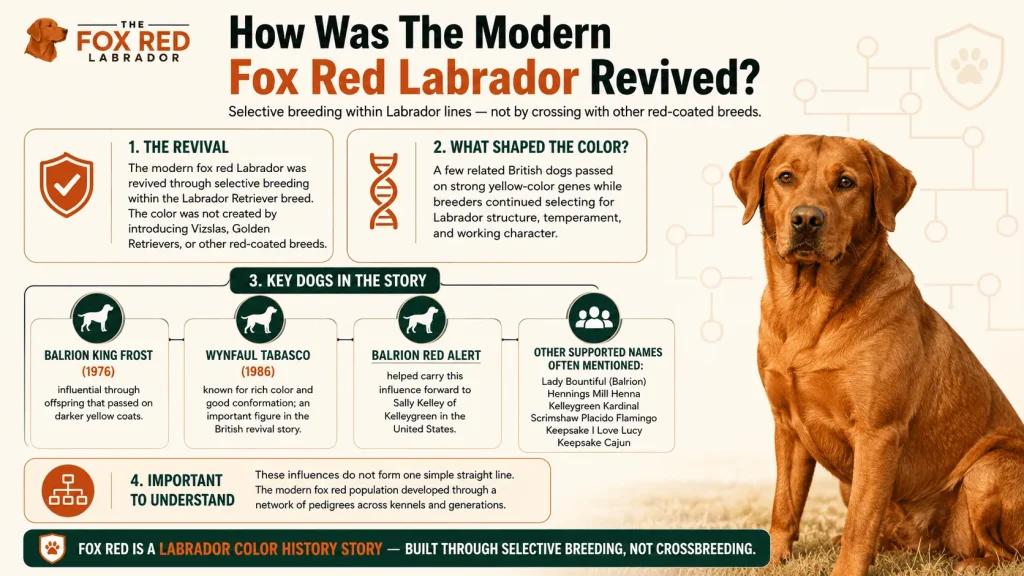
The revival was achieved by selective breeding of the Labrador, and not by introducing Vizslas, Golden Retrievers or any other red-coated breed. A few related British dogs passed on strong yellow genes, but continued to be bred for Labrador structure and character.
That’s important because not all animals made all the living foxes red. The modern population has been bred in kennels and through multiple influences of pedigrees.
Which Dogs Influenced Modern Fox Red Bloodlines?
Balrion King Frost, who was born in 1976, made a mark through his offspring which gave dark-yellow coats. Born in 1986, Wynfaul Tabasco was bred in rich colour and had good conformation and was a key figure in the British story of the revival.
This influence was carried to Sally Kelley, of Kelleygreen, USA, born in 1990, in the form of Balrion Red Alert. Lady Bountiful (Balrion), Hennings Mill Henna, Kelleygreen Kardinal, Scrimshaw Placido Flamingo, Keepsake I Love Lucy, and Keepsake Cajun were all supported dogs. Their pedigrees are not a single stream of parents to children, but rather a network of pedigrees
How Did Fox Red Labradors Spread In The United States?

American breeders were able to use established dark-yellow pedigrees from British imports. Sally Kelley was the Balrion Red Alert at Kelleygreen and Keepsake’s Judy and Josh McCormick also added to the lines. Later matings by Dot Galvin, Henning Mill Henna.
This was an extension, not a second source. Fox red puppies became more uniform and conspicuous throughout the working, show and companion homes as the network expanded during the 1990s.
When Did Fox Red Labs Become Popular Again?
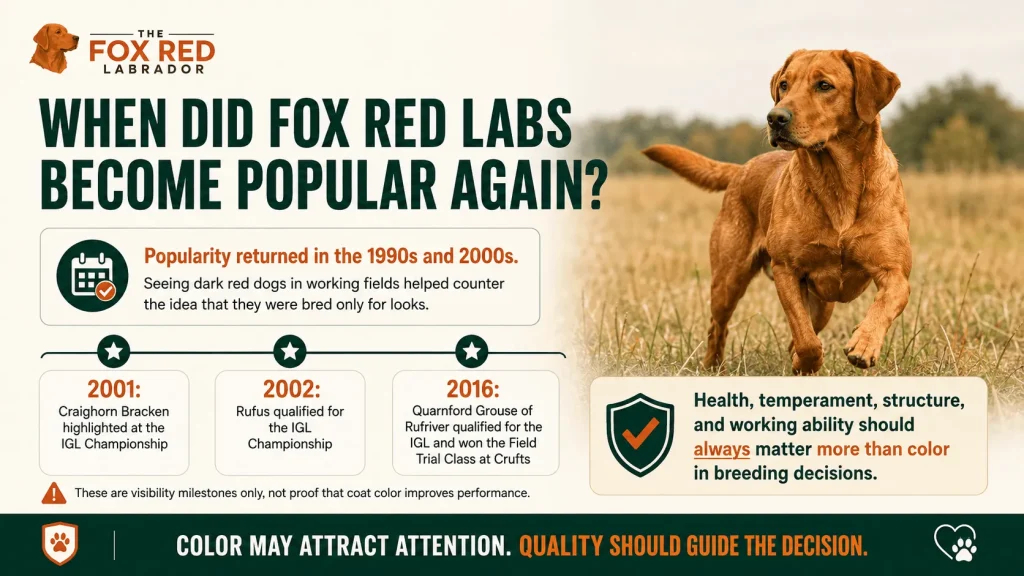
The trend of the return continued in the 1990s and 2000s. The fact that some dark red dogs could be seen in fields helped to dispel the notion that they had only been bred for looks.
The Field singles out the deep yellow Craighorn Bracken at the 2001 IGL Championship. Rufus went on to qualify for the 2002 championship and Quarnford Grouse of Rufriver went on to qualify for the 2016 IGL and win the Field Trial Class at the Crufts that year. These are only visibility milestones and do not indicate performance improvement from coat color.
There’s a warning, too, for the modern demand. Beauty should never be considered more important than health, temperament, structure or working ability in a breeding decision.
Are Red Labradors Genetically Different From Yellow Labs?

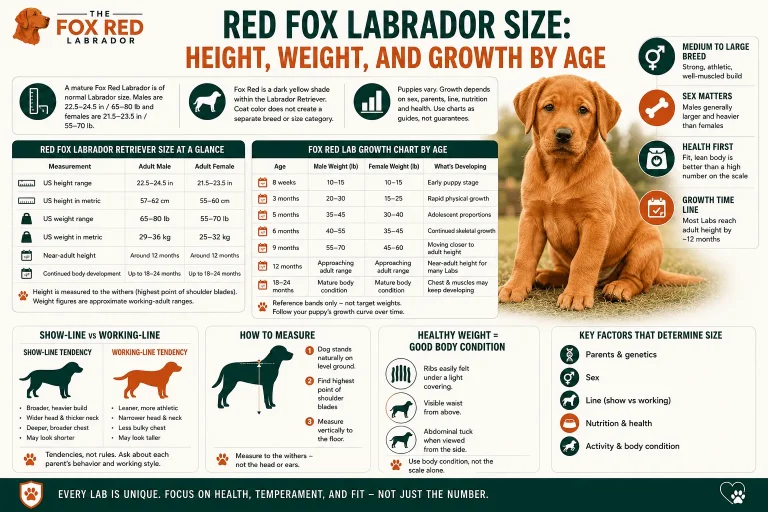
When a fox red Labrador is at its base colour, it is yellow. The yellow-to-red colours are caused by pheomelanin and other inherited factors influence the extent of these colours. It’s more complex than a single recessive “red gene.” Coat genes affect pigmentation, but they do not create a separate body type; expected measurements are covered in the red fox Labrador size guide.
Fox red is also not related to the dilution behind silver or champagne colors. If both of the yellow Labradors carry the pigmentation to produce a dark-red coat, they can produce dark-red puppies, but the colour may vary in one litter. The B locus, E locus and intensity modifiers can be covered in a separate guide without becoming a biology exam.
Red Fox Labrador History Timeline

Below are the dates that indicate that a working-dog ancestry has been recognized as a modern shade. There are some milestones related to the Labrador breed in general and others related to the revival of darker yellow pedigrees.
Red Labrador Breed Timeline
- Newfoundland water dogs start to arrive at significant British estates in the 1830s.
- Late 1800s: Yellow puppies have been noted in mostly black lines.
- 1899: Ben of Hyde is born.
- In the 1920s, a royal photo documents a dark yellow Labrador.
- 1976: Balrion King Frost joins the later fox red tale.
- Wynfaul Tabasco was an influential British dog in 1986.
- An important bloodline was brought to the United States from Balrion Red Alert in 1990.
- During the 1990s, breeding programs for foxes in the United States began to expand to the red fox.
- 2001- 2016: Deep-yellow and fox-red dogs are more visible in the field.
- The yellow color is still registered as Fox red.
Conclusion
Red Lab history starts from Newfoundland water dogs through to British sporting kennels and American bloodlines. As tastes evolved, the shade appeared in yellow Labradors, faded and was restored through careful selection.
A fox red Lab is still a full-blown Labrador and remains yellow. While its coat may attract attention first, its breeding and true breed personality are more important.
FAQ’s
The red Labrador came from the yellow Labrador bloodline, which originated from Newfoundland working water dogs. Early records were of dark yellow coats, which were rare and were reintroduced from British and American breeding programmes.
They are descended from Newfoundland water dogs and the modern Labrador breed was developed in Britain. Later influential British fox red bloodlines were exported to the United States, where they were multiplied by American breeders.
Early preference was for black Labradors, and later for pale cream and lighter yellow Labradors. The number of dark yellow dogs that were chosen for breeding was reduced so that fox red was less common but not eradicated from the Labrador breed.
A red Lab is a yellow Labrador with a darker coat color. They are both of the same breed and official colour class, and size, temperament, health and working ability cannot be differentiated by colour alone.
The Labrador Retriever is believed to be the main ancestor of the St. John’s water dog of Newfoundland. These were good water dogs that were brought into Britain and bred into the modern Labrador.
Yellow Labrador coats contain pheomelanin, which produces shades from pale cream to rich red. Inherited pigmentation modifiers affect how strongly that color appears, giving some yellow Labs a much darker coat.
The earliest recorded Labrador population was predominantly black. Yellow and liver inheritance existed within some lines, but breeder preference meant black dogs were more commonly retained, bred, and documented.
There is no confirmed first fox red litter. Ben of Hyde became the first widely recorded yellow Labrador in 1899, while deliberate preservation of modern fox red lines gained momentum in Britain during the late twentieth century.
Newfoundland working water dogs supplied the Labrador’s retrieving ability, swimming strength, and weather-resistant coat. British breeders then refined those dogs for sporting work, gradually establishing the structure, temperament, and breed standard recognized today.
Fox red Labs can be fully purebred Labrador Retrievers. Their coat is simply a dark expression of yellow. A registered pedigree can confirm ancestry, but color alone says nothing about health testing, temperament, or responsible breeding practices.
No. Fox red is not a separate breed, hybrid, or official Labrador subtype. It describes the darkest part of the yellow coat range. Fox red dogs share the same breed standard and ancestry as other registered Labrador Retrievers.
Dark-yellow and reddish coats appeared early in documented yellow Labrador history. They were not recognized as a separate color, however. Modern kennel clubs continue to classify fox red as yellow rather than treating it as a fourth Labrador color.
The name describes a warm copper or reddish-yellow coat resembling the coloring of a red fox. It is an informal shade name used by breeders and owners. Registration documents still identify these dogs as yellow Labradors.
The earliest recorded Labrador population was mainly black. Some early yellow Labradors had dark golden or reddish coats, but surviving evidence does not prove that the first Labs were fox red. Ben of Hyde remains the first widely recorded yellow Labrador.
Early breeders strongly preferred black Labradors, while pale cream and lighter yellow later became fashionable. As fewer dark-yellow dogs were selected for breeding, fox red became less visible. The shade remained present within certain Labrador pedigrees.
Yes. Two yellow Labradors can produce fox red puppies when both pass on inherited factors that support stronger red-yellow pigmentation. Coat intensity can vary within one litter, so some puppies may be darker than their siblings.
Not automatically. While a dark coat can help camouflage against reeds, grass, or fall color, color doesn’t make a hunter. Performance is much more influenced by working ancestry, physical soundness, retrieving drive, training and skilled handling.
They have a luxuriant coat which will give them a unique look, but they will still have the Labrador characteristics. Increased interest due to greater visibility in working homes, breeding programs, and online photographs. Coat color should be considered last and should not be the primary concern for responsible buyers.
References
- https://www.akc.org/dog-breeds/labrador-retriever/
- https://www.royalkennelclub.com/search/breeds-a-to-z/breeds/gundog/retriever-labrador/
- https://thelabradorclub.com/labrador-breed-standard/
- https://www.thefield.co.uk/gundogs/the-rise-and-rise-of-the-fox-red-labrador-45707
- https://foxredlabrador.it/en/history-of-the-foxred/
- https://www.hoertersganderacres.com/history-of-fox-red-labs.html