Fox Red Lab Coat and Genetics: How Fox Red Color Is Inherited
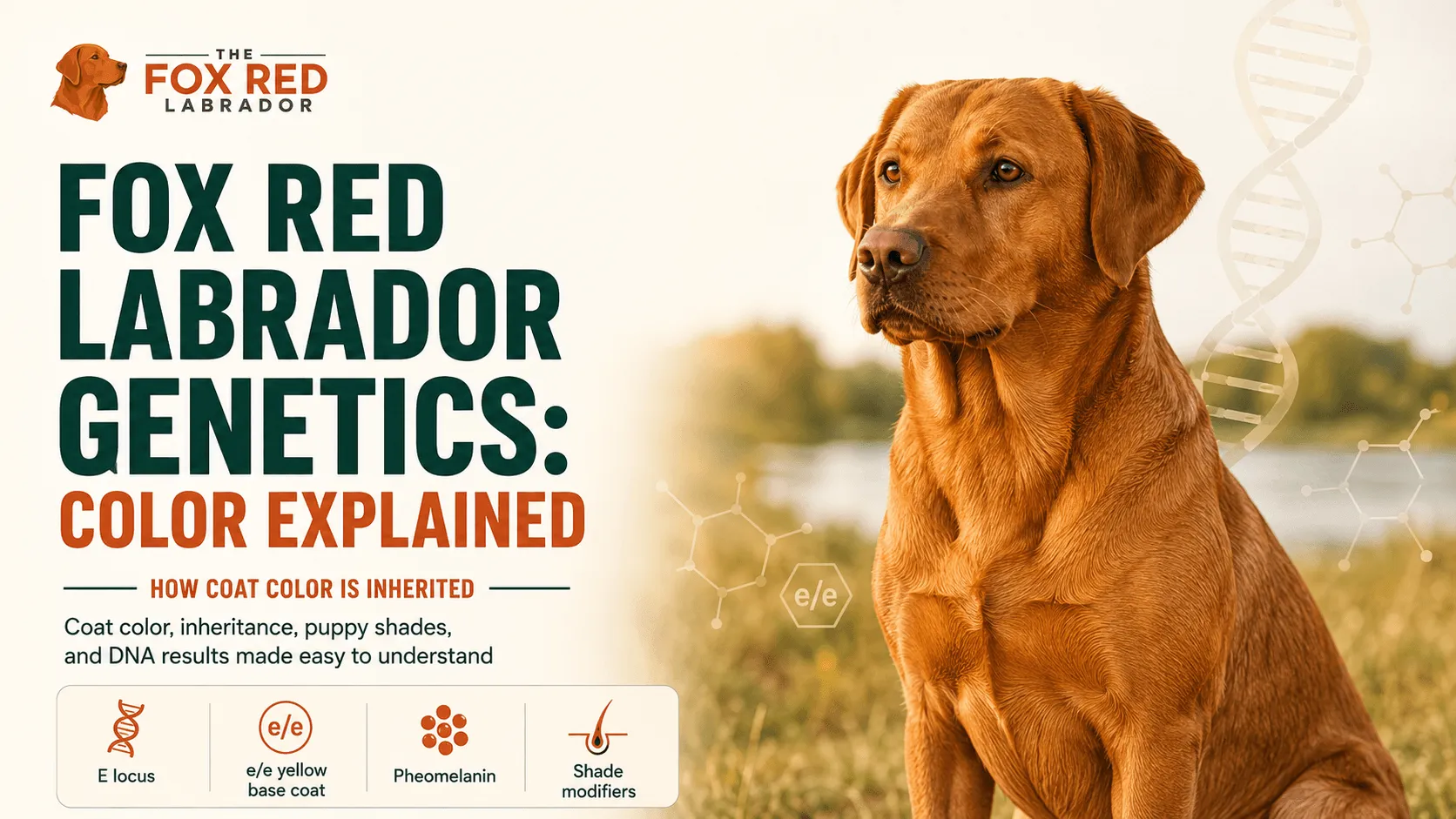
Fox red Labradors are genetically yellow Labradors. They generally receive two recessive e alleles at the E locus (e/e), which means that most of their hair remains unpigmented.
Their copper-red color is due to the pigment pheomelanin, which is responsible for yellow-to-red hair. Other inherited factors affect the lightness or darkness of the pigment. Consequently, e/e is responsible for the yellow color of the coat and does not ensure a fox red color.
A puppy’s base colour can be predicted by the parents’ genotype. Labrador genetics is the real interest when it comes to exact red intensity, as it is not as predictable.
Quick Answer
A fox red Labrador is a yellow-to-red pheomelanin strongly expressed genetically yellow Labrador. The recessive e/e genotype will produce the yellow coat, and a number of inherited modifiers will affect the darkening of the red.
Are Fox Red Labradors Genetically Different?
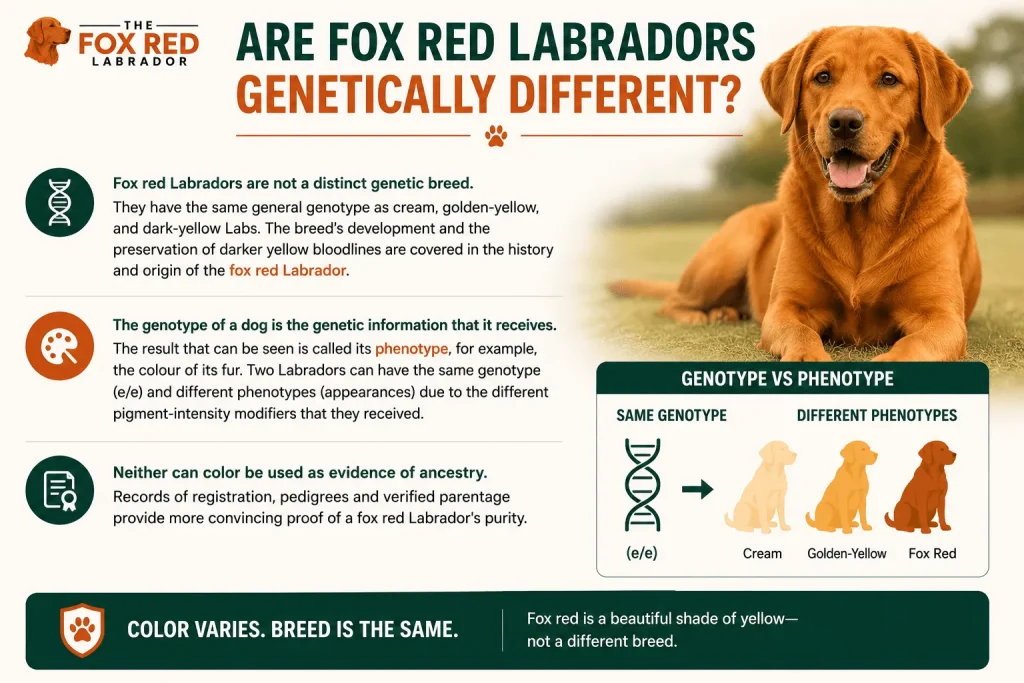
Fox red Labradors are not a distinct genetic breed. They have the same general genotype as cream, golden-yellow, and dark-yellow Labs. The breed’s development and the preservation of darker yellow bloodlines are covered in the history and origin of the fox red Labrador.
The genotype of a dog is the genetic information that it receives. The result that can be seen is called its phenotype, for example, the colour of its fur. Two Labradors can have the same genotype (e/e) and different phenotypes (appearances) due to the different pigment-intensity modifiers that they received.
Neither can color be used as evidence of ancestry. Records of registration, pedigrees and verified parentage provide more convincing proof of a fox red Labrador’s purity.
Is Fox Red A Separate Labrador Breed Or Color?
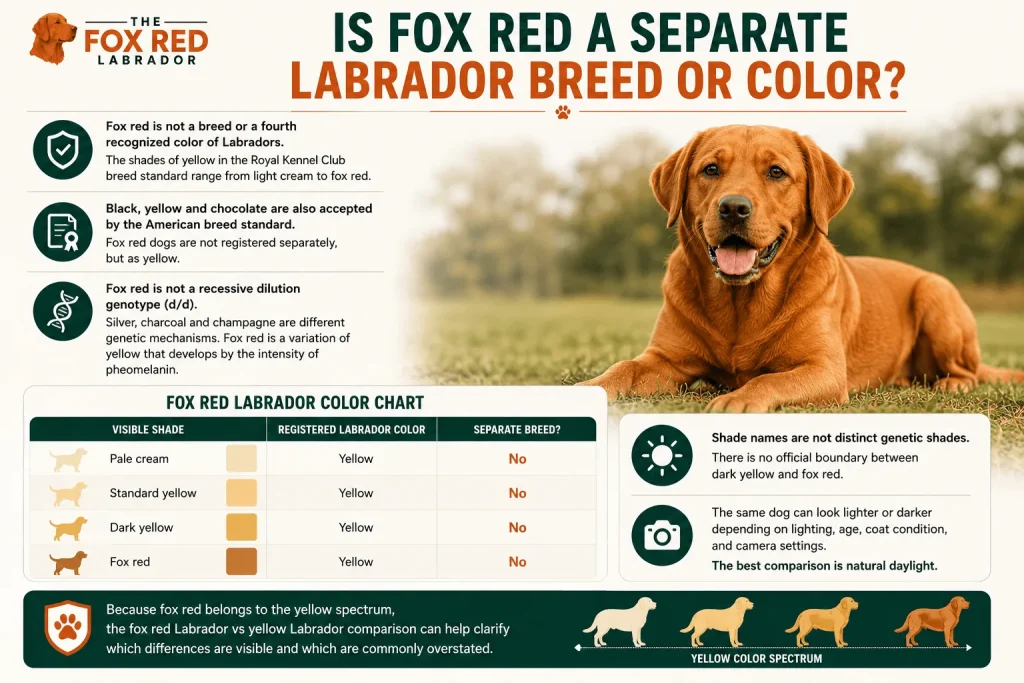
Fox red is not a breed or a fourth recognized color of Labradors. The shades of yellow in the Royal Kennel Club breed standard range from light cream to fox red.
Black, yellow and chocolate are also accepted by the American breed standard. Fox red dogs are not registered separately, but as yellow.
Fox red is not a recessive dilution genotype (d/d). Silver, charcoal and champagne are different genetic mechanisms. Fox red is a variation of yellow that develops by the intensity of pheomelanin.
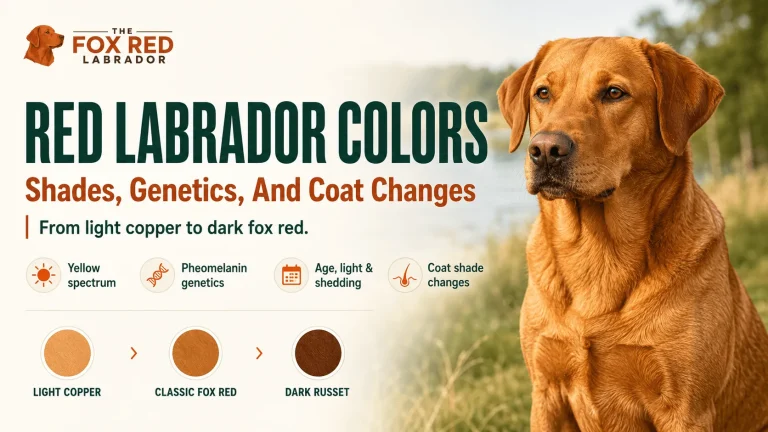
Fox Red Labrador Color Chart
Shade names are not distinct genetic shades. There is no official boundary between dark yellow and fox red.
| Visible Shade | Registered Labrador Color | Separate Breed? |
|---|---|---|
| Pale cream | Yellow | No |
| Standard yellow | Yellow | No |
| Dark yellow | Yellow | No |
| Fox red | Yellow | No |
The same dog can look lighter or darker depending on lighting, age, condition of coat, and camera settings. The best comparison is natural daylight.
What Causes The Fox Red Labrador Coat Color?
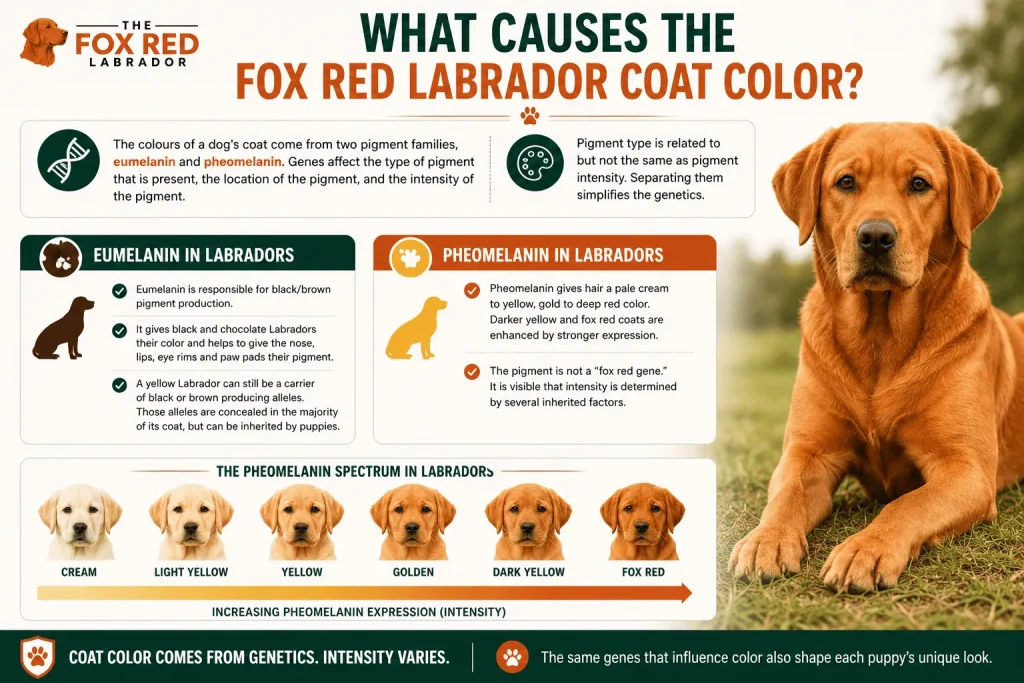
The colours of a dog’s coat come from two pigment families, eumelanin and pheomelanin. Genes affect the type of pigment that is present, the location of the pigment, and the intensity of the pigment.
Pigment type is related to but not the same as pigment intensity. Separating them simplifies the genetics.
Eumelanin In Labradors
Eumelanin is responsible for black/brown pigment production. It gives black and chocolate Labradors their color and helps to give the nose, lips, eye rims and paw pads their pigment.
A yellow Labrador can still be a carrier of black or brown producing alleles. Those alleles are concealed in the majority of its coat, but can be inherited by puppies.
Pheomelanin In Labradors
Pheomelanin gives hair a pale cream to yellow, gold to deep red color. Dark-yellow and fox red coats are enhanced by stronger expression.
The pigment is not a “fox red gene.” It is visible that intensity is determined by several inherited factors.
Which Gene Controls Labrador Coat Color?

There is no single gene that determines all aspects of Labrador coat color. The E locus determines whether or not dark pigment is present throughout the hair, and the B locus determines whether the pigment is black or brown.
There are other genetic regions that are involved in the yellow-to-red intensity. Consider it like a bunch of controls, not one big one.
The MC1R Gene And E Locus
The E locus is the location of the MC1R gene. An allele is a particular form of a gene and each puppy will inherit one E-locus allele from each parent.
Dark eumelanin is visible in the coat if the E allele is functional. Yellow and fox red Labradors have the recessive e alleles.
| E-Locus Genotype | Visible Base-Color Effect | Can Pass e? |
|---|---|---|
| E/E | Can express black or chocolate | No |
| E/e | Can express black or chocolate | Yes |
| e/e | Yellow spectrum | Always |
An E/e Labrador can appear black or chocolate with yellow. If dark pigment is allowed, the B locus determines which of the dark pigment colors will show up.
Why e/e Does Not Guarantee Fox Red
The e/e genotype creates a yellow base coat. Does not indicate pale cream, standard yellow, dark yellow or fox red.
It is therefore inaccurate to refer to e/e as the fox red gene. It sets the genetic background for the appearance of yellow to red pheomelanin, and other factors determine its expression.
How Does The B Locus Affect Fox Red Labradors?
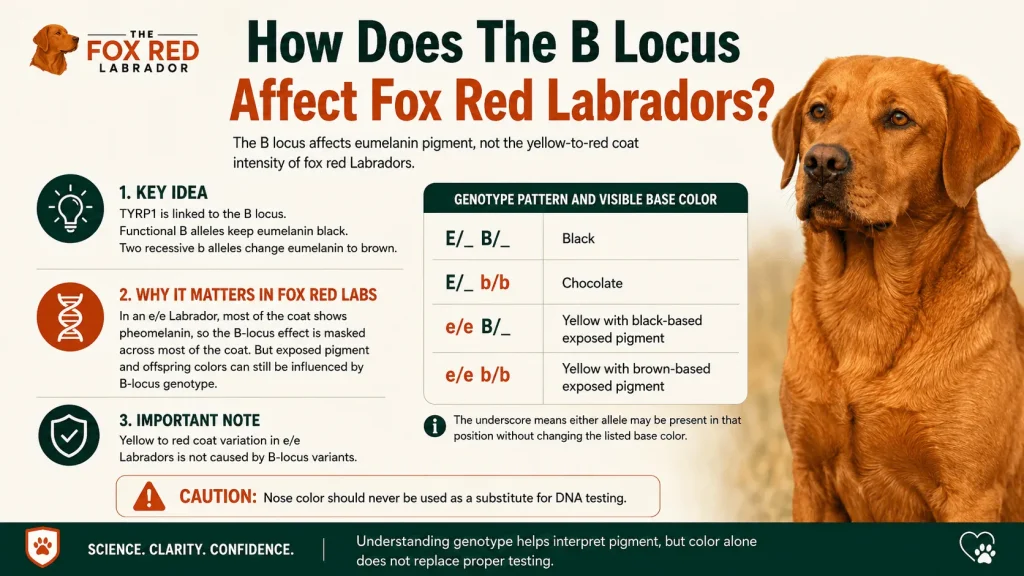
TYRP1 is linked to the B locus. Two recessive brown alleles convert eumelanin to brown, whereas functional B alleles maintain black eumelanin.
This effect is masked throughout the majority of the coat in an e/e Labrador as the coat shows pheomelanin. Exposed pigment and offspring colors may still be influenced by the B-locus genotype. The TYRP1 record also indicates that the yellow to red variation of e/e coats is not due to B-locus variants.
| Genotype Pattern | Visible Base Color |
|---|---|
| E/_ B/_ | Black |
| E/_ b/b | Chocolate |
| e/e B/_ | Yellow with black-based exposed pigment |
| e/e b/b | Yellow with brown-based exposed pigment |
The underscore indicates that either of the two alleles can be present on that position without altering the base color listed above. Nose color should never be used as a substitute for DNA testing.
Why Are Some Yellow Labradors Dark Red?
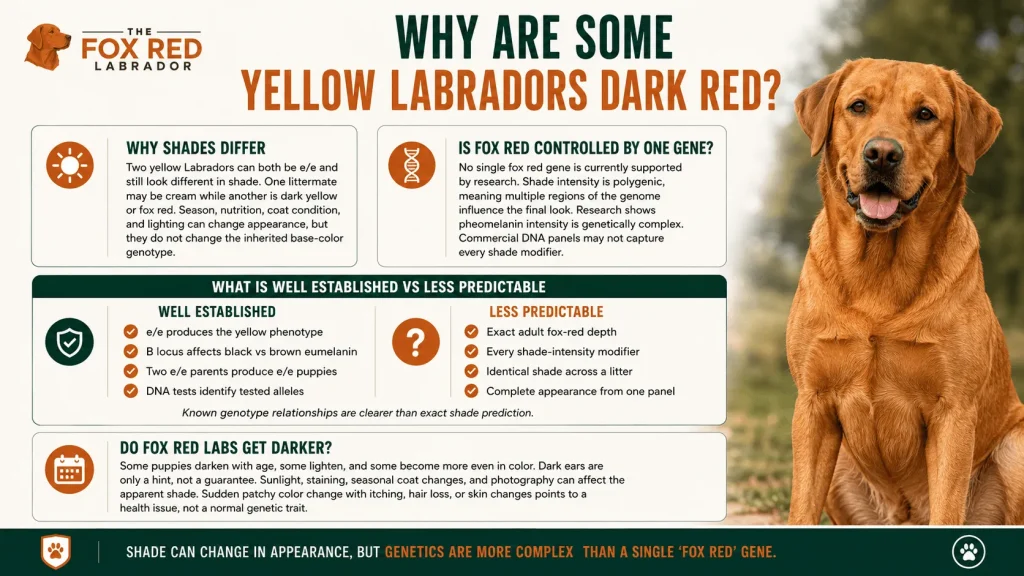
Two yellow Labradors with the same e/e base-color genotype can have different shades due to different shade modifiers. One littermate can be cream and the other dark yellow or fox red.
Appearance may change due to season, nutrition, hair condition and light. They do not alter the inherited base-color genotype.
Is Fox Red Controlled By One Gene?
There is no single fox red gene that is currently supported by research. The trait is polygenetic; that is, multiple regions of the genome are responsible for the observed effect, not just a single allele.
Several variants have been identified that are linked to variation in pigment intensity in dogs, such as variation in the KITLG region, and research has revealed that pheomelanin intensity is genetically complex.
Older explanations which attribute fox red to the A- and C-locus genes are incomplete. Not all modifiers that impact the shade of Labrador are necessarily in a single commercial panel.
| Well Established | Less Predictable |
|---|---|
| e/e produces the yellow phenotype | Exact adult fox-red depth |
| The B locus affects black versus brown eumelanin | Every shade-intensity modifier |
| Two e/e parents produce e/e puppies | Identical shade across a litter |
| DNA tests identify tested alleles | Complete appearance from one panel |
The left column focuses on outcomes with known genotype relationships. The right illustrates the need for caution in making exact shade predictions.
Do Fox Red Labs Get Darker?
Some fox red puppies will darken when they grow up. Some get lighter, or some get more evenly colored, so dark ears are only a hint.
Apparent changes can be caused by sunlight, staining, seasonal changes, and photography. Any sudden patchy color change, along with itching, hair loss, or skin changes, is a sign of a problem, not a genetic trait.
How Is Fox Red Labrador Color Inherited?
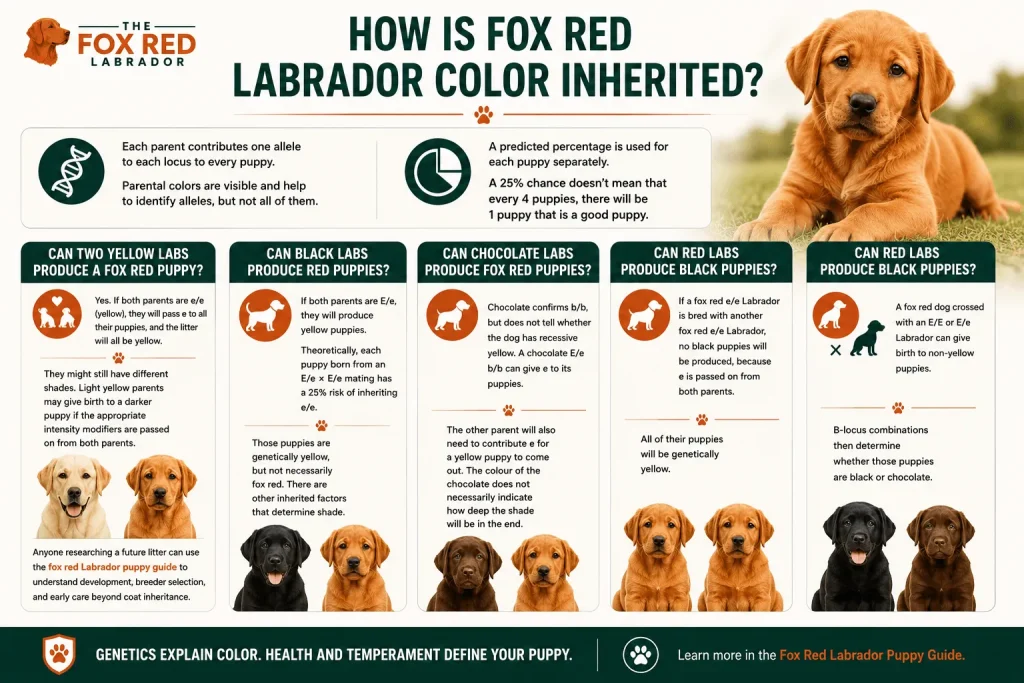
Each parent contributes one allele to each locus to every puppy. Parental colors are visible and help to identify alleles, but not all of them.
A predicted percentage is used for each puppy separately. A 25% chance doesn’t mean that every 4 puppies, there will be 1 puppy that is a good puppy.
Can Two Yellow Labs Produce A Fox Red Puppy?
Yes. If both parents are e/e (yellow), they will pass e to all their puppies, and the litter will all be yellow.
They might still have different shades. Light yellow parents may give birth to a darker puppy if the appropriate intensity modifiers are passed on from both parents. Anyone researching a future litter can use the fox red Labrador puppy guide to understand development, breeder selection, and early care beyond coat inheritance.
Can Black Labs Produce Red Puppies?
If both parents are E/e, they will produce yellow puppies. Theoretically, each puppy born from an E/e × E/e mating has a 25% risk of inheriting e/e.
Those puppies are genetically yellow, but not necessarily fox red. There are other inherited factors that determine shade.
Can Chocolate Labs Produce Fox Red Puppies?
Chocolate confirms b/b, but does not tell whether the dog has recessive yellow. A chocolate E/e b/b can give e to its puppies.
The other parent will also need to contribute to a yellow puppy to come out. The colour of the chocolate does not necessarily indicate how deep the chocolate will be in the end.
Can Red Labs Produce Black Puppies?
If a fox red e/e Labrador is bred with another fox red e/e Labrador, no black puppies will be produced, because e is passed on from both parents. All of their puppies will be genetically yellow.
A fox red dog crossed with an E/E or E/e Labrador can give birth to non-yellow puppies. B-locus combinations then determine whether those puppies are black or chocolate.
Can Red Lab DNA Tests Identify Genetics?
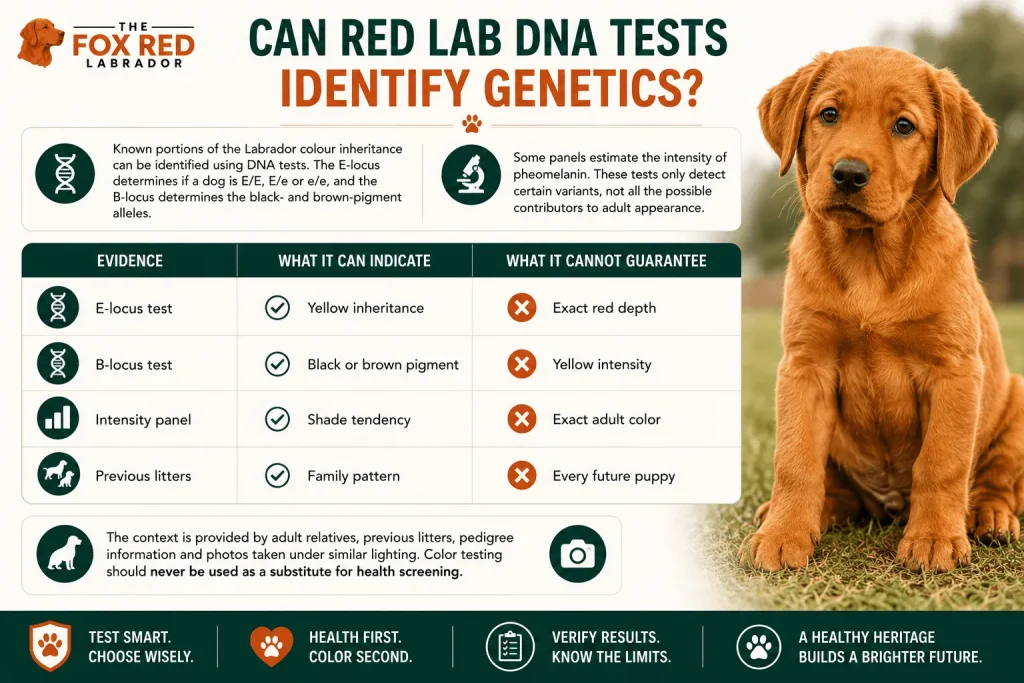
Known portions of the Labrador colour inheritance can be identified using DNA tests. The E-locus determines if a dog is E/E, E/e or e/e, and the B-locus determines the black- and brown-pigment alleles.
Some panels estimate the intensity of the pheomelanin. These tests only detect certain variants, not all the possible contributors to adult appearance.
| Evidence | What It Can Indicate | What It Cannot Guarantee |
|---|---|---|
| E-locus test | Yellow inheritance | Exact red depth |
| B-locus test | Black or brown pigment | Yellow intensity |
| Intensity panel | Shade tendency | Exact adult color |
| Previous litters | Family pattern | Every future puppy |
The context is provided by adult relatives, previous litters, pedigree information and photos taken under similar lighting. Color testing should never be used as a substitute for health screening.
Genetics Fox Red Labrador: A Short History
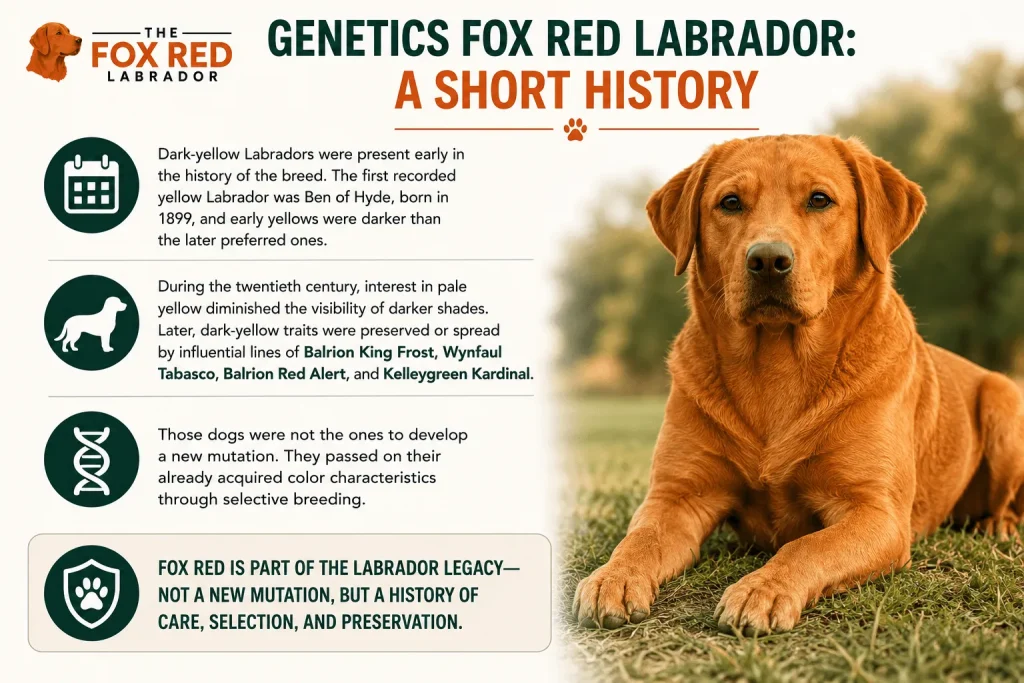
Dark-yellow Labradors were present early in the history of the breed. The first recorded yellow Labrador was Ben of Hyde, born in 1899, and early yellows were darker than the later preferred ones.
During the twentieth century, interest in pale yellow diminished the visibility of darker shades. Later, dark-yellow traits were preserved or spread by influential lines of Balrion King Frost, Wynfaul Tabasco, Balrion Red Alert, and Kelleygreen Kardinal.
Those dogs were not the ones to develop a new mutation. They passed on their already acquired color characteristics through selective breeding.
Does Fox Red Genetics Affect Health Or Temperament?
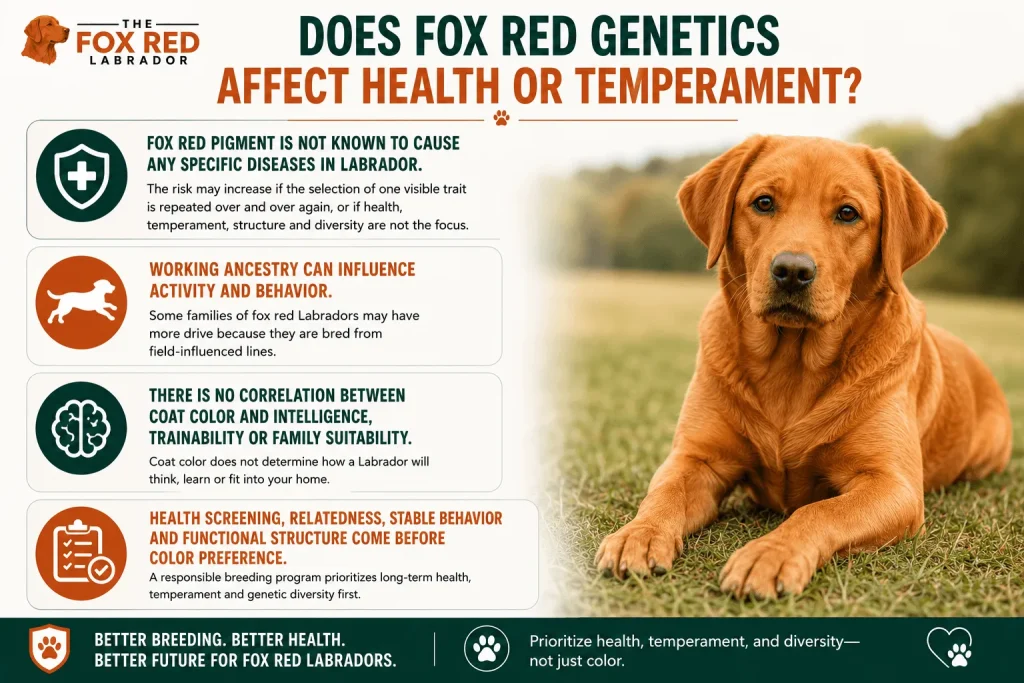
Fox red pigment is not known to cause any specific diseases in Labrador. The risk may increase if the selection of one visible trait is repeated over and over again, or if health, temperament, structure and diversity are not the focus. Working ancestry can influence activity and behavior, but the broader range of expected traits is covered in the fox red Labrador temperament guide.
There is no correlation between coat colour and intelligence, trainability or family suitability. There may be more drive in some families of fox red Labradors because they are bred from field-influenced lines.
Health screening, relatedness, stable behavior and functional structure are all taken into account in a responsible breeding program before color preference.
Key Takeaways
- Fox red is a colour of yellow.
- Fox red Labradors are normally e/e.
- The yellow to red coat is the result of pheomelanin.
- Yellow hair may cover the B locus.
- There are a number of inherited factors that affect redness.
- Color tests should not be used as a substitute for health screening.
These points distinguish predictable base-color inheritance from less predictable shade intensity. That distinction helps to avoid a lot of common misunderstandings. Those comparing prospective dogs should treat color as only one characteristic alongside expected fox red Labrador size, temperament, health, and working drive.
FAQ’s
When genetically yellow, a Labrador will express a dark concentration of pheomelanin and look fox red. The dog must be e/e (yellow) in genotype, but a number of inherited modifiers affect the color of the coat, which can be cream, gold, dark yellow or fox red.
Yes, fox red is a natural trait in purebred Labrador lines. The red coat does not establish a dog’s pedigree; pedigree records, registration documents and verified parentage are more reliable indicators of a dog’s pedigree.
No. A fox red Labrador is a dark yellow colored Labrador Retriever. It is not a hybrid breed or a Labrador mixed with a fox.
The fox red color is not a single gene color. The recessive yellow phenotype is caused by variants of the gene at the E locus, while a number of other genetic regions affect the intensity of the pheomelanin and the darkness of the coat.
Yellow Labs have the potential to receive various combinations of pigment-intensity modifiers. Pale yellow and fox red dogs can be both e/e, but the modifiers influence the expression of the yellow-to-red pheomelanin.
This is because a fox red Labrador has to receive e from both parents to be yellow. The red intensity of the exact red is not a simple recessive trait, but rather is determined by several genetic factors.
Fox red Labradors are not a rare color, but are less prevalent than the normal yellow color in many areas. The availability is largely based on bloodlines, breeder focus and demand, and sometimes “rare” is more of a marketing term than a genetic one.
There is no evidence that the fox red colour is associated with any different temperament. Coat colour is not the only factor that influences behaviour; it is also influenced by other inherited characteristics (working or show line), socialisation, health, training and environment.
Fox red pigment is not known to cause any special Labrador health problems. There may be a greater risk if breeders breed closely related dogs to maintain color and neglect to focus on health testing and genetic diversity.
The yellow Labrador colour is a shade of fox red. Both are usually e/e at the E locus and the difference is only in the intensity of the pheomelanin which gives one coat a darker, redder appearance.
Multiple genes are involved. The E locus (MC1R) determines if the coat is yellow or not, and the B locus (TYRP1) determines if the coat is black or brown eumelanin. Other genetic areas control the yellow to red intensity.
The E- and B-locus genotypes can be confirmed by DNA tests and pigment intensity can be estimated by selected variants. They are not always able to ensure a precise adult fox red shade as there are no single panels that will capture all possible modifiers.
Fox red is not a colour category, but is accepted as part of the official yellow range. Yellow is used to register eligible fox red Labradors with major kennel organizations.
When their temperament, activity level and training are appropriate for the family, they can make great family dogs. Coat color is not a family indicator; socialization, lineage, exercise, and responsible breeding are much more important.
One allele at each of the color-related loci is passed on from each parent to each puppy. The E locus determines the expression of yellow, the B locus determines black or chocolate pigment, and other inherited factors determine the intensity of the yellow coat.
Two Labradors can have two different combinations of visible colors and hidden alleles, resulting in either black, chocolate or yellow puppies. Parents’ E and B-locus genotypes must be known to get an accurate probability, and appearance is not enough to determine all the alleles carried.
The puppy coat is gradually replaced by an adult coat that may appear lighter, darker, or more even. Seasonal shedding, sunlight, coat condition, and photography can also change how the color looks without altering the dog’s genotype.
Pheomelanin is the pigment responsible for cream, yellow, gold, and red hair. Differences in its inherited intensity help explain why one e/e Labrador is pale yellow while another is fox red.
MC1R is associated with the E locus and helps control whether dark eumelanin is deposited in the hair. Labradors with two recessive e alleles cannot express black or chocolate across most of the coat, producing the yellow phenotype.
Yes. A properly registered fox red Labrador can compete as a yellow Labrador when it meets the applicable breed standard. Judges assess the whole dog, including structure, movement, temperament, and condition—not red intensity alone.
They sometimes cost more because demand is high and the shade is marketed as uncommon. A higher price does not prove better health, temperament, pedigree quality, or breeding standards.
Most debate concerns rare-color marketing, premium prices, color-first breeding, and reduced genetic diversity within narrow bloodlines. The accepted fox red shade itself is not evidence of poor breeding or crossbreeding.
References