Red Fox Lab Size: Height, Weight & Growth Chart by Age
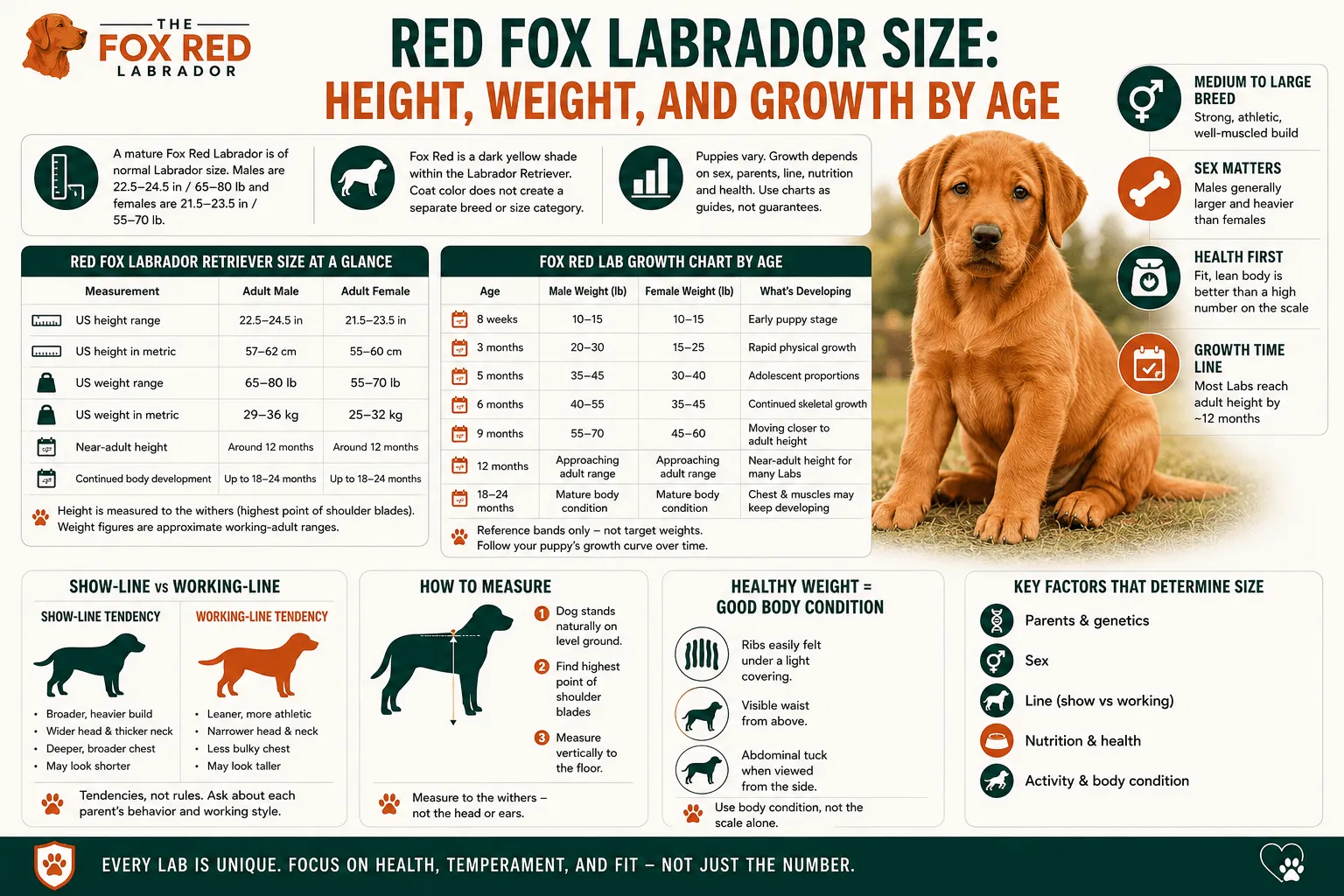
A mature Red Fox Labrador is of normal Red Fox Labrador size. The US breed standard calls for a male to be 22.5–24.5 inches in height and weigh 65–80 pounds. Females are 21.5–23.5 inches and weigh 55–70 pounds.
The typical name is “Fox Red Labrador”. The dark yellow colour of the Labrador is often referred to as “Red Labrador” or “red fox Labrador”. The coat does not form a separate breed or size category.
Don’t assume that puppies are as predictable as standards when they’re adults. Growth is influenced by sex, parental build, show or working ancestry, nutrition and health. The following graphs are helpful references, but a puppy’s individual progress is more important than comparing one “neat number”.
Red Fox Labrador Size At A Glance
Labrador height is taken from the floor to the withers (the highest point of the shoulder blades). Measurement to the head or ears will result in a taller figure, which can not be fairly compared to the breed standard.
The weight figures below refer to the approximate sizes of working adults according to the US standard. These are not goals that all dogs have to attain.
| Measurement | Adult male | Adult female |
|---|---|---|
| US height range | 22.5–24.5 in | 21.5–23.5 in |
| US height in metric | 57–62 cm | 55–60 cm |
| US weight range | 65–80 lb | 55–70 lb |
| US weight in metric | 29–36 kg | 25–32 kg |
| Near-adult height | Around 12 months | Around 12 months |
| Continued body development | Up to 18–24 months | Up to 18–24 months |
Two dogs may have the same size, but appear entirely different. Perceived size is influenced by chest depth, bone, muscle, body length and coat condition. A dog that is lean can appear taller and a dog that is broad can appear much heavier at almost the same show-line.
How Big Does A Full Grown Fox Red Labrador Get?
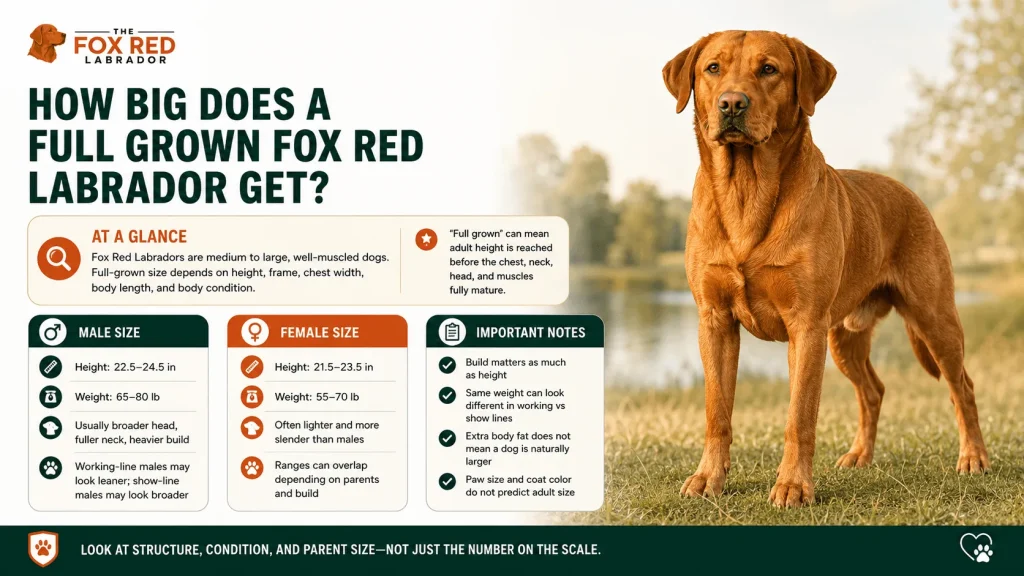
A Fox Red Labrador is a medium to large, well muscled dog. While height is one component, frame, chest width, body length and condition determine the actual physical space a dog will take up.
The term “full grown” can have two meanings. A young lab may have ceased growing up when the chest, neck, head and muscles are still growing.
A 70-pound working-line male, for instance, can appear tall and narrow. A show-line male at the same weight may look shorter and fatter due to the extra bone and breadth in the chest.
Male Fox Red Labrador Size
Adult males are usually 22.5-24.5 inches at the withers and weigh about 65-80 lbs. Males tend to have fuller necks, wider heads and heavier bodies than females.
The working-line males tend to be on the leaner end of the range. Show-line dogs can have more substance and not have to be tall.
Weight should be appropriate for the frame, but still be in proportion to the person’s size. If a lot of the weight is due to excess body fat, a high number on the scale is not necessarily a sign that a dog is unusually large.
Female Fox Red Labrador Size
The adult female is typically 21.5-23.5 inches tall and 55-70 pounds. She may be more slender and lighter than her male relatives.
Those ranges overlap. Sex gives some indication, but not a guarantee, that a broad female from large parents will outweigh a lightly built working male.
Colour or paw size is not a good indicator for parental measurements. Big paws are cute, but they haven’t signed an adult-size contract.
US vs UK Red Fox Lab Size Standards
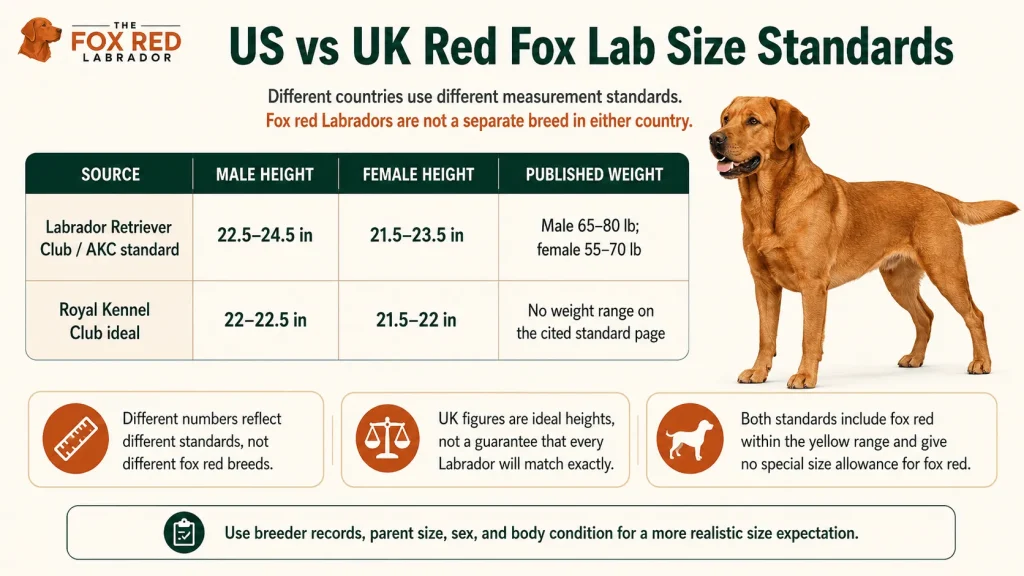
There are different measurement systems, which is why the number of guides for Labradors on the internet may vary. The difference is not that there is a different breed of Fox Red Labrador in each country.
The US Labrador Retriever Club standard includes height ranges and approximate working weights. The narrower ideal heights are published by the Royal Kennel Club in the UK.
| Source | Male height | Female height | Published weight |
|---|---|---|---|
| Labrador Retriever Club/AKC standard | 22.5–24.5 in | 21.5–23.5 in | Male 65–80 lb; female 55–70 lb |
| Royal Kennel Club ideal | 22–22.5 in | 21.5–22 in | No weight range on the cited standard page |
The figures given for the UK are for ideal height and are not a guarantee that every registered Labrador will be exactly that height. The Royal Kennel Club recognizes that there are dogs that are bigger or smaller.
The two standards cover fox red in the identified yellow range. Neither applies a special height or weight allowance to it.
Fox Red Lab Growth Chart By Age
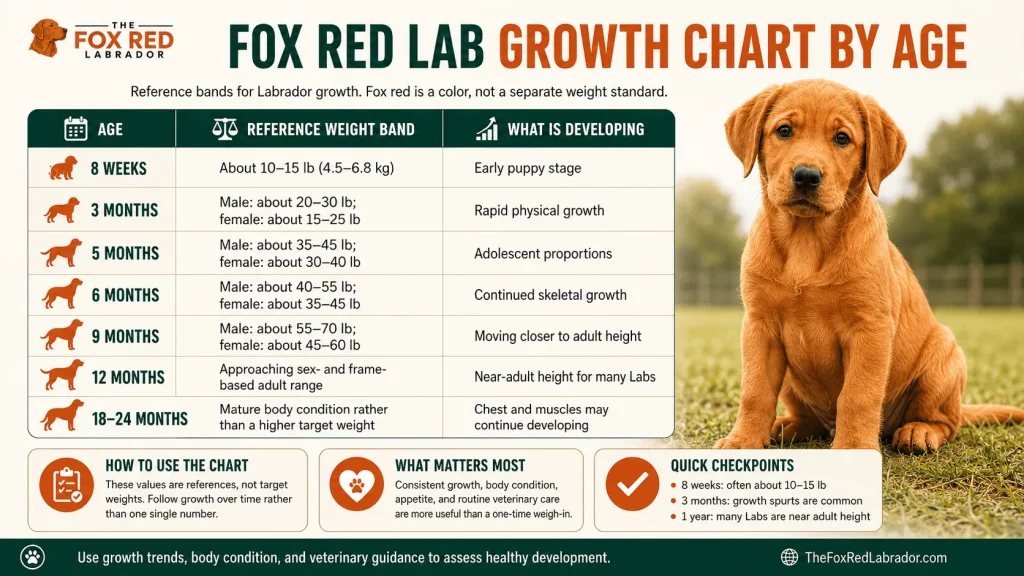
Fox Red Labrador puppies do not have an official weight standard. Fox red is a colour, and general Labrador and evidence-based canine growth references are the best comparison.
The following are general editorial reference bands based on typical growth guides reported for Labrador. The Waltham puppy growth charts take into account sex and adult size to keep an eye on a puppy’s specific growth curve.
| Age | Reference weight band | What is developing |
|---|---|---|
| 8 weeks | About 10–15 lb (4.5–6.8 kg) | Early puppy stage |
| 3 months | Male: about 20–30 lb; female: about 15–25 lb | Rapid physical growth |
| 5 months | Male: about 35–45 lb; female: about 30–40 lb | Adolescent proportions |
| 6 months | Male: about 40–55 lb; female: about 35–45 lb | Continued skeletal growth |
| 9 months | Male: about 55–70 lb; female: about 45–60 lb | Moving closer to adult height |
| 12 months | Approaching sex- and frame-based adult range | Near-adult height for many Labs |
| 18–24 months | Mature body condition rather than a higher target weight | The chest and muscles may continue developing |
These values are references, not target weights. Research in dogs indicates that it is better to use a puppy’s growth curve over time rather than relying on a single number for each age.
A puppy that is healthy can be above or below average. One single weigh-in gives a poor idea of the health of the animal, so consistent growth, body condition, normal appetite and routine veterinary care are more useful.
How Much Does An 8-Week-Old Fox Red Labrador Weight?
An 8-week-old Fox Red Labrador typically weighs 10-15 lbs (4.5-6.8 kg). That number can change with litter size, sex, birth weight, parental size and early feeding.
A good breeder should supply a current weight, feeding history and health history. Those specifics say more about the particular puppy than an average one on the internet. Weight records should be considered alongside health documents and breeding practices, including the warning signs covered in this guide to fox red Labrador breeder red flags.
How Much Does A 3-Month-Old Red Labrador Weigh?
A male at three months can weigh about 20–30 pounds, and a female can weigh about 15–25 pounds. This is when growth spurts in height and body length are frequent.
A lot of puppies seem to be a bit of a skimp on legs or a bit off balance for a time. They can look like they have been to separate meetings for their paws, ears and limbs, but the proportions tend to get more balanced as they get older.
Progress on a monthly basis is more important than comparing with a littermate. Puppies raised in the same litter can grow up at different speeds.
What Size Is A 5-Month-Old Fox Red Labrador?
Typically, a 5-month-old boy will weigh 35 to 45 pounds. A female can lose anywhere from 30-40 pounds, but the size and bloodline of the parent can cause an individual to fall outside the range.
The chest is still narrow at this age. Puppies from the working line can look long and light and puppies from the show line can look broad, all with the same shoulder height.
Assess condition in conjunction with the scale. Ribs should feel under a light covering and the waist should be seen from above. If a dog has doubled its weight in five months, this may give a rough estimate for some dogs, but it is not sufficient to give as a guarantee.
How Much Should A 6-Month-Old Red Labrador Weigh?
A six-month-old boy can weigh about 40-55 pounds and a six-month-old girl can weigh about 35-45 pounds. Skeleton, muscle, coordination, and body shape still developing.
It is not automatically concerning when there are small deviations from an average. If a child suddenly stops growing, if they are losing weight, if they are not eating, or if they have ongoing digestive problems, it is important to seek veterinary advice.
How Large Is A 1-Year-Old Fox Red Labrador?
Many Fox Red Labradors have reached adult size at one year. Use the dog’s age to compare with the male or female range listed at the top of the page; there isn’t a single “birthday weight” for dogs.
The body may still look young. After growth has slowed, chest depth, neck thickness, head shape and muscle may become more prominent.
When Do Red Labradors Stop Growing?
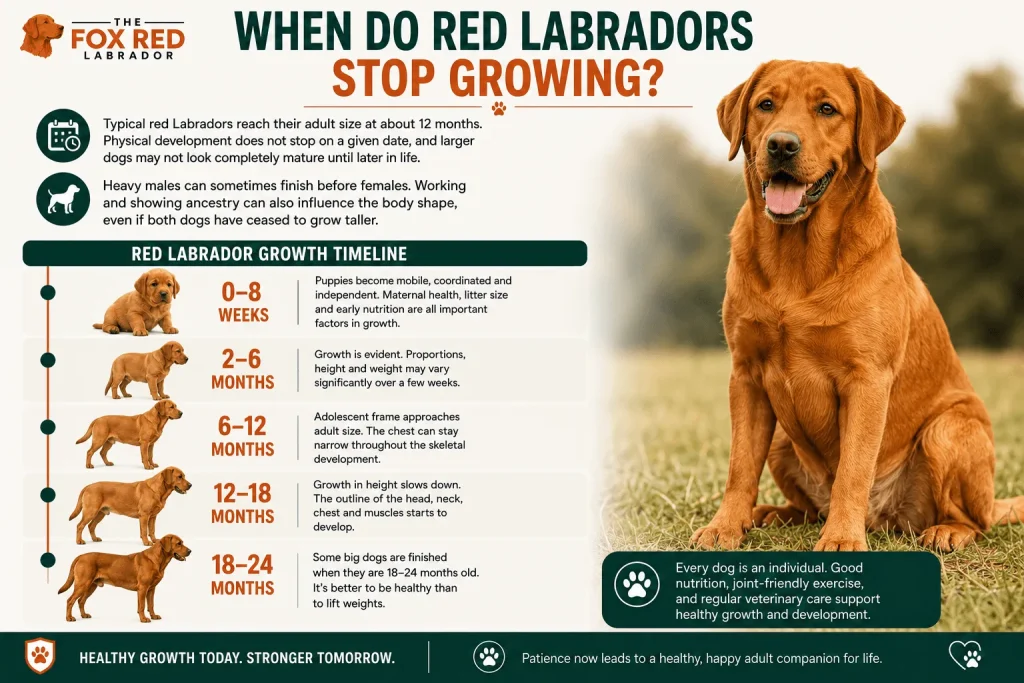
Typical red Labradors reach their adult size at about 12 months. Physical development does not stop on a given date, and larger dogs may not look completely mature until later in life.
Heavy males can sometimes finish before females. Working and showing ancestry can also influence the body shape, even if both dogs have ceased to grow taller.
Red Labrador Growth Timeline
- 0-8 weeks: Puppies become mobile, coordinated and independent. Maternal health, litter size and early nutrition are all important factors in growth.
- 2-6 months: Growth is evident. Proportions, height and weight may vary significantly over a few weeks.
- 6-12 months: Adolescent frame approaches the adult size. The chest can stay narrow throughout the skeletal development.
- 12-18 months: Growth in height slows down. The outline of the head, neck, chest and muscles starts to develop.
- Some big dogs are finished when they are 18-24 months old. It’s better to be healthy than to lift weights.
Does Fox Red Colour Affect Labrador Size?
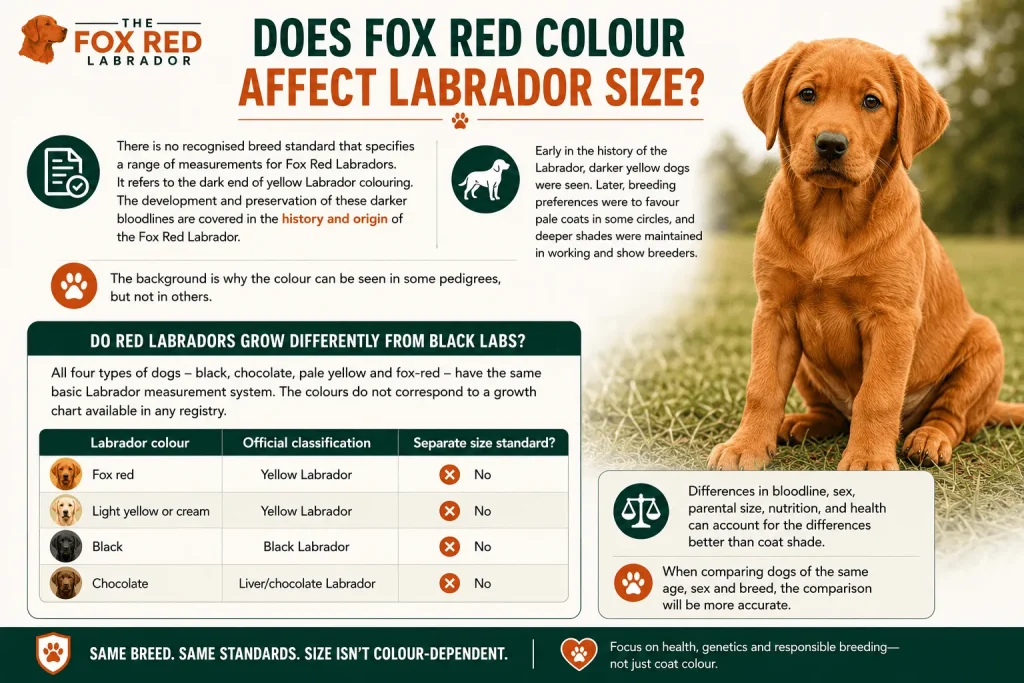
There is no recognised breed standard that specifies a range of measurements for Fox Red Labradors. It refers to the dark end of yellow Labrador colouring. The development and preservation of these darker bloodlines are covered in the history and origin of the Fox Red Labrador.
Early in the history of the Labrador, darker yellow dogs were seen. Later, breeding preferences were to favour pale coats in some circles, and deeper shades were maintained in working and show breeders.
The background is why the colour can be seen in some pedigrees, but not in others.
Do Red Labradors Grow Differently From Black Labs?
All four types of dogs – black, chocolate, pale yellow and fox-red – have the same basic Labrador measurement system. The colours do not correspond to a growth chart available in any registry.
| Labrador colour | Official classification | Separate size standard? |
|---|---|---|
| Fox red | Yellow Labrador | No |
| Light yellow or cream | Yellow Labrador | No |
| Black | Black Labrador | No |
| Chocolate | Liver/chocolate Labrador | No |
Differences in bloodline, sex, parental size, nutrition, and health can account for the differences better than coat shade. When comparing dogs of the same age, sex and breed, the comparison will be more accurate.
English vs American Red Lab Size
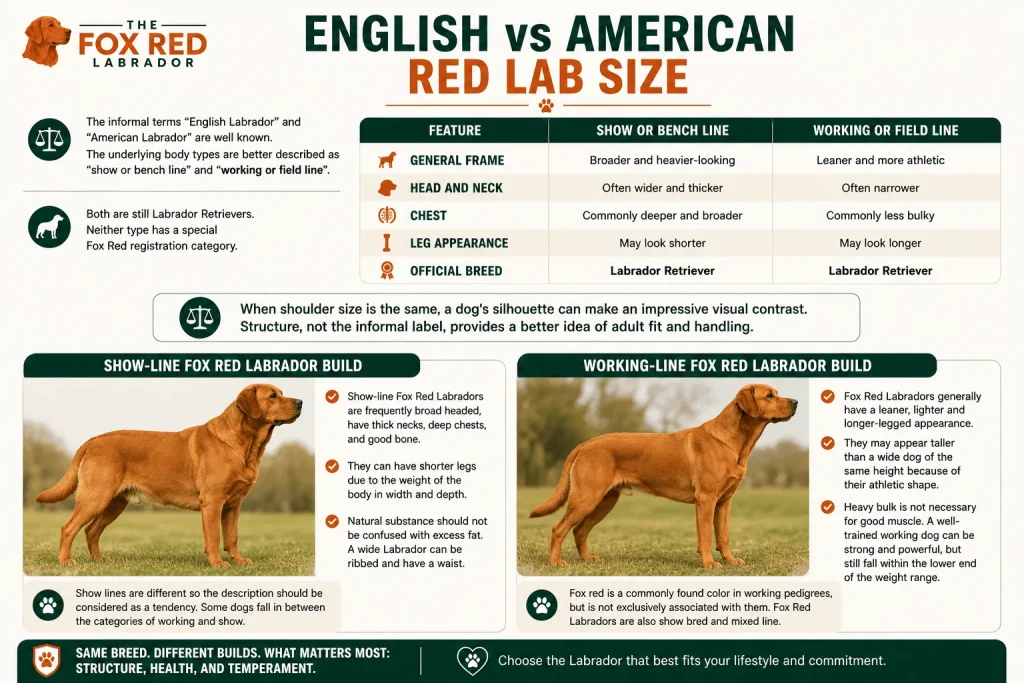
The informal terms “English Labrador” and “American Labrador” are well known. The underlying body types are better described as “show or bench line” and “working or field line”.
Both are still Labrador Retrievers. Neither type has a special Fox Red registration category.
| Feature | Show or bench line | Working or field line |
|---|---|---|
| General frame | Broader and heavier-looking | Leaner and more athletic |
| Head and neck | Often wider and thicker | Often narrower |
| Chest | Commonly deeper and broader | Commonly less bulky |
| Leg appearance | May look shorter | May look longer |
| Official breed | Labrador Retriever | Labrador Retriever |
When shoulder size is the same, a dog’s silhouette can make an impressive visual contrast. Structure, not the informal label, provides a better idea of adult fit and handling.
Show-Line Fox Red Labrador Build
Show-line Fox Red Labradors are frequently broad headed, have thick necks, deep chests, and good bone. They can have shorter legs due to the weight of the body in width and depth.
Natural substance should not be confused with excess fat. A wide Labrador can be ribbed and have a waist.
Show lines are different so the description should be considered as a tendency. Some dogs fall in between the categories of working and show.
Working-Line Fox Red Labrador Build
Fox Red Labradors generally have a leaner, lighter and longer-legged appearance. They may appear taller than a wide dog of the same height because of their athletic shape.
Heavy bulk is not necessary for good muscle. A well-trained working dog can be strong and powerful, but still fall within the lower end of the weight range.
Fox red is a commonly found color in working pedigrees, but is not exclusively associated with them. Fox Red Labradors are also show bred and mixed line.
What Determines A Fox Red Labrador Adult Size?
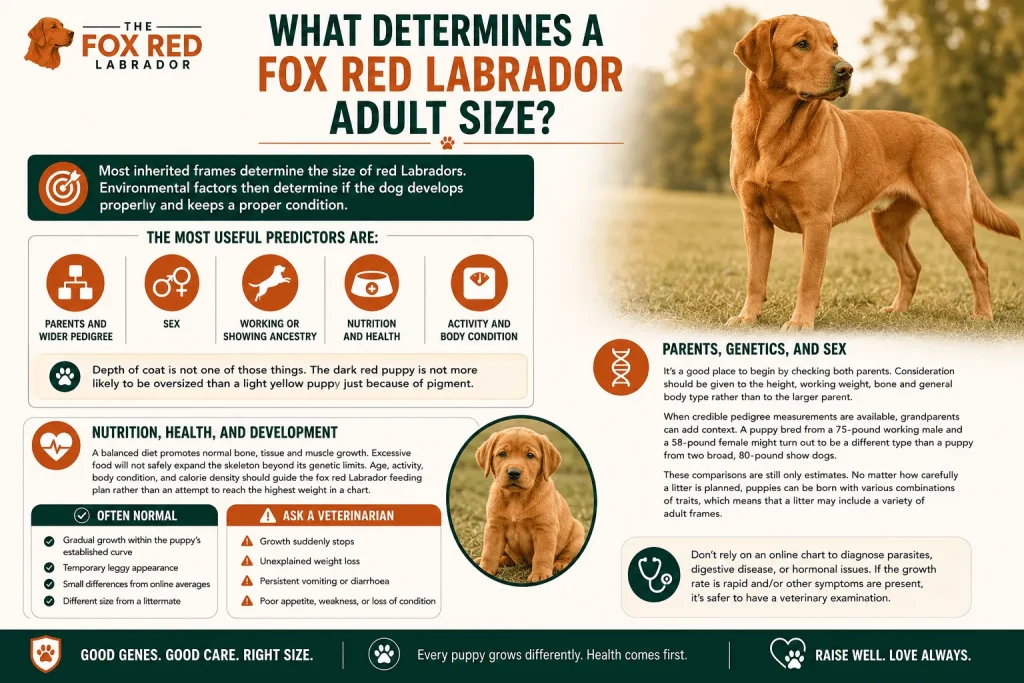
Most inherited frames determine the size of red Labradors. Environmental factors then determine if the dog develops properly and keeps a proper condition.
The most useful predictors are:
- Parents and wider pedigree
- Sex
- Working or showing ancestry
- Nutrition and health
- Activity and body condition
Depth of coat is not one of those things. The dark red puppy is not more likely to be oversized than a light yellow puppy just because of pigment.
Parents, Genetics, And Sex
It’s a good place to begin by checking both parents. Consideration should be given to the height, working weight, bone and general body type rather than to the larger parent.
When credible pedigree measurements are available, grandparents can add context. A puppy bred from a 75-pound working male and a 58-pound female might turn out to be a different type than a puppy from two broad, 80-pound show dogs.
These comparisons are still only estimates. No matter how carefully a litter is planned, puppies can be born with various combinations of traits, which means that a litter may include a variety of adult frames.
Nutrition, Health, And Development
A balanced diet promotes normal bone, tissue and muscle growth. Excessive food will not safely expand the skeleton beyond its genetic limits. Age, activity, body condition, and calorie density should guide the fox red Labrador feeding plan rather than an attempt to reach the highest weight in a chart.
Growth problems can be caused by health issues, but size does not necessarily indicate a cause. All the above factors should be taken into account.
| Often normal | Ask a veterinarian |
|---|---|
| Gradual growth within the puppy’s established curve | Growth suddenly stops |
| Temporary leggy appearance | Unexplained weight loss |
| Small differences from online averages | Persistent vomiting or diarrhoea |
| Different size from a littermate | Poor appetite, weakness, or loss of condition |
Don’t rely on an online chart to diagnose parasites, digestive disease, or hormonal issues. If the growth rate is rapid and/or other symptoms are present, it’s safer to have a veterinary examination.
How To Measure A Fox Red Labrador Correctly
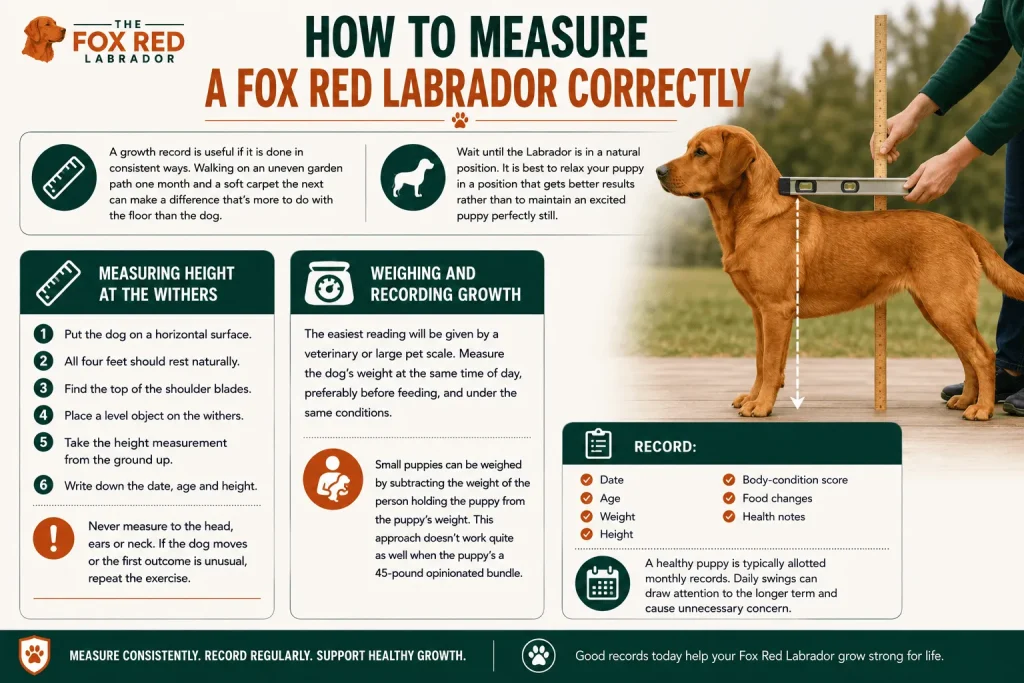
A growth record is useful if it is done in consistent ways. Walking on an uneven garden path one month and a soft carpet the next can make a difference that’s more to do with the floor than the dog.
Wait until the Labrador is in a natural position. It is best to relax your puppy in a position that gets better results rather than to maintain an excited puppy perfectly still.
Measuring Height At The Withers
The highest point of the shoulder blades is the withers. The height of the breed standard is vertical from that point to the floor.
- Put the dog on a horizontal surface.
- All four feet should rest naturally.
- Find the top of the shoulder blades.
- Place a level object on the withers.
- Take the height measurement from the ground up.
- Write down the date, age and height.
Never measure to the head, ears or neck. If the dog moves or the first outcome is unusual, repeat the exercise.
Weighing And Recording Growth
The easiest reading will be given by a veterinary or large pet scale. Measure the dog’s weight at the same time of day, preferably before feeding, and under the same conditions.
Small puppies can be weighed by subtracting the weight of the person holding the puppy from the puppy’s weight. This approach doesn’t work quite as well when the puppy’s a 45-pound opinionated bundle.
Record:
- Date
- Age
- Weight
- Height
- Body-condition score
- Food changes
- Health notes
A healthy puppy is typically allotted monthly records. Daily swings can draw attention to the longer term and cause unnecessary concern.
Healthy Weight vs Large Body Size
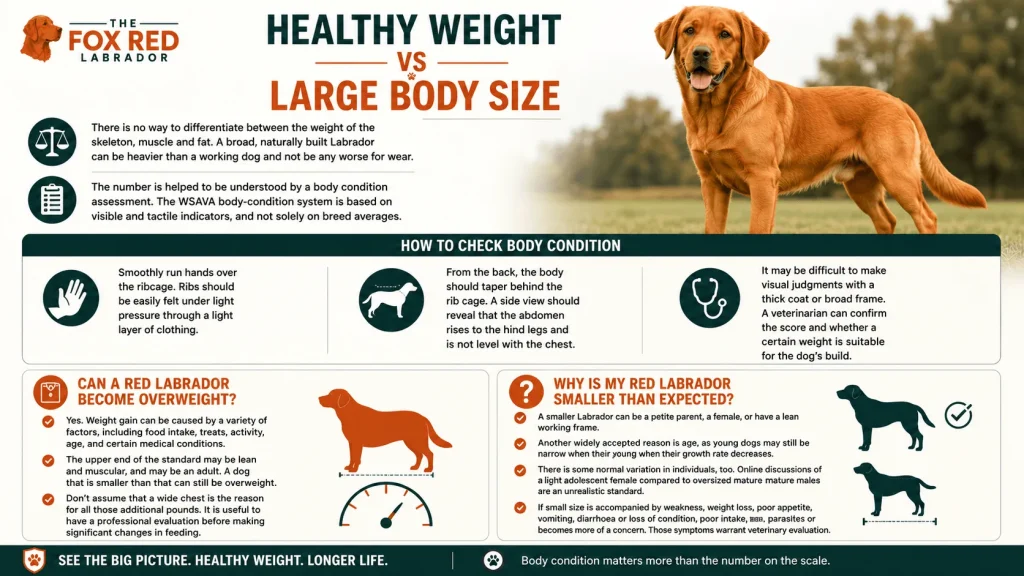
There is no way to differentiate between the weight of the skeleton, muscle and fat. A broad, naturally built Labrador can be heavier than a working dog and not be any worse for wear.
The number is helped to be understood by a body condition assessment. The WSAVA body-condition system is based on visible and tactile indicators, and not solely on breed averages.
How To Check Body Condition
Smoothly run hands over the ribcage. Ribs should be easily felt under light pressure through a light layer of clothing.
From the back, the body should taper behind the rib cage. A side view should reveal that the abdomen rises to the hind legs and is not level with the chest.
It may be difficult to make visual judgments with a thick coat or broad frame. A veterinarian can confirm the score and whether a certain weight is suitable for the dog’s build.
Can A Red Labrador Become Overweight?
Yes. Weight gain can be caused by a variety of factors, including food intake, treats, activity, age, and certain medical conditions.
The upper end of the standard may be lean and muscular, and may be an adult. A dog that is smaller than that can still be overweight.
Don’t assume that a wide chest is the reason for all those additional pounds. It is useful to have a professional evaluation before making significant changes in feeding.
Why Is My Red Labrador Smaller Than Expected?
A smaller Labrador can be a petite parent, a female, or have a lean working frame. Another widely accepted reason is age, as young dogs may still be narrow when their growth rate decreases.
There is some normal variation in individuals, too. Online discussions of a light adolescent female compared to oversized mature males are an unrealistic standard.
If small size is accompanied by weakness, weight loss, poor appetite, vomiting, diarrhoea or loss of condition, poor intake, parasites or digestive trouble becomes more of a concern. Those symptoms warrant veterinary evaluation.
Red Fox Lab Size Comparisons
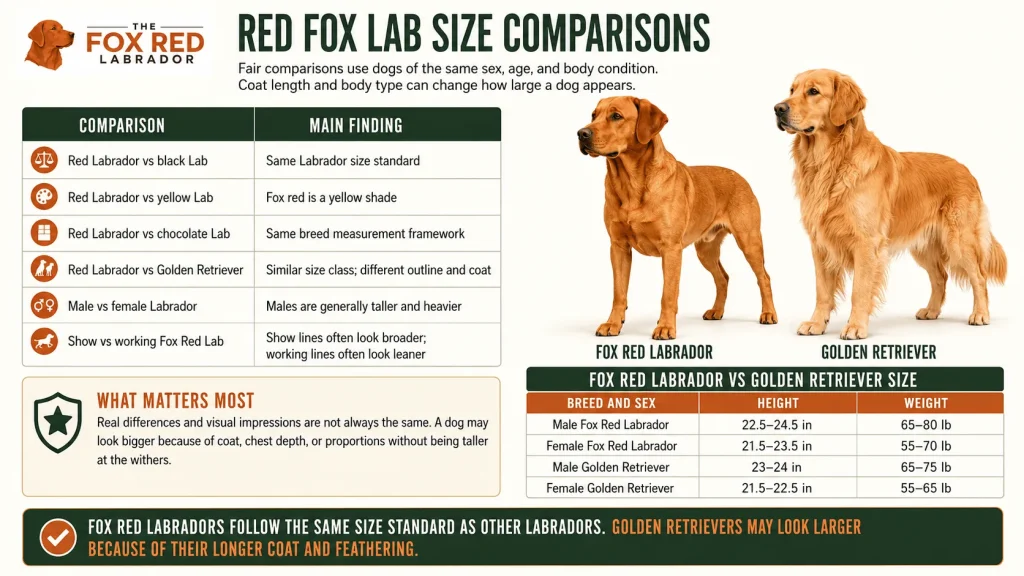
Fair comparisons involve dogs of the same sex, age and condition. Even if two breeds fall within the same size range, their coat length and body type can result in different perceived sizes.
| Comparison | Main finding |
|---|---|
| red labrador vs black lab size | Same Labrador size standard |
| red labrador vs yellow lab size | Fox red is a yellow shade |
| red labrador vs chocolate lab size | Same breed measurement framework |
| red labrador vs golden retriever size | Similar broad size class; different outline and coat |
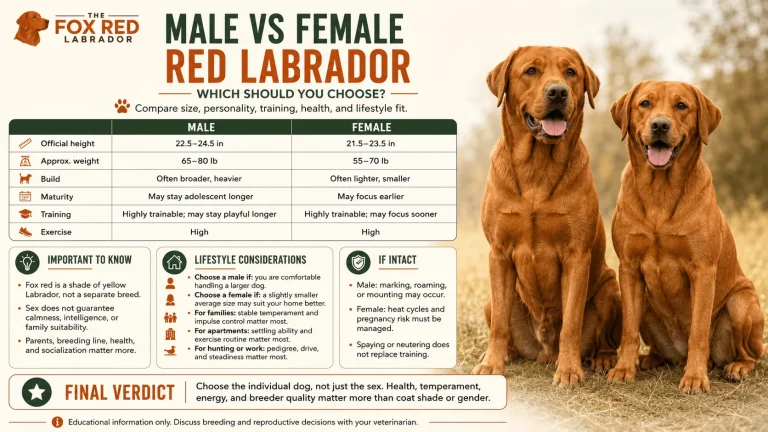
| Male vs female Labrador size | Males are generally taller and heavier |
| Show vs working Fox Red Lab | Show lines often look broader; working lines often look leaner |
The table distinguishes between real differences and impressions. A dog can be larger in coat, chest depth or proportion, but not be taller at the withers.
Fox Red Labrador vs Golden Retriever Size
According to the US standards, Fox Red Labradors and Golden Retrievers fall in a similar size class. They are based on accepted ranges, which overlap, but with a slightly higher upper weight limit for male Labradors.
| Breed and sex | Height | Weight |
|---|---|---|
| Male Fox Red Labrador | 22.5–24.5 in | 65–80 lb |
| Female Fox Red Labrador | 21.5–23.5 in | 55–70 lb |
| Male Golden Retriever | 23–24 in | 65–75 lb |
| Female Golden Retriever | 21.5–22.5 in | 55–65 lb |
The longer coat and feathering of a Golden may give the impression of a larger body. The Labrador’s short coat provides a more compact outline and the increased weight allowance for the upper can result in a heavier adult male.
Is A Red Labrador A Medium Or Large Dog?
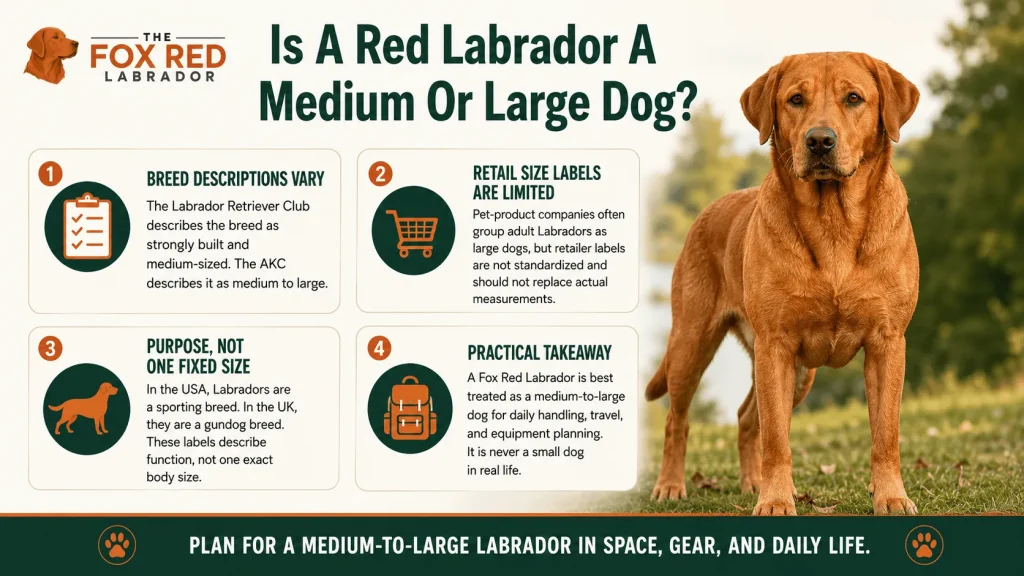
The label is used according to its function. The Labrador Retriever Club’s breed description says the breed is strongly built and medium-sized, whereas the AKC breed description calls it medium to large.
Labrador companies that sell pet products tend to categorize adult Labradors. The retailer labels are not standardized and should not be used in place of actual measurements.
The Labrador is a sporting breed in the USA and a gundog in the UK. Those classifications refer to the purpose for which the body is used, not a single body size.
A Fox Red Labrador is a good medium to large dog for daily handling, travel and equipment planning. No matter how skinny the grown-up is, a grown-up is not a little dog when he wants to take the whole sofa.
Practical Size Guide For Crates, Beds, Collars, And Harnesses
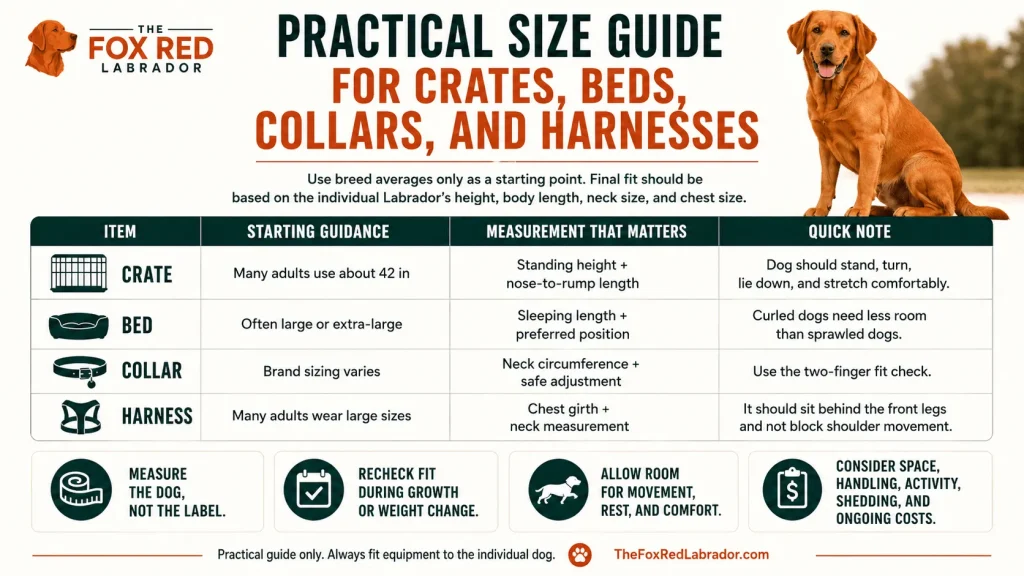
Use the breed averages as a guideline for equipment. Final fit should be based on the standing height, length of the body, length of the neck and length of the chest of the individual Labrador.
| Item | Starting guidance | Measurement that matters |
|---|---|---|
| Crate | Many adults use approximately 42 inches | Standing height and nose-to-rump length |
| Bed | Often large or extra-large | Sleeping length and preferred position |
| Collar | Brand size varies | Neck circumference plus safe adjustment |
| Harness | Many adults fall into large sizes | Chest girth and neck measurement |
The crate should give the dog room to stand, turn, lie down and stretch without touching the sides of the crate. A safe divider can actually decrease the amount of space available as the puppy grows.
Measure the dog in its normal sleeping position and select a bed. A curled Labrador doesn’t need as much space as a tree-shaped one.
Collars should be a snug fit of two fingers. The harness should be adequate behind the front legs and should not impede shoulder movement. Space, handling, activity, shedding, and ongoing costs should all be considered when deciding whether a fox red Labrador is right for your household.
Conclusion
A fox red Labrador adheres to the standard Labrador measurement system. The depth of the coat is far less important than sex, parents, and working or show ancestry in determining adult height and build.
Puppy charts are for reference, not for grades. Monthly checks, proper measurement techniques and BCS provide a more accurate indication of development.
Veterinary advice eliminates the uncertainty when growth is rapid or weight gains and losses are hard to understand.
FAQ’s
A mature red Labrador generally stands 21.5–24.5 inches at the shoulder and weighs 55–80 pounds. Sex, frame, and bloodline determine where an individual falls within that combined range.
Red Labs are not smaller because of colour. Some look leaner because fox red is common in working lines, which often have narrower, more athletic frames.
There is no one registry that publishes an absolute maximum for each individual Labrador. If a dog is higher than the typical range, it could be due to a larger frame, body fat or a mix of both.
The “Giant Red Labrador” is not an official variety or breed. Sometimes used in advertising for an unusually heavy or tall fox-red dog.
Males are taller and heavier than females. Overlap in measurement is a normal occurrence and is more common where a female is bred from large show lines and a male is bred from a lean working family.
The ideal weight is determined by the frame and body condition, and not a single figure. The ribs are easily felt, the waist is visible and there is an abdominal tuck, which are more useful.
If both dogs are of similar body type, a good approximation can be made from parent measurements. Smaller or larger offspring can still be produced in the same litter due to genetics.
There is some overlap in the height and weight ranges of the breeds. The upper weight allowance is slightly greater for male Labradors and a Golden’s longer coat could give the impression of a larger size.
Most adults use a crate that is about 42 inches long. Working and show-line bodies may vary, so standing height and nose-to-rump length should confirm the final fit.
Yes, an individual can be over 80 lbs, but not necessarily a bigger, healthier frame. Body-condition scoring and veterinary assessment help to differentiate between natural size and excess weight.
Reference Box
Breed Standards
- American Kennel Club: Labrador Retriever
- Labrador Retriever Club: Breed Standard
- Royal Kennel Club: Labrador Retriever Breed Standard
- Golden Retriever Club of America: Breed Standard
Puppy Growth
- Waltham Puppy Growth Charts
- Evidence-Based Growth Standards for Dogs
- Labrador Retriever Growth and Weight Chart
Body Condition
Historical Context
- Foxred Labrador Italy: History of the Foxred
- The Field: The Rise of the Fox-Red Labrador